






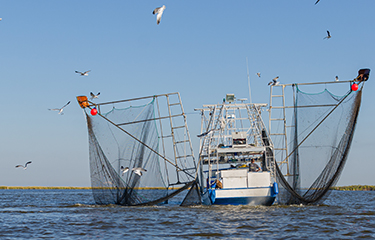
NOAA recently released preliminary data on shrimp landings from the Gulf of Mexico and the South Atlantic for April 2023, with the data showing the price of shrimp continues to sit near historic lows.
Across the Gulf of Mexico – which is listed by landings from Texas, Louisiana, Mississippi, Alabama, and Western Florida, and compiled monthly by the Southern Shrimp Alliance from NOAA data – most states saw increases shrimp catches sitting above historical averages. Overall landings across the state, however, were down thanks to a lack of data from Louisiana, which historically has averaged over 884,000 pounds, or roughly 401 metric tons (MT), of shrimp landed for the month.
The largest increase over historical average went to Mississippi, which caught 99,000 pounds (45 MT) of shrimp in April 2023, 220.6 percent above the historical average of 30,755 pounds (14 MT).
Alabama saw the second-largest bump in landings over the historical average, with the state harvesting 656,000 pounds (297.5 MT) in the month, 97.7 percent above the historical average of 331,614 pounds (150 MT). While the historical average represents an average of the catch since 2002, landings started to increase in 2015, and the only year post-2015 that the state landed shrimp close to the historical average is 2020, when it caught 330,000 pounds (149 MT). All other years since 2015 have been significantly above the historical average.
The state of Texas also had a banner month for shrimp landings, catching 1.37 million pounds (621 MT) of shrimp in April 2023. That total is 41.1 percent above the historical average of 976,000 pounds (442 MT).
The West Coast of Florida, however, saw lower landings in April, catching just 421,000 pounds (191 MT) of shrimp in April – 34.1 percent below the historical average of 638,600 pounds (289 MT).
NOAA has not yet reported on landings for Louisiana for the month of April.
Across the entire shrimp fishery in the Gulf of Mexico, shrimpers are 10.4 percent below historic landing averages with 2.55 million pounds (1,156 MT) landed, compared to the historical April average of 2.8 million pounds (1,270 MT). However, that total doesn’t include Louisiana’s catch in April. Historically the average catch in the state in April is 884,000 pounds (401 MT), although that average is slightly skewed by a few outliers in years when the state caught over 2 million pounds (907 MT) of shrimp in the month.
For the year, landings in Alabama have reached 3.38 million pounds, (1,533 MT), 105 percent above the historical average of 1.6 million pound (725 MT) and the best start for the state since 2001. Landings in Mississippi are also above historical averages. The state has caught 549,000 pounds (249 MT) of shrimp in 2023, 77 percent higher than the historical average of 309,000 pounds (140 MT).
Despite a solid April, landings in Texas for the year are 3.5 percent lower than the historical average. The state caught 3.95 million pounds (1,791 MT) of shrimp in the first four months of the year, slightly behind the 4.09 million pounds (1,855 MT) average.
Landings in Louisiana are also below the historical average – in part thanks to the lack of reporting in April. The state has – excluding April’s data – caught 3.4 million (1,542 MT) pounds of shrimp in 2023. While just 17.6 percent below the historical average, even with the lack of an entire month’s catch data, the state is significantly behind last year’s total of 6.2 million pounds (2,812 MT).
Overall, shrimp landings in the Gulf of Mexico are 1.1 percent above historical averages, with 12.7 million pounds (5,760 MT) of shrimp caught in the first four months of 2023.
As catches match or exceed historical averages, the price of shrimp has continued to sit at the already low levels in March. The ex-vessel price for U15s in April fell to USD 7.07 (EUR 6.45) per pound, the second-lowest level since 2020 – when the Covid-19 pandemic first started to impact prices. The price is down compared to the USD 7.35 (EUR 6.71) reported in March 2023, and significantly down from the USD 10.40 (EUR 9.49) recorded in April 2022.
The price of 15/20s is also down in April 2023 compared to March 2023. NOAA reported an ex-vessel price of USD 4.36 (EUR 3.98) per pound in April, the lowest since 2018 and another drop from the already low USD 4.54 (EUR 4.14) reported in March 2023.
Across smaller sizes, however, the prices showed small signs of improvement month over month. NOAA reported that 21/25 shrimp increased to USD 3.85 (EUR 3.51) per pound, up from USD 3.74 (EUR 3.41) in March. The price is still down from the USD 7.20 (EUR 6.57) received in April 2022.
For 26/30, NOAA reported an ex-vessel price of USD 3.39 (EUR 3.09), also up from the USD 2.99 (EUR 2.73) reported in March. It too, however, was down year over year – the size received USD 5.73 (EUR 5.23) in April 2022.
For 31/35, NOAA reported an ex-vessel price of USD 2.95 (EUR 2.69), up compared to USD 2.63 (EUR 2.40) in March but again down compared to USD 4.69 (EUR 4.28) received in April 2022.
The last size that NOAA reported data on, 36/40, saw a price increase as well month over month. The size garnered USD 2.77 (EUR 2.52) per pound in April 2023, up from USD 2.59 (EUR 2.36) in March, though still down from the USD 3.23 (EUR 2.94) it received in April 2022.
The low price of domestic caught shrimp has mirrored a contraction in demand for shrimp in the U.S. as seafood firms work to clear out high-priced inventories. The low prices, Southern Shrimp Alliance Executive Director John Williams told SeafoodSource last month, were already forcing shrimpers to stop fishing.
“The market is overloaded with cheaper imported shrimp. This is the worst I have ever seen our industry. Fuel prices are high and shrimp prices are almost non-existent,” Williams said.
The issue has caught the attention of U.S. media, as Williams and other advocates for the industry push for greater scrutiny of cheaper farm-raised shrimp imports that they say are driving shrimp harvesters out of business.
“Too many shrimp are being imported due to slave labor that reduces the cost of production overseas,” Williams said. “As long as we keep importing these illegal shrimp. There will be no bottom to the prices. The domestic shrimp industry will likely just disappear.”
Photo courtesy of William A. Morgan/Shutterstock
