






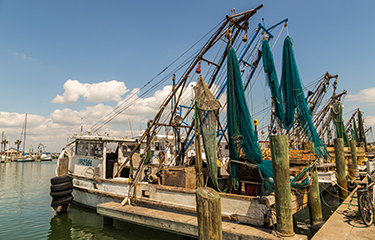
Shrimp landings in the U.S. South beat historical averages in March 2023, but were down compared to 2022 as harvesters faced plummeting prices.
According to data collected by the Southern Shrimp Alliance, shrimp landings in the Gulf of Mexico in March beat out their historical average of 2.49 million pounds, or 1,129 metric tons (MT), by 3.8 percent, reaching 2.58 million pounds (1,170 MT) total.
While the landings beat averages, they were down year over year, and the total was relatively low compared to banner years like 2017, when shrimpers caught 3.6 million pounds (1,632 MT) in the month of March. It also represented the lowest number of March landings since 2018 and the third straight year of declining volume for the month.
Landings in the U.S. state of Louisiana increased in March to 528,000 pounds (239 MT), compared to the 348,000 pounds (157 MT) caught in 2022. That put the state ahead of the 458,000-pound (207 MT) historical average for the month.
For 2023 overall, based on the latest data, the state’s shrimp landings were down compared to 2022 but ahead of the historical average. The state caught just under 3.4 million pounds (1,542 MT) of shrimp in the first three months of 2023. While that’s down on last year's record-breaking total of 5.8 million pounds (2,630 MT), it’s slightly ahead of the historical average of 3.2 million pounds (1,451 MT).
Landings in the U.S. state of Texas in March were also up compared to the historical average but down compared to 2022. The state landed 1.18 million pounds (535 MT) in March, which is lower than the 1.31 million pounds (594 MT) caught in March 2022 but up on the 1.01-million-pound (458 MT) historical average. For the year, however, landings are down compared to both the historical average and 2022 – Texas shrimp harvesters pulled in 2.57 million pounds (1,165 MT) in the first three months of 2023, which is down from the 3.59 million pounds (1,628 MT) caught last year and the historical average of 3 million pounds (1,360 MT).
Landings on the west coast of the U.S. state of Florida were also down in March. The state caught just 172,000 pounds (78 MT) in the month, which is the lowest total since 2001 and 72 percent below historical averages. Shrimp landing totals for the first three months of the year were also near historic lows at just over 1 million pounds (453 MT), down by over half from the 2.2 million pounds (997 MT) caught in 2022 and the 1.7-million-pound (771 MT) historical average.
The only state to record gains compared to 2022 was the U.S. state of Alabama. The state caught 705,000 pounds (319 MT) of shrimp in March, up from the 631,000 pounds (286 MT) caught in 2022 and well ahead of the 387,000-pound (175 MT) historical average. For the first three months of the year, harvesters in the state caught 2.7 million pounds (1,224 MT), well ahead of the 1.3-million-pound (589 MT) historical average and the 2 million pounds (907 MT) that the state caught in the first three months of 2022.
The drop in landings in March 2023 compared to March 2022 has coincided with a similar drop in ex-vessel prices to the lowest levels since 2019. For U15 shrimp, the price dropped to USD 7.35 (EUR 6.53) in March, down from USD 10.10 (EUR 8.98) in the same month last year. Prices for 15/20 have plummeted from USD 8.53 (EUR 7.58) in 2022 to just USD 4.54 (EUR 4.03) in March 2023. The Ex-vessel price for 21/25 dropped from USD 6.87 (EUR 6.11) in 2022 to USD 3.74 (EUR 3.32) in 2023; 26/30 dropped to USD 2.99 (EUR 2.65) from USD 5.48 (EUR 4.87); 31/35 dropped to USD 2.63 (EUR 2.33) from USD 4.30 (EUR 3.82); 36/40 is at USD 2.59 (EUR 2.30) – the 36/40 size has no data for the Gulf of Mexico from 2022 – and 41/50 dropped down to USD 1.90 (EUR 1.69) from USD 3.65 (EUR 3.24).
Southern Shrimp Alliance Executive Director John Williams told SeafoodSource the price drops have forced some shrimp trawlers to sit out the season.
“The Texas season opened a couple days ago, and a lot of shrimp trawlers are not going to go shrimping. This is due to extremely low prices, and some areas are not purchasing from the boats that do go because they can’t resell the shrimp,” Williams said.
Williams placed the blame for plummeting prices squarely on cheaper imported shrimp.
“This is the worst I have ever seen our industry," he said. "Fuel prices are high, and shrimp prices are almost nonexistent.”
The drop in domestic U.S. shrimp prices continues a trend for the year. Prices for domestic shrimp were already at historic lows in February, with some “massively below” prior years.
While Williams placed the blame on imports, the drop in domestic shrimp prices coincides with a drop in imports. U.S. shrimp imports are down 50,000 MT year over year, and lower prices and higher costs are hammering some overseas aquaculture operations.
Ecuador’s shrimp industry has been sounding the alarm on a USD 1 billion (EUR 889 million) economic hit thanks to lower international shrimp prices and surging farming costs. A glut of farmed shrimp in China – Ecuador’s main customer – dragged down prices, but U.S. price inflation and an inventory of higher-priced shrimp has kept shrimp prices elevated at the store level, further softening demand in the U.S.
As demand softens, the Southern Shrimp Alliance has continued to push for greater controls on imported shrimp and is urging the U.S. government to move the “LESS” (Laws Ensuring Safe Shrimp) act forward. The group has long blamed cheap shrimp imports for shrinking the margins on domestic shrimp to their breaking point.
The act would see 70 percent of import duties collected on imported shrimp deposited into a fund, half of which would go toward U.S. Food and Drug Administration activities to “eliminate banned antibiotics from shrimp supply chains.” The other half would go into a U.S. Department of Agriculture program to finance the purchase of shrimp from domestic producers for distribution programs.
“Pushed to the margins by cheap imports tainted with harmful chemicals, shrimpers are struggling to sell their catch and are confronting one of the worst years this industry has ever experienced,” Williams said in a release. “The LESS Act is proof that Congress has a vital role in the continued viability of our shrimp industry.”
Photo courtesy of Warren Price Photography/Shutterstock
