






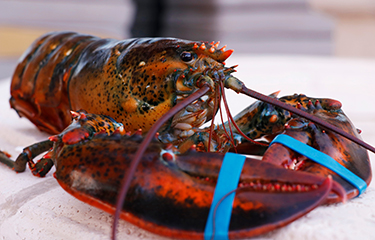
Over the past three years, China maintained its lobster imports from the U.S. and Canada at nearly pre-pandemic levels, portending a likely increase in trade now that the country has lifted its zero-Covid inspection regime for imported foods.
Between 2018 and 2022, China imported between 62 million and 72 million pounds of lobster annually, according to data presented at the shellfish panel at the 2023 Global Seafood Market Conference in Palm Springs, California, U.S.A. on 18 January.
The Sino-U.S. trade war sapped energy from the once-thriving U.S. lobster trade with China, but the fact that traded volumes of North American lobster (Homarus americanus) stayed as high as they did – in large part thanks to Canadian exporters – could mean the market is primed for expansion in 2023, Ready Seafood Director of Sales and Business Development Andrew Daughan said.
“Five years ago in this category, all we talked about was China and how they were coming in bigger and bigger,” he said. “The fact that they were able to continue those level of imports even during zero-Covid goes to show now that they are probably going to go up pretty significantly in 2023. And that obviously probably is going to have a major effect on pricing and availability.”
Daughan said predictions for 2023 are calling for landings to be consistent with the recent past, and for the resource to come back to a 50-50 split between the live market and processing.
“We don't see anything dramatically going to change. Year over year, any change in landings is really more of a function of weather, market pricing, and trips, but it's a very healthy and very sustainable resource,” he said.
Combined, Canada and the U.S. landed around 340 million pounds of lobster in 2022, down slightly from the 350 million pounds landed in 2021 and about even with 2020 landings.
The larger volumes and high prices of 2021, when lobster tails never sunk below USD 22 (EUR 20.31) per pound and lobster meat reached USD 40 (EUR 36.93 ) per pound, were outliers, Daughan said. In 2022, lobster tail prices sunk from USD 25 (EUR 23.08) in January to below USD 17 (EUR 15.69) at the end of the year, and remained that level thus far in 2023. Lobster meat is now below USD 25 (EUR 23.08) per pound, with both meat and tail prices starting the 2023 season at 31 percent below its prices a year prior.
“End user inventory was strong going into 2022, [which] deterred buying out of the gate for spring season,” Daughan said. “When the snow crab pricing began to correct in the spring, many lobster packers attempted to draw a line on raw material costs as to not share the same fate as the snow crab packers. It turned out not to be enough.”
With American consumers running out of Covid-related support they had received from the government, suppliers and retailers had to run promotions and reduce prices in order to run through their inventories, Daughan said. That cycle has largely played out and prices are starting to pick up again, he said, predicting a steady 2022 for the lobster sector.
“Last year, like every other category, it had inflationary pressures, whether it was labor or fuel, but the reality is we have a sustainable biomass, and we have a sustainable labor group that wants to go out and catch lobster. So that to me makes lobster seem like one of the few products that's kind of coming out of this hangover, per se, a little quicker or easier [and] we can be a little more predictive on it,” he said.
A pick-up in exports to China will help, Rob Kragh, the vice president of category management at Chicken of the Sea Frozen Foods.
“We'll have to see how it all shakes out with China,” he said. “Whatever we catch, we're gonna sell it – whether it goes live, whether it goes processed, it's going to go somewhere. Now it's just trying to find out what's the best way to do it where it works out best for the processors, the importers, and the end-users.”
Photo courtesy of Libin Jose/Shutterstock
