






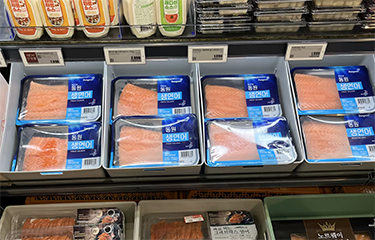
A weak krone in the month of August has once again boosted Norway’s seafood export value year over year, driving exports up 15 percent by value.
Norwegian exporters shipped NOK 14.2 billion (USD 1.32 billion, EUR 1.23 billion) worth of seafood in August, an increase of NOK 1.8 billion (USD 168 million, EUR 156 million) over the same month last year. However, Norwegian Seafood Council (NSC) CEO Christian Chramer cautioned that much of that increase can be attributed to the weaker krone, which has been a frequent theme for Norway’s seafood industry in 2023.
“The devaluation of the krone is the main reason for the increase in the export value,” Chramer said. “In August, the Norwegian krone was as much as 16 percent weaker against the euro than in the same month last year. This explains almost the entire increase in export value.”
In August 2022, the country exported seafood worth NOK 12.5 billion, which at the time was worth USD 1.24 billion and EUR 1.25 billion.
While the weak krone was a large part of the increase in value, salmon exports continued a two-and-a-half year streak of value growth in August.
“In August, Norwegian salmon exceeded a total export value of over NOK 10 billion [USD 933 million, EUR 870 million],” Chramer said. “This is the 30th month in a row with value growth, and it shows what a strong position Norwegian salmon has in the markets. The prices of fresh whole salmon and trout measured in euros are still lower than at the same time last year.”
The country exported 125,041 metric tons (MT) of salmon in the month, the NSC said.
“[August] is currently the last in a series of 30 months with continuous growth in value measured against the same period the previous year,” NSC Seafood Analyst Paul T. Aandahl said. “We must go back to May 2011 to find an equally long continuous growth period.”
In addition to the continued strong export performance of salmon, the NSC highlighted the large increase in exports to the U.S. The export value to the North American market – which is mostly made up of the U.S. market – increased by 24 percent to NOK 1.5 billion (USD 140 million, EUR 130 million), or 10.4 percent of the total value of Norwegian seafood exports, the NSC said.
“The U.S.A. is becoming an increasingly large and important market for us,” Chramer said. “We must go back to the 1980s to find an August month when more than 10 percent of the total value of Norwegian seafood exports went to North America.”
In terms of export value, Poland represented the largest market for Norwegian seafood, taking in NOK 435 million (USD 40 million, EUR 37 million) worth of Norwegian salmon compared to the same period last year, the NSC said.
The NSC also highlighted “historically strong” sales of king crab in August. The country exported 392 metric tons (MT) of the species in the month worth NOK 177 million (USD 16.5 million, EUR 15.4 million), an increase of NOK 74 million (USD 6.9 million, EUR 6.4 million), or 73 percent, compared to the same month of 2022. That figure is a monthly record value for Norwegian king crab exports, according to NSC Shellfish Manager Josefine Voraa.
“It is NOK 28 million [USD 2.6 million, EUR 2.4 million] higher than the previous record month, which was in August 2021,” Voraa said.
Chramer attributed the increase to a pickup in demand for live king crab in the Asian market.
“In August, we saw this in the hotel, restaurant, and [cafeteria] segment,” he said. “Here, there was particularly large growth to Hong Kong SAR and to China.”
Fresh cod also saw growth in both volume and value for the month. The country exported 2,403 MT of fresh cod, an increase of 46 percent over August 2022. Those shipments were valued at NOK 139 million (USD 13 million, EUR 12 million), an increase in value by NOK 49 million (USD 4.5 million, EUR 4.2 million), or 55 percent.
Of that total, 14 percent of all of Norway’s cod exports in August 2023 were farmed cod – a dramatic increase compared to the complete lack of exports of farmed cod in August 2022.
“It is therefore likely that farmed cod will be exported in all months of the year in 2023,” NSC Seafood Analyst Eivind Hestvik Brækkan said.
Exports of frozen cod, meanwhile, decreased in both value and volume. The country exported NOK 209 million (USD 19.5 million, EUR 18.2 million) worth of frozen cod, a drop of NOK 99 million (USD 9.2 million EUR 8.6 million), or 32 percent. By volume, Norway exported 3,618 MT of frozen cod, down 37 percent year over year.
Exteral sales of cod clipfish, meanwhile, saw increases in both volume and value. The country exported 7,668 MT of clipfish, an increase of 20 percent over August 2022. Those exports were valued at NOK 506 million (USD 47 million, EUR 44 million), an increase of NOK 94 million (USD 8.8 million, EUR 8.2 million), or 23 percent, year over year.
August also saw positive results for herring exports, up 11 percent by volume to 15,740 MT, and up 42 percent by value to NOK 300 million (USD 28 million, EUR 26 million). Poland was Norway's largest market for the species.
“There is currently a good development here, and the export value of Norwegian herring to Poland has so far this year seen a value increase of 40 percent and a volume increase of 25 percent,” NSC Pelagic Species Manager Jan Eirik Johnsen said.
Fresh mackerel exports declined, with poor landings leading to a 73 percent drop in export volume to 7,898 MT and a 65 percent decline in the value of mackerel exports NOK 173 million (USD 16 million, EUR 15 million). The decrease is partially attributable to a later start in the fishing season, the NSC said.
“With the conclusion of a bilateral mackerel agreement with Great Britain on 8 June this year, and a reduction in the quota of almost 19 percent, it was expected that the season would start significantly later this year,” Johnsen said.
Frozen mackerel sales abroad dropped from 99,000 MT of exports to just 49,500 MT in August.
Photo courtesy of the Norwegian Seafood Council
