






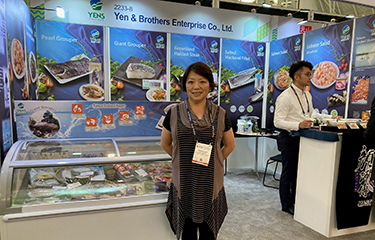
New Taipei City, Taiwan-based Yen and Brothers hit USD 170 million (EUR 159 million) in revenue in 2022, making it one of the country’s largest seafood importers.
And despite tensions with China, which claims Taiwan as Chinese Taipei, the future is looking positive for the company, according to its sales director, Margaret Chu.
Yen and Brothers, or Yens, operates three seafood-processing facilities in Taiwan – two in Tainan and one in Kaohsiung. A specialist in frozen seafood, Yens imports a huge range of seafood, including vannamei shrimp, salmon, Greenland halibut, whelk, capelin, mussels, squid, and toothfish. It also sources much of its seafood from Taiwan’s local and distant-water fleet, including tuna and mackerel. It has a chain of custody certification from the Marine Stewardship Council and Aquaculture Stewardship Council, as well as approval for export from the E.U. and U.S. Food and Drug Administration, in addition to halal certification and HACCP, ISO 22000, and ISO9001 certifications.
Chu said 80 percent of the company’s sales are to Taiwan’s domestic market, which she described as “seafood-crazy,” with average annual per capita consumption at 30 kilograms, or 66 pounds.
“We believe this number is actually under-measured, as the collective number doesn’t count consumption outside of buying from fish markets,” Chu said. “It’s a good base but it is not without problems.”
Among those problems are a declining birth rate and population total, and a developed economy that has higher production costs than China, Thailand, and other regional competitors. On the plus side, Taiwan’s unemployment rate is around 3.5 percent, meaning most people have money to spend, and 70 percent consider themselves “foodies,” with 29 percent of the country’s residents eating out at restaurants at least twice per week, Chu said, citing a recently conducted national poll. Taiwanese people are also busy and heavily reliant on take-out and convenience food, Chu said.
In response to the country’s unique demographics and political situation, Yens decided to undertake a major pivot from concentrating on wholesale frozen seafood to value-added products. For foodservice, emphasis was placed on providing convenience and decreasing food waste. The shift was perfectly timed to meet the surge in seafood demand that came out of the Covid pandemic in 2021 and 2022, according to Chu.
“We saw trends that had emerged before Covid only reinforced during the pandemic. E-commerce, Uber Eat,s and other food delivery services, all doubled their business. Even big famous restaurants had to go for takeaway and delivery, that helped them make it through. Now, delivery has slowed down a little bit, but overall, seafood consumption has improved," Chu said. "For restaurants and foodservices, we want things to be easy for them, so they don’t have to cut and clean fish, because there’s not enough labor in the restaurants. And we are trying to supply price by piece, not by weight.”
For retail, Yens has established a robust research and development department that has come up with a range of ready-to-cook and ready-to-eat seafood items, stretching from snacks to full meals.
“We want to be making innovative products,” Chu said. “People are busy in Taiwan. Ready-to-eat meals, especially for one person, are becoming very popular. And especially for the younger generation born after 2000, three meals a day is not necessary for them – snacks are more important than meals to them.”
Chu said Yens would like to extend its reach further into supermarkets, both with sushi items for the domestic market and specialty items for Chinese and Taiwanese people living abroad.
Yens still buys from and sells into China, but that has become more difficult as China has begun imposing restrictions on Taiwanese imports. It also sells several other international markets, and Chu said Yens wants to continue to diversify, including boosting sales to Australia and New Zealand, as well as the United States.
“The relationship between Taiwan and China is quite tense right now, and that is causing trading complications and is forcing us to react,” Chu told SeafoodSource. “Regarding seafood, there is a heavy reliance on the Chinese market, but now China has closed doors to Taiwan food processors. We believe our government will try to negotiate with China, but politically, it will be difficult to improve relations. We don’t want to be dependent on China as our only market, so we need to diversify or shift to other markets.”
Chu said the company has exhibited many times at the Seafood Expo North America in Boston, Massachusetts, U.S.A. as a means of gaining exposure to North American buyers.
“The U.S. market is more vibrant, more open – it’s easier for us to talk with customers here,” she said. “We are happy to adopt our product to fit this market’s needs.”
Chu said she would like to see Taiwan join the Comprehensive and Progressive Agreement for Trans-Pacific Partnership (CPTPP), a trade pact eliminating most duties between its 11 members – Australia, Brunei, Canada, Chile, Japan, Malaysia, Mexico, New Zealand, Peru, Singapore, and Vietnam. But with China vehemently opposed to its effort, Chu said she’s not hopeful, at least for the time being.
“Politics is making business difficult,” Chu said. “Customs duties are not friendly to anyone.”
Chu brushes aside concerns China might invade Taiwan, a possibility international relations experts have claimed has been growing in likelihood in recent months.
“We have always felt political tension – we’ve heard about it since we’re little. It’s something we put aside in the back of our heads and keep moving on,” Chu said. “For us, it’s best way to be able to defend ourselves. If we stop and worry too much, then we lose.”
She praised Taiwan’s government for maintaining its democracy despite China’s imposition of power.
“The Taiwanese government is doing a great job with a tough task,” she said. “For any government, citizens’ welfare should be on the top of the list.”
Photo by Cliff White/SeafoodSource
