






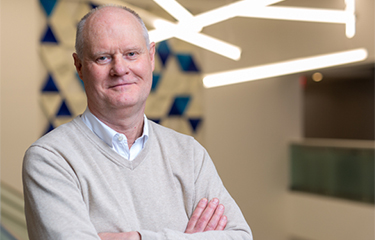
Oliver Peoples is the president and CEO of Yield10 Bioscience, which is developing Camelina sativa as a sustainable platform crop to produce feedstock oil for omega-3 oil. The company recently won approval from the U.S. Department of Agriculture Animal and Plant Health Inspection Service (USDA-APHIS) to grow and breed its stacked herbicide tolerant camelina in the U.S. The Woburn, Massachusetts, U.S.A-based company signed a letter of intent in November 2023 with Aarhus, Denmark-based aquafeed firm BioMar to commercialize a fish oil alternative derived from camelina.
SeafoodSource: Many different companies – Calysta, NovoNutrients, Corbion, KnipBio, ADM, Unibio, NuSeed, Veramaris, Houdek, and Aquaterra, to name a few – are trying different solutions to create omega-3 additives as a replacement for marine products used in fishmeal and fish oil. Why is yours better than theirs?
Peoples: First of all, there's no ocean harvesting solution to this, because you're harvesting a resource out of the ocean that’s finite and, in fact, dwindling. Yet demand for omega-3s and demand for high-quality protein like farmed salmon continues to grow. In fact, probably one of the main constraints on the industry, other than regulations and a need to transition over to closed-loop recycled-water aquaculture, is a supply of the right ingredients at a cost that makes sense. So the industry is trapped.
Camelina is a sustainable solution that we have to scale up and commercialize as a way to solve the bottleneck. Our big focus on camelina today is to make a low-carbon impact feedstock oil and biofuel. The one thing it has to be is cost-effective and we've been building the camelina platform with that in mind.
And I think the main thing is if you look at the space and you look at algal systems versus the camelina, based on the quality of the product and the cost structure, camelina is going to win. It’s just that simple. It doesn't mean there's no room for all those other systems, it just means they're probably not going to be able to expand, because the cost differential is going to basically be too problematic.
SeafoodSource: Can you expand on that? Why is there such a large cost differential between camelina and Yield10’s competitors in the sector?
Peoples: If you look at the algal systems, and I'm very familiar with fermentation technology – I have a deep background in that and I have the scars to prove it – their processes are pretty inefficient. Corbion’s requires a lot of energy and spews a lot of CO2 back out into the atmosphere. In Veramaris’ case, their dedicated facility cost around USD 200 million (EUR 185.8 million). If the industry is trying to grow between 3 and 6 percent per year, that means we’ll need 20,000 to 30,000 tons of additional fish oil, so every year you’ve got to spend another USD 200 million building a facility. That gets expensive very quickly, and those facilities have high operating costs.
For us, we will contract with farmers to plant [the acreage we need], so [we] don't have to spend hundreds of millions of dollars for every 20,000 tons of oil you want. For USD 20 million to USD 30 million (EUR 18.6 million to EUR 27.9 million), we can get this commercialized, where the algal guys have to spend USD 200 million for each 20,000 tons they want to produce. Once we’re more easily scalable, we can make 100,000 or 500,000 tons just depending on how much camelina we grow. Once we have this process developed and approved, we can make as much as you want and it's very cost-effective, and that's the key to this.
SeafoodSource: How did the partnership with BioMar arise?
Peoples: We secured an exclusive option agreement and research collaboration agreement with Jonathan Napier at Rothamsted Research and the progress being made [on converting camelina into a fish oil alternative], and we decided this is the right time to [get involved]. We had some early inbound inquiries from some of those people on the business development side, and BioMar [was one]. BioMar is a believer in this – they’ve used the oil and they’re very familiar with it. They have a very smart, sensible, and nuanced way of looking at this, and how this fits into aquaculture. They came to us very quickly, and we said, well, why don't we put an [agreement] in place and start working together on a joint program to get this commercialized? They stepped up very quickly and you can see that they are really looking at this as a solution to a big problem.
SeafoodSource: What is next for Yield10 in the aquafeed space?
Peoples: Ultimately, we'll be able to create something that looks but hopefully doesn't smell like anchovy oil, with the right levels of EPA and DHA. The Rothamsted team has seen examples of that, so we know we can get there. This first product is critical to the near-term future of the industry. We’re doing 50 acres in Chile of the first one of these lines and we've also got the regulatory approval pending. What we see is we see a path forward, and our focus is really scaling this up. No doubt there will be bumps in the road. We get really excited about the prospect of working with BioMar, because BioMar has been involved with Rothamsted since 2014. They've always had the vision that this is going to be important and they've really been involved with Rothamsted in doing salmon feed trials with first generation very successfully. They’ve showed this can be repeated and we can replace fish oil at very large scale at low cost.
SeafoodSource: How far along are you to full commercialization and scaling up?
Peoples: We’re scaling up now … Right now, we are small-scale, so the challenge is, until the USDA APHIS approves this production line that we have, this variety in the U.S, doing large-scale production under regulated permits is very expensive. So that's probably not the right way to do it in the near-term. And we have some work to do with the aquafeed companies, including BioMar, to really be able to get them pumped up to use it. And we've got to go through the regulatory process in the U.S. and Europe, so those are the key things.
SeafoodSource: What are your biggest hurdles? Where do you see the most work that needs to be done between what you have now and where you'd like to be?
Peoples: A big challenge is transitioning camelina, which is a European crop not native to North America, into a high-tech crop in North America. And a big piece of that is being able to use the same tools the industry uses for soybean, canola, and corn to grow camelina. But a big advantage for us is that camelina is not canola, soybean, or corn – it's not a major commodity crop that's really deeply entangled in commodity export markets for North America.
[We’re working hard] on developing growing processes for our two varieties [of camelina]. One just makes EPA – up 20 percent EPA in the oil – and the second one makes DHA plus EPA, about 10 percent each. Phase one is getting this EPA oil into the market soon as possible, get it in the hands of customers, work through the regulatory systems in Europe and Chile and just scale as quickly as possible, because there are ample sources of DHA, such as Corbion and ADM. Ultimately, what you want, according to the industry, is about 1 percent EPA and 1 percent DHA in the feed. The scientists will say you actually want twice that, but with a finite supply, that's not really feasible.
SeafoodSource: Are you using GMO crops? Do you think that will hinder uptake of your product?
Peoples: Yes, they're both GMO. What Jonathan [Napier] did is he intercepted several genes from algal systems that basically enabled the biology within the camelina seeds to produce high levels of EPA and EPA plus DHA, so these are, by definition, genetically modified. With Peru canceling its first anchoveta season, that’s 20 percent of global production gone, and the second harvest is underway but it’s down 26 percent.
Europe’s GMO policy basically can be summed up in two words: needs and must. Europe needs protein for animal feed, therefore it imports GMO soybeans from Brazil, Argentina, and the U.S. that have been GMO for the last 20-odd years. Nobody says anything about it, because guess what? They have to have it. So to my mind, at least … [that] indicates that this is really more about politics.
Norway has approved the use of NuSeed’s canola product, which only contains DHA. We look at them as fellow travelers in this space, because they removed that roadblock in Norway. But there's still work to do with consumers. Today, what we're seeing across the board, especially with this generational shift, is younger people are more interested in sustainability than being hung up on GMO. Some of the branded companies are still trying to perpetuate that, but in reality, we've all been vaccinated several times using gene technology. There’s a 30-year track record of safety there – this is a non-issue. But the omega-3 content is the big marketing advantage with salmon. Otherwise, it's just protein.
If we want to keep supplying a high-quality, high-value protein source that results in a fish with great flavor and tremendous aesthetic appeal, it has to have the right level of omega-3s to give it the right color and flavor, and increasingly, it has to be sustainably produced. And you can't get there without GMO. If you look at all the exports from Norway, they're not eating much salmon in Norway compared to the export markets. Fundamentally, there's only one answer to this, which is to use advanced technology, which has a track record of safety and can deliver not only high-quality omega-3 product, but sustainability benefits.
SeafoodSource: So currently, you're growing in in Chile. Is the plan to eventually grow in in the U.S. or elsewhere?
Peoples: Ideally, it would be grown in the U.S. – that’s probably the best place for this type of technology given the very favorable regulatory environment. We see a clear path in the U.S. not only to commercialize this generation but we're going to combine the herbicide tolerance with the omega-3, and that'll be the next generation, and then the generations beyond that, which will improve the level of omega-3. We see a continuous process of improvement here that can be done. It takes time because crop science does. But ultimately, we're getting closer and closer to something that looks like anchovy oil with high omega-3 and low omega-6.
SeafoodSource: Are you actively looking for investors? How far advanced are those conversations?
Peoples: We are talking to the industry about funding partnerships. We're not an aquafeed company or a salmon farmer. We recognize that we need a partnership. And so the discussions we are having with folks is really to look at the prospect of partners and indicate in exchange for financial support, we are willing to give preferential offtake. The developments with camelina are the ultimate manifestation of a value-based that can be scaled economically and deliver real value for a sector that desperately needs it.
Photo courtesy of Yield10
