




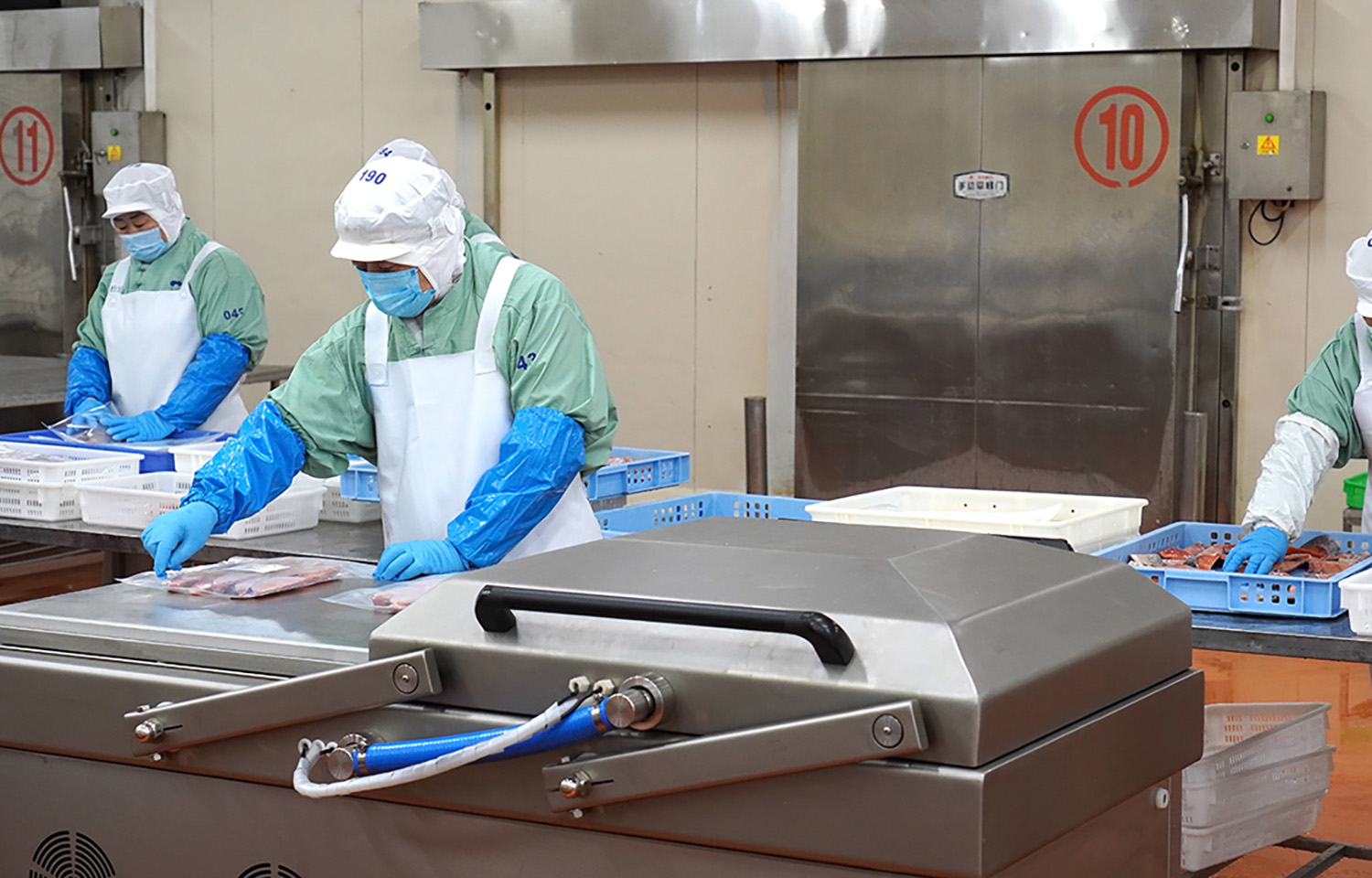
Worsening trade uncertainty and increases in raw material costs have created a “very challenging” environment for the Chinese whitefish-processing industry.
“Due to the high price on [headed and gutted] cod, haddock, and pollock, as well as uncertainties surrounding trade tariffs with the U.S., most processors have reduced their production scale by 20 percent to 50 percent,” David Jiang, the managing director of Unibond Seafood International, which sources seafood in China for European customers, told SeafoodSource. “Some factories are trying to develop the Chinese domestic market, but the progress is slow and needs a long-term commitment. Overall, it is a very challenging time for whitefish processors in China.”
Sigmund Bjorgo, the head of the Norwegian Seafood Council’s (NSC) office in China, said that the situation has arisen largely due to reduced quotas and U.S. tariffs, which have pushed up prices for Norwegian cod and haddock in particular, a large share of which is traditionally processed in China and reexported to the U.S.
“Since March, when U.S. tariffs on Chinese seafood increased in several rounds, the uncertainty in the market has been high and the export volumes on Norwegian cod and haddock to China dropped significantly,” he said.
Exports of frozen whole cod from Norway to China between January and September to China dropped 43 percent, while prices increased 30 percent, Bjorgo explained.
Chinese import statistics, which combine Atlantic and Pacific cod, show a more holistic picture of the tough environment processors face. The statistics show that China’s imports of cod were down 17 percent to nearly 81,700 metric tons between January and August of this year, while prices increased 36 percent. Russia is the largest supplier of cod to China and saw the volume of its cod exports drop 16 percent to the Asian market, while prices increased 43 percent.
The latter decrease comes as U.S. Marine Mammal Protection Act stipulations state that from 1 January 2026 onward, seafood processed in China using Russian raw materials will be barred from entering the U.S., removing a major sales channel for Russian cod and haddock.
Bjorn Marius Jonasson, the director of sales for groundfish at Iceland Seafood, said that this situation has left processors in dire straits.
“If a [Chinese] processor is at 50 percent capacity, he is doing well,” Jonasson said. “High raw material prices and duties, coupled with the American ban on Russian seafood, mean the U.S. market is closed effectively. The E.U. has high raw material prices and duties, but their saving grace is Russian raw materials. The Chinese caused none of it but got handed the bill.”
