
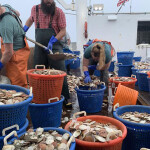

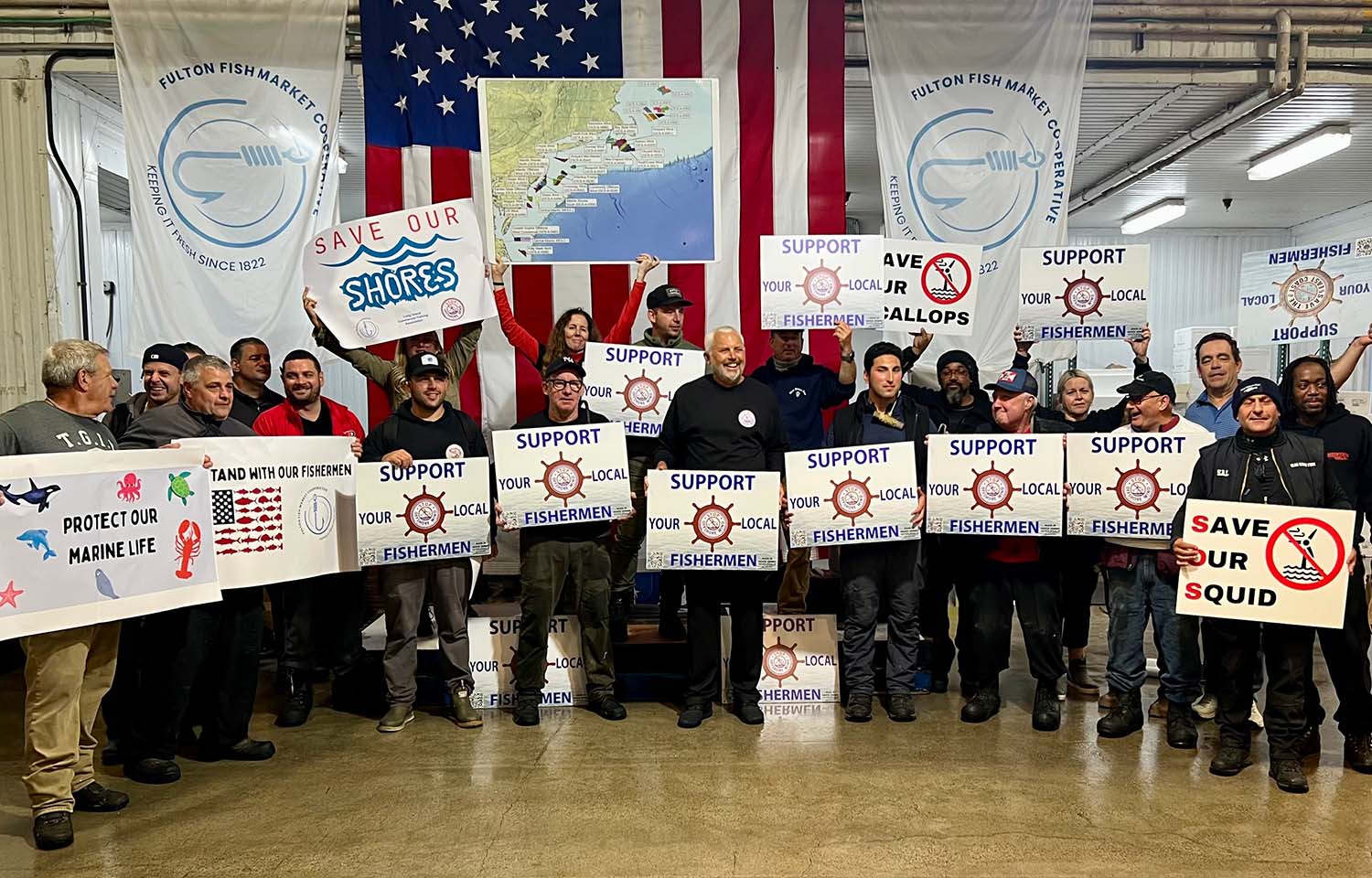
Bronx, New York City, USA-based Fulton Fish Market Cooperative held an emergency rally on 16 July to urge U.S. President Donald Trump to halt the Empire Wind offshore wind project that seafood industry stakeholders claim will put their livelihoods at risk.
Seafood industry stakeholders gathered at the event – many of whom were unionized employees of the market – said the project threatens their livelihoods and those in New York’s seafood industry. Fulton Fish Market Cooperative CEO Nicole Ackerina said the project will heavily damage the industry and push it out of the region.
“These projects will eliminate access to vital fishing grounds, destabilize our seafood infrastructure, and trade American jobs for short-term foreign-backed construction contracts,” Ackerina said during the rally.
The Empire Wind project is planned to be constructed along the coasts of New York and New Jersey. Developed by Norwegian energy company Equinor, the project would encompass a 79,350 acre lease area granted by the U.S. Bureau of Ocean Energy Management (BOEM).
The Fulton Fish Market Cooperative recently became a plaintiff in a federal lawsuit against the Empire Wind project – Protect Our Coast New Jersey v. United States. Plaintiffs in the case represent a variety of U.S. seafood and environmental stakeholders, including ship captains, wholesalers, processors, right whale conservation groups, and more.
The long-standing conflict between fishing interests and offshore wind frequently stems from the unclear impacts wind projects will have on the environment – and the clear impacts the projects will have on historic fishing grounds, which could become inaccessible due to the spacing of offshore wind turbines.
Warren Kremin, a shareholder with the Fulton Fish Market Cooperative and the principal at Blue Ribbon Fish, said that lack of science is untenable for a project like Empire Wind.
“Where is the science? We’re not asking for anything unreasonable, but before we lose all these jobs, where is the data? When the government doesn’t have the data, they shut down a fishery in the name of conservation and sustainability,” Kremin said. "This is a major issue that bridges both sides of the aisle. We need the Trump administration to look into this deeply, because the trickle-down effect of this project could be severe for our industry.”
Ackerina told those gathered at the protest on 16 July that the Market employs over 1,200 full-time workers, many of whom are Bronx residents. She also told SeafoodSource that it’s not just Fulton employees that would be affected: she said the majority of the supply chain in the region would be impacted by the project. Despite the impacts, stakeholders wouldn’t get any compensation from the developers taking their livelihood away by limiting access to fishing grounds that have been used for generations.
“The fishing and seafood industry in New York produces 70,000 jobs and USD 10 billion [EUR 8.6 billion] in sales annually, and in New Jersey it produces 72,000 jobs and USD 13 billion [EUR 11.2 billion] annually,” she said. “We're out here to fight for our fisherman, fisheries, and oceans, but these projects will undeniably have snowball effects economically that'll rattle our industry as a whole.”
Ackerina said the lack of access to fishing grounds would impacts supplies, which would then impact prices and availability which would then go on to hurt sales – having effects down the supply chain.
“American, union jobs will be lost to the industrialization of our oceans by European and big oil/gas joint ventures,” Ackerina said. “This project will also impact overall sale of seafood in the region, one of our last pure proteins, obtained through an already well-established regulated and sustainable industry, which has been feeding Americans and drawing tourists to our waterfronts for centuries.”
Conflicts between fisheries and off-shore wind projects are neither new nor limited to the U.S.
The Responsible Offshore Development Alliance (RODA) has been attempting to legally block the Vineyard Wind project, a wind energy project off the coast of Martha’s Vineyard, Massachusetts, since 2022. Most recently, the organization petitioned the U.S. Supreme Court to reconsider an appeals court decision which rejected its attempts to stop the project.
Elsewhere in the U.S., developers of wind projects have agreed to pay compensation to commercial fishers and related businesses. In Maryland and Delaware, for instance, US Wind was granted an 80,000 acre federal lease 11 miles off the coast of Ocean City, Maryland, but the BOEM required the company to pay fishers for lost revenue as part of the agreement.
A group of eleven states in the U.S. have even collaborated to create an Offshore Wind Fisheries Compensation Fund to address the issue as wind energy projects become more common.
The rally at Fulton Fish Market emphasized that many seafood industry stakeholders, like seafood packers and processors, would not be represented by such an organization or compensated by such rulings.
For rallygoers, the protest was a means of trying to gain attention for the industry, which some say goes unnoticed.
Long Island Commercial Fishing Association Executive Director Bonnie Brady said consumers often forget the role fishermen play in the economy. Brady said that she had not seen convincing evidence that the project would generate jobs, and was concerned about the ways in which Empire Wind could disrupt radar and increase sea temperatures – which could impact fisheries.
“My husband’s a commercial dragger. He leaves in darkness and comes home in darkness. People think that because we’re not seen, we don’t exist,” she said. “We may be unseen most of the time, but we will not go quietly. We will not be erased.”
