




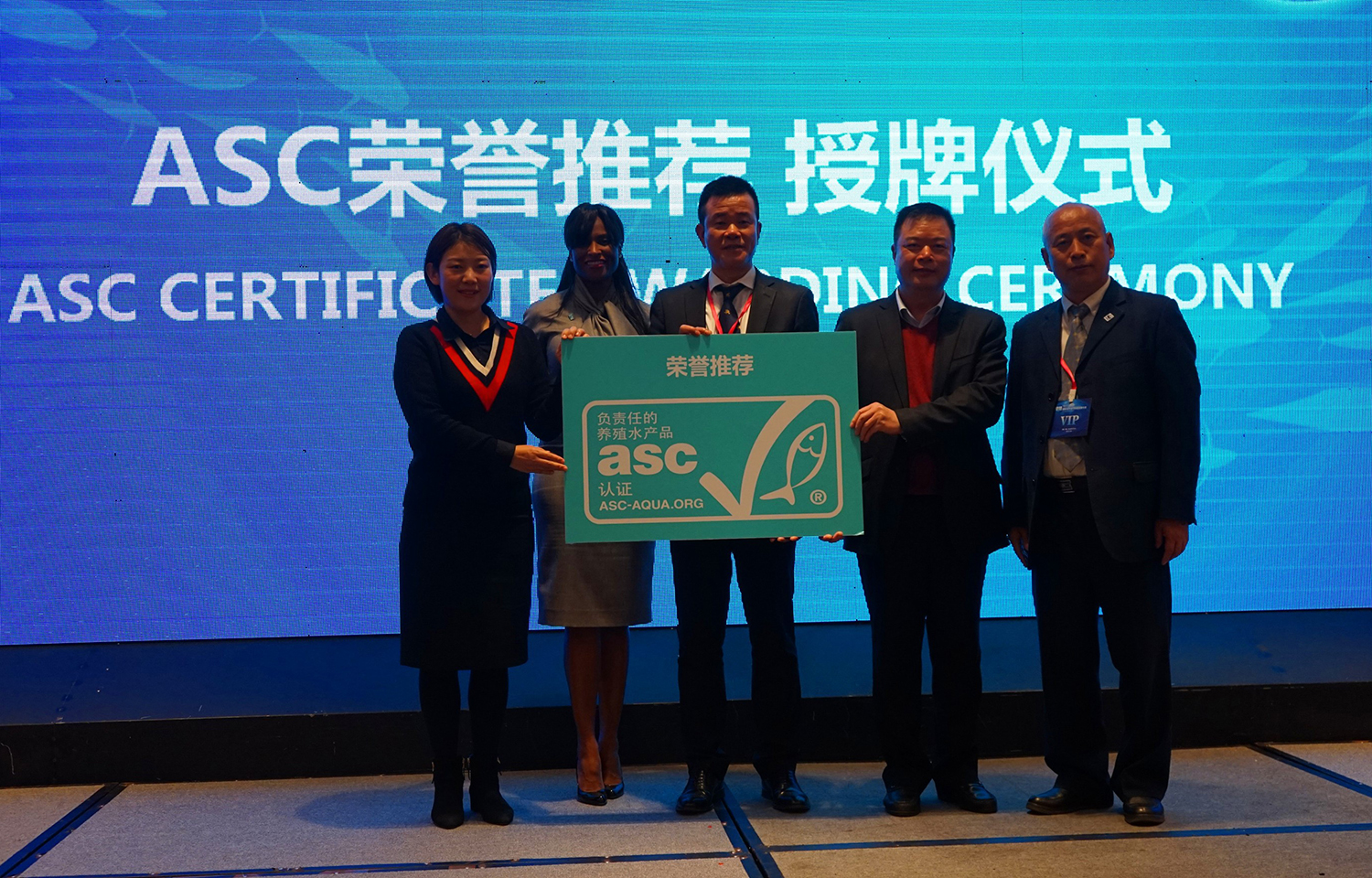
The Aquaculture Stewardship Council (ASC) has confirmed that its certification program is set to expire in China in 2027, requiring several companies certified under the standard to pivot within the next year.
The ASC began phasing out operations in China in March 2024 and closed its office in the country around that time.
“ASC has undertaken a strategic business review of internal operations and of current and future operational regions and markets,” ASC Global Press and PR Manager Sophia Balod-Lorenzo told SeafoodSource in a statement at the time. “As a result of this business review, ASC has decided to phase out program operations and cease investment in China. This will allow ASC to focus and invest in coming years in regions, markets, and activities where we believe we can have the greatest impact through effective use of our limited resources. Our position may change following future business reviews.”
Before it made the decision to shutter its operations in China, the ASC faced criticism for failing to detect evidence of forced labor in Chinese seafood-processing plants carrying the joint ASC/Marine Stewardship Council chain of custody certification. The issue was brought to light by an investigation from the Outlaw Ocean Project.
In response to the investigation, former ASC Reputation and Engagement Stakeholder Manager Desirée Pesci said it was “concerning.”
“[ASC was] not aware of the extent to which the Xinjiang labor transfer program expanded outside of the Xinjiang Region and the risks that this presents to employees of seafood operations in other provinces across China, until your investigation brought this to our attention,” Pesci said at the time, adding that ASC condemns all forms of forced labor and has “a robust and rapidly developing human rights program.”
Now, several Chinese companies are set to be impacted by their upcoming inability to recertify, including Guolian Yiyang Crayfish Breeding Biotechnology, which has an ASC-certified crayfish farm, and Conson Aquaculture Vessel (Qingdao) Ocean Technology, which had its floating tropical marine finfish vessel certified by the ASC.
Elsewhere, Hainan Xiangtai Fishery’s pompano production is certified under the ASC Tropical Marine Finfish category, and abalone producer Fujian China-Singapore Evervest also carries an ASC certification, both of which declined to comment on the matter.
With Chinese consumer preference for certifiably sustainable seafood on the rise, some firms may choose to switch over to another credential, like the Global Seafood Alliance’s (GSA) Best Aquaculture Practices (BAP) certification.
GSA Head of Business Development in China Iris Xin Wang told SeafoodSource it “is possible that some facilities may switch regarding certification solutions.”
“China has global influence as a seafood-producing country and as a major market, and BAP has been operating in China since 2006, when we issued our first certificate here,” Wang said. “Other aquaculture certification programs may hold hundreds of chain-of-custody certificates, but … BAP has the most certified farms of any international certification program operating in China.”
Last year, GSA said it was experiencing a surge in BAP applications from Chinese seafood companies targeting the premium domestic market.
The firm found that new applicants targeting the Chinese domestic market accounted for just 3 percent of new applications in the country as recently as 2020, but that the figure stood at 50 percent by July 2025.
