






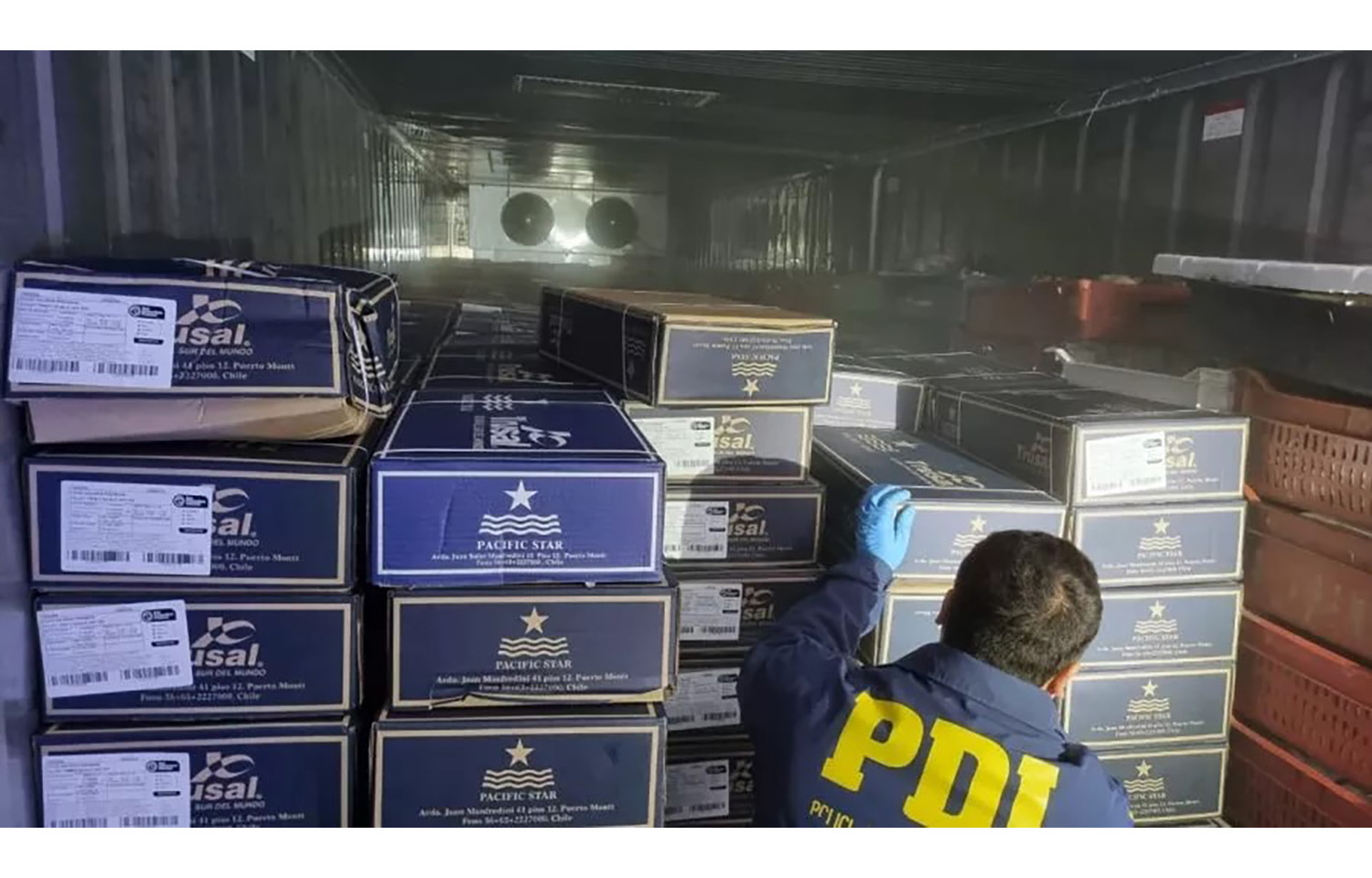
The theft of salmon is one of three areas that the Chilean internal revenue service, SII, has begun to investigate in relation to complex crimes occurring in the country.
The tax service specifically created a unit to look into complex crimes and found three areas of pressing need for further investigation to be the supply of informal commerce, vehicle theft, and mafia activity affecting the salmon industry.
Regarding the latter issue, organized crime rings have increasingly been robbing from salmon-farming firms and selling the stolen goods to the local market. According to numbers provided by industry association SalmonChile, there have been 170 reports of salmon theft from cargo operators, farming centers, and processing plants from 2018 to June 2024.
“We have discovered, through the analysis of sales and purchase invoices, companies selling more salmon than they buy. How do salmon multiply in some companies? There is a part that is from the black market because they buy from those who steal salmon,” SII Director Javier Etcheberry told local publication Diario Financiero.
Etcheberry highlighted the need for increased state coordination to address security problems that the country is experiencing, including issues in the salmon industry.
“Sometimes, the state continues to operate as it did when there were no car thefts or organized crime. [However,] there are efficient organizations that offer prices that compete with each other,” he said. “If the main priority of Chileans is [dealing with] insecurity, why can’t we coordinate better to be able to solve these issues? This is not only a tax issue but a country issue. We have to have control … to know what is happening.”
Salmon theft costs the country as much as USD 80 million (EUR 77.4 million) each year, and the Chilean government is working to establish harsher punishments for the crime. Legislators are preparing a bill that would stiffen penalties for salmon theft, strengthen controls around the illicit practice, and enable the use of special investigation techniques for prosecution.
Chile’s Investigative Police (PDI) has coordinated efforts to address salmon thievery.
In September 2024, some 100 detectives participated in a sting operation dubbed “Operación Santo Salmón” and arrested 11 members of a criminal organization that had robbed multiple truckloads of salmon destined for export.
The thieves, armed with firearms, assaulted a refrigerated warehouse and threatened workers in the port city of San Antonio in central Chile, escaping in three trucks carrying a total of 76 pallets of salmon fillets worth an estimated CLP 600 million (USD 622,900, EUR 602,900).
In January 2025, an armed gang comprising six members kidnapped truck driver Jaime Pérez Álvarez in the southern city of Osorno and made off with 27,500 kilograms of fish feed valued at more than CLP 50 million (USD 52,000, EUR 50,000). The Association of Truck Owners of Puerto Montt (Asoducam) expressed its concern and condemned the event, calling it “a blow not only to the safety of our partners and workers but also to the entire industry that depends on our operations.”
The concern goes beyond security issues, according to SalmonChile.
“In addition to gang violence [in the form of] kidnapping and attacks on drivers, there are other worrying aspects to take into consideration such as the risk to people's health due to the sale of salmon [that has been destined for] mortality processing and loss of the cold chain, in addition to the use of documentation for the transfer of salmon for the ‘laundering’ of illegal fishing and hydrobiological resources,” it said.
The association created the anti-theft office in 2011 to confront these criminal acts, maintains communication with the nation's Public Prosecutor's Office, the police, and the Navy, and is part of a working group with the Chilean Undersecretary of the Interior to address the issue.
