






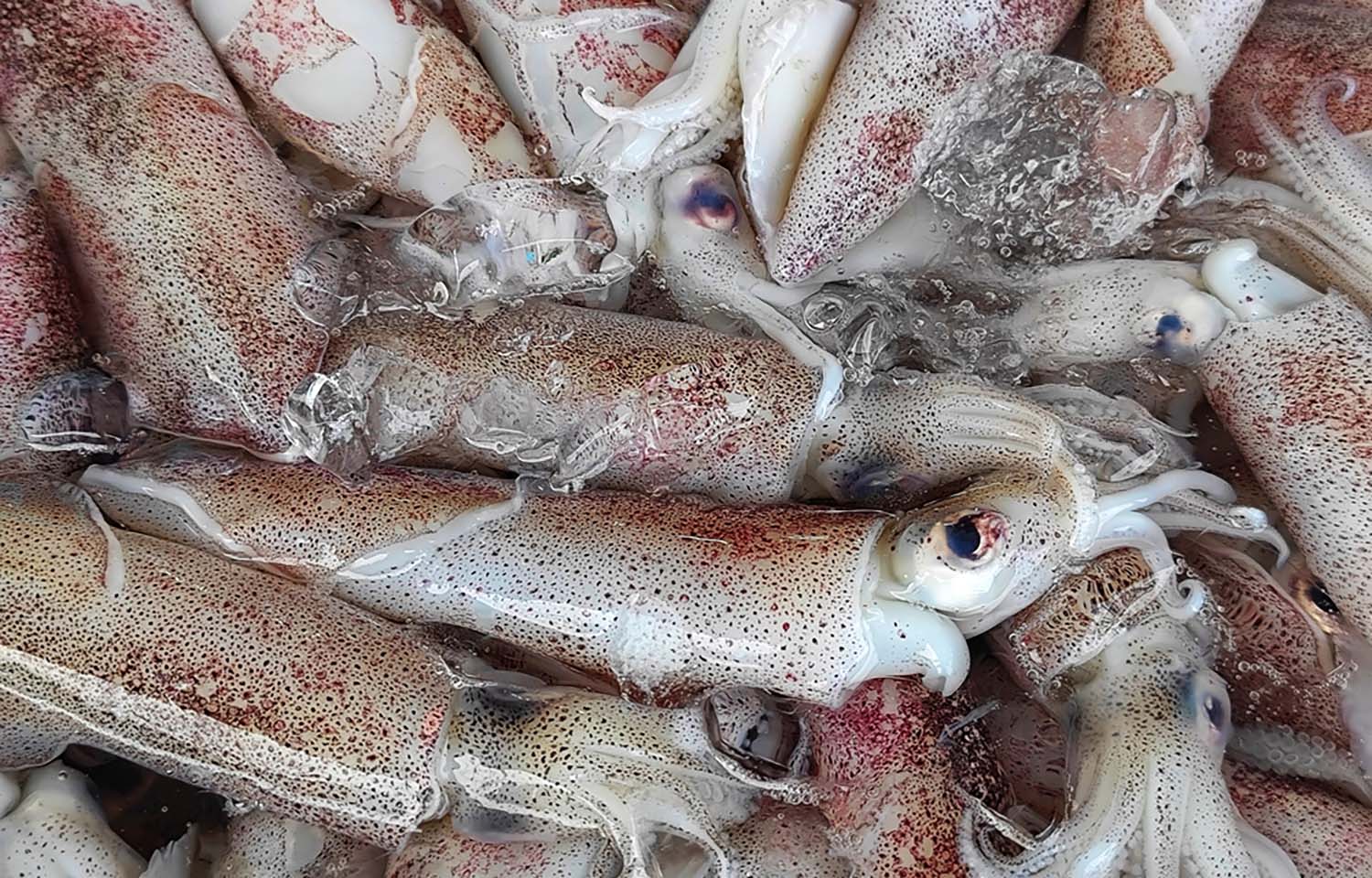
Chinese fishery officials have developed a proposal for establishing better cooperation with South American nations to more effectively manage global squid resources.
The proposal, dubbed the “Shanghai Proposal for the Sustainable Development of Global Squid Fisheries,” aims to provide “a basis for formulating scientific and reasonable resource management measures” and “avoid overfishing of squid resources,” according to the document.
Squid is the top species by catch volume for China’s distant-water fleet, and the country has announced other conservation measures for the lucrative cephalopod in the past, including in 2020 and 2022, when it introduced moratoriums on fishing by its fleet in the North Indian Ocean and in parts of the Southwest Atlantic Ocean.
Sun Haiwen, the deputy head of China’s Fisheries Administration, said that the new proposal, as well as past measures the nation has made to monitor its fleet, “reflects China's open and transparent development of distant-water fisheries.”
The moratoriums, however, were criticized by NGOs such as Oceana at the time as being performative rather than effective. Milko Schvartzman, an ocean policy coordinator at Argentinian environmental NGO Circulo de Politicas Ambientales, agreed and said that the new proposal is just the latest such “insult to common sense” that China has perpetrated.
"I analyzed the official documents,” Schvartzman said of the moratoriums instituted in years past. “It was a closure in areas where there is no squid fishing and during the offseason period. As I used to say, ‘It was like banning fishing on the moon.’”
Instead of performative measures like announcing collaboration with China, Schvartzman wants Argentina to take more concrete measures, like ratifying the High Seas Treaty, which is the result of a deal that was finalized in March 2023 after nearly 20 years of United Nations-facilitated talks. The treaty first opened for ratification in September 2023 and requires at least 60 countries to ratify the agreement in order to enter into force.
Schvartzman also wants Argentina to ratify the Cape Town Agreement, a deal negotiated by the International Maritime Organization (IMO) to set minimum safety and communications requirements for fishing vessels of 24 meters in length.
Daniel Voces, the CEO of European fisheries trade body Europêche, has also been skeptical of China’s announced measures to rein in its fleet.
“China operates the world’s largest distant-water fleet, with many vessels fishing under minimal or no oversight, transhipping catches at sea and repeatedly accused of human rights violations,” he told SeafoodSource earlier this year. “Under these circumstances, terms like fair competition, traceability, and sustainability lose all meaning.”
Voces wants the E.U. to increase scrutiny on imports of Chinese squid and tuna while ensuring that “any tariff concessions are conditional on robust sustainability and traceability criteria.”
For Latin America, though, Schvartzman said it’s a bigger uphill climb to scrutinize China publicly, explaining that China’s economic footprint in Latin America “limits the ability to criticize China and the ability for regional governments to defend their countries’ interests.”
“We have a [long history] of Chinese embassies pushing and pressuring foreign affairs agencies – publicly with the media, using social networks, and in closed meetings with officials. China exerts strong pressure on most government areas, and our economic dependence is [a source of] of leverage,” he said. “I think this can change by us having more skilled representatives or government officials and stronger civil society and journalism to disclose the reality, as is the case with IUU fishing.”
