






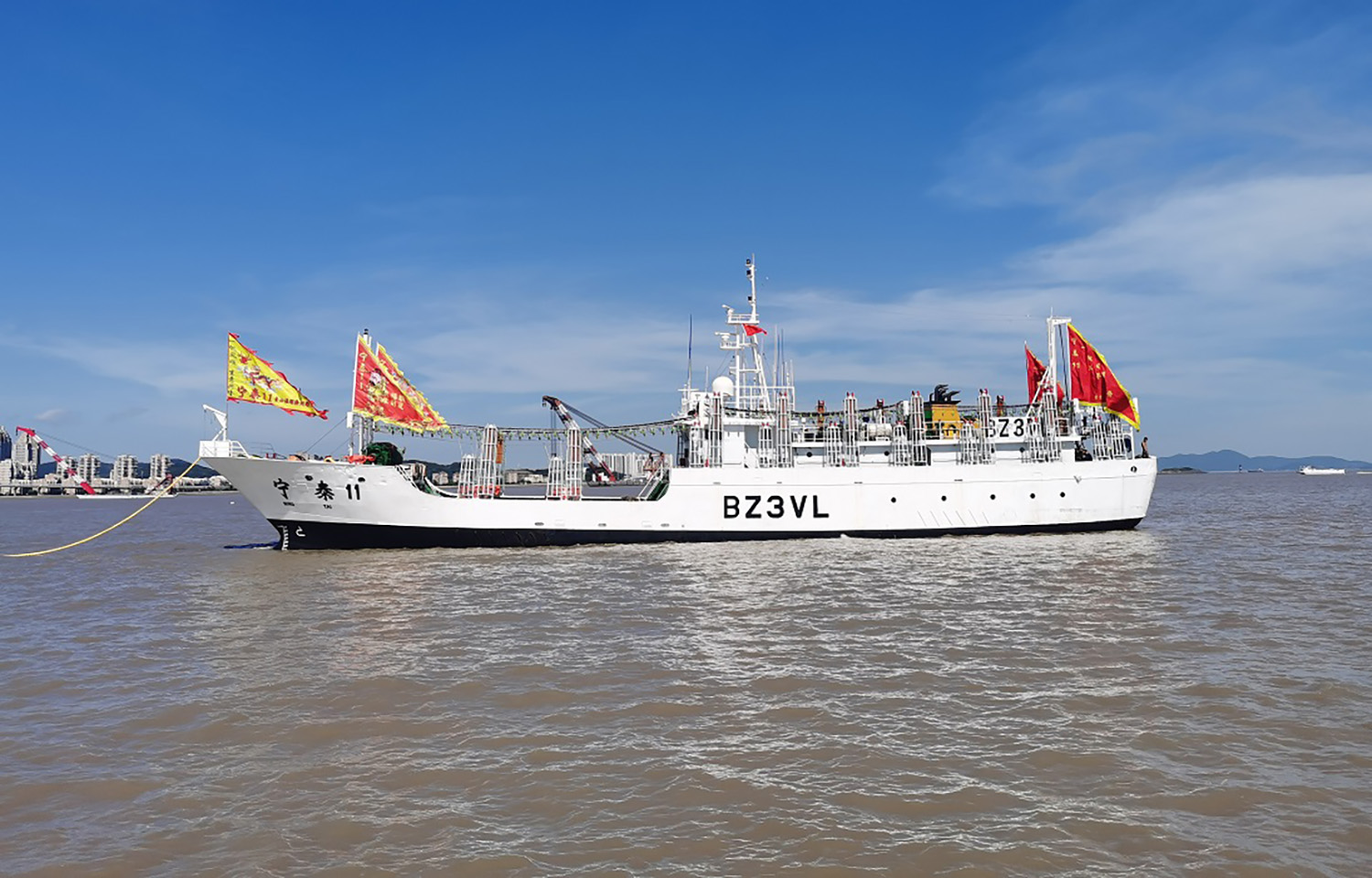
Chinese squid-fishing companies have been stepping up efforts to secure a bigger share of the E.U. market.
Multiple Chinese companies, along with officials from municipal governments, said that they can sell more squid to the E.U. by getting more Chinese vessels to meet requirements for E.U. import registration. The requirements would also would elicit the benefits of catching more squid, achieving higher prices for it, and modernizing the Chinese fleet, according to the government-run Qianjiang Evening News.
“There is a premium of CNY 300 [USD 41, EUR 40] to CNY 500 [USD 68, EUR 67] per ton in profit for squid caught by E.U.-registered vessels,” said representatives from Zhoushan Ningtai Ocean Fishery Co., a major Chinese squid-fishing firm, according to Qianjiang Evening News.
Adherence to E.U. requirements entails vessels to meet rigorous standards concerning equipment, onboard processing facilities, worker living conditions, and vessel safety, according to the Qianjiang Evening News.
Three vessels owned by Zhoushan Ningtai – Ningtai 12, Ningtai 22, and Ningtai 89 – were listed recently on the European Commission's Directorate-General for Health and Food Safety as being permitted to ship to the E.U. market, and the company is aiming to get more vessels registered.
Processing companies back in China are trying to find a way to benefit from an increased catch from the nation’s distant-water fleet. The municipal government in Zhoushan, a major squid-processing hub where Zhoushan Ningtai is also based, has offered subsidies to fishing companies that transport their catch home for processing, rather than abroad to markets like the E.U.
So long as the Chinese fleet is sending its products to Europe for processing, though, E.U. processors stand to benefit from an increased number of Chinese vessels registered to import into the bloc.
The E.U. Fish Processors and Traders Association and the European Federation of National Organizations of Importers and Exporters of Fish (AIPCE-CEP) have called imports “the lifeblood of the [E.U. seafood-processing] industry for many years.”
“The utilization of various species and the complementing of domestic and external supplies have allowed the sector to maintain and increase its relevance across all member states,” it said.
E.U. fishers, on the other hand, have complained that the bloc’s current E.U. autonomous tariff quota (ATQ) import system, through which seafood caught by countries like China pass, deprioritizes their catch in their own domestic market. They have also stated that it does little to curb fish caught through illegal, unreported, and unregulated (IUU) practices.
“Under the E.U.’s IUU regulation, member states shall refuse the importation of fishery products into the E.U. in cases of noncompliance,” Europêche Managing Director Daniel Voces de Onaíndi told SeafoodSource in a 2023 interview. “However, when compared to the number of imports received annually into member states, the number of refusals is tremendously low.”
Environmentalists, fishery representatives, and policymakers in several countries outside of China have similarly expressed concern about the scale of the Chinese squid fleet – which is the top species of the Chinese distant-water fleet’s annual catch.
“China’s colossal distant-water fleet is monopolizing the world’s oceans,” Oceana Campaign Director Max Valentine said in early 2024.
Regardless of the backlash, China is aiming to find new ways to prop up its distant-water fleet, and a greater number of vessels registered to import into the E.U., among other initiatives, would be one way to do so.
