

In 1986, Dayseaday Group got its start in a 40-square-meter space as a small seafood company, with founders Henk van Veen and Jelle van Veen hand-filleting products for a small array of customers.
Forty years later, the Urk, Netherlands-based business is expanding its existing space by thousands of square meters as demand for its products outstripped its ability to provide them.
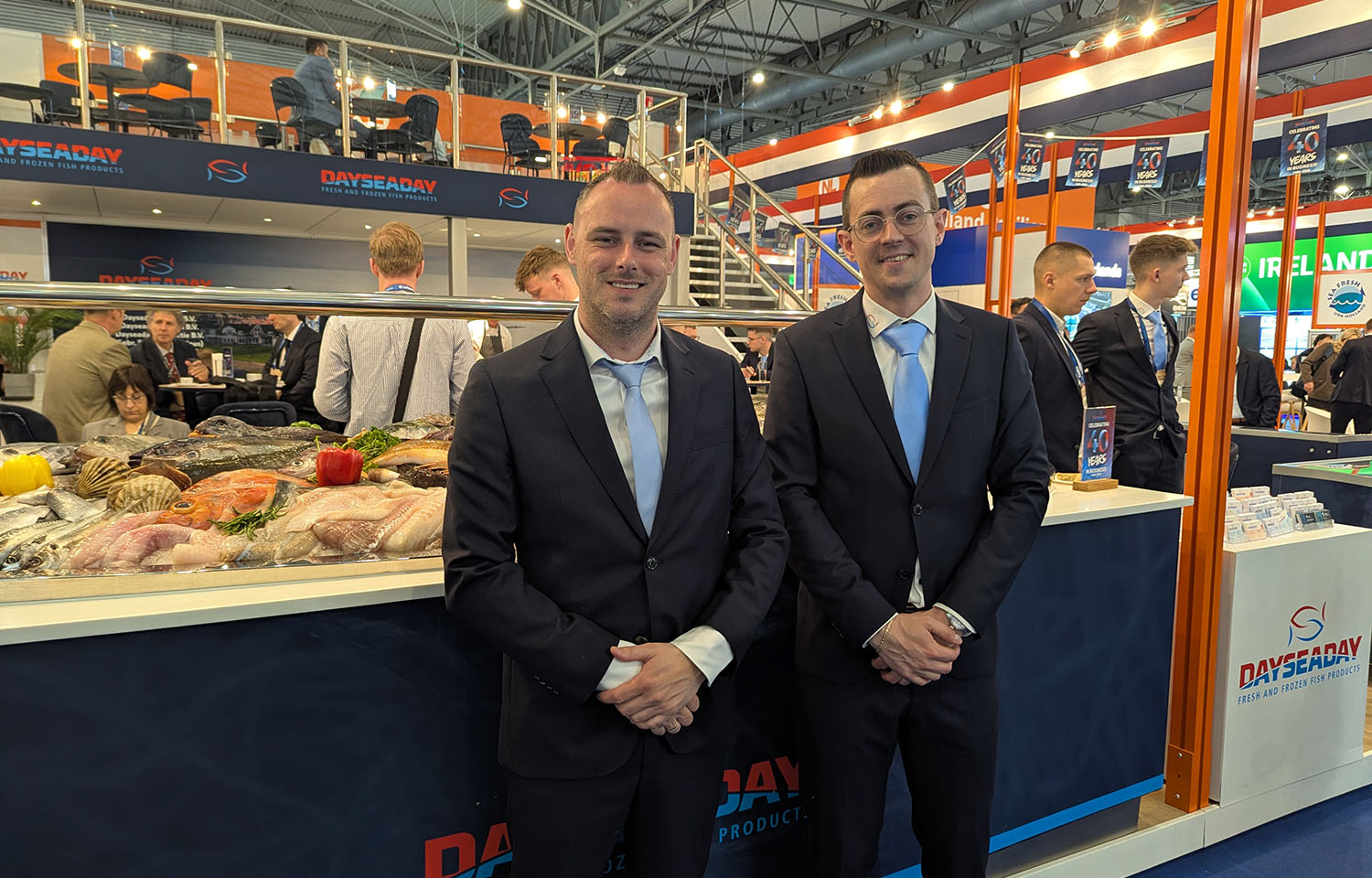
“We kept on growing and growing, and now the company has 250 employees,” Klaas van Veen, the son of the company's founder, told SeafoodSource during Seafood Expo Global, which is running from 21 to 23 April in Barcelona, Spain.
Dayseaday Group supplies both fresh and frozen seafood to its customers, with a focus on Europe. The company processes its goods in its facilities, producing fresh salmon fillets, frozen black tiger shrimp, and a range of other products and species.
Hendrik van Veen, who is also part of the family ownership of Dayseaday, told SeafoodSource seventy percent of its fresh sales come from its salmon, with a large portion of its sales heading to Europe.
“In Baltic countries, we are also very strong in frozen seafood,” Hendrik said.
Dayseaday purchases most of its fresh salmon products from Norway and imports frozen products mainly from Asia, selling them to wholesale clients throughout Europe and with growing distribution to the Middle East.
Hendrik said one of the strengths of the company is the diversity of products it offers. It can sell shrimp, salmon, mackerel, and more to customers who want it, serving as a one-stop-shop for their needs. It recently acquired a meat company as well, allowing customers more variety and giving them the ability to buy everything they need in one transaction.
That ability to offer a diverse array of products, and the fact it is still family owned, is part of the secret of Dayseaday Group’s success, both Klaas and Hendrik said. Over the years, the companies it provides seafood to have grown alongside it, starting small just like Dayseaday did and gradually becoming a major customer.
“We have clients who, when they started, came to buy only one box of each product they wanted every week,” Klaas said. “Now, he buys pallets.”
Not all of the company’s growth has been entirely organic. Dayseaday Group has also expanded to new areas of Europe through the acquisition of other companies, such as a Romania-based Oceania in 2012. It also acquired 50 percent of PetsFish earlier this year, expanding its product offerings.
However, Hendrik said acquiring those companies is never a main goal, and most of its acquisitions resulted naturally from long-term relationships.
“It’s not our goal to take over all the small companies,” Hendrik said.
Klaas said the Romanian company is a great example – it was at one time a client of Dayseaday and ran into issues that resulted in them struggling.
“We said ‘okay, how can we solve this?’” Klaas said.
The acquisition was a way to ensure its long time client stayed in business, while also expanding the offering that Dayseaday could offer.
Hendrik said Dayseaday’s acquisitions, when they come, are largely opportunities that result naturally from its long-term relationships with its clients – opportunities that would be more difficult to capitalize on if they weren’t still family owned.
While the acquisitions are largely through happenstance, expanding its facilities is a deliberate move that was necessitated by the strong demand the company has been seeing for its fresh and frozen products.
“It’s incredible, we’ve worked the past few years with double shifts at our existing facility, but we decided we needed to expand because business is crazy,” Klaas said.
Klaas said Dayseaday acquired a different company’s facility and actively started expanding it just two weeks before Seafood Expo Global.
“It’s almost three times bigger than the old one,” he said.
The space will allow it to go back to a more regular production schedule, and it is also allowing it to expand its blast freezing capabilities. Some of the company’s products, like squid, have a short season that requires the company to be able to store supplies for its year-round customers.
“When the season comes at the end of the year, we have a lot of blast freezing production to do, but we cannot handle it, so we are hiring other companies to blast freeze for us because of the volume,” Hendrik said.
The company also has plans to increase the size of a cold storage facility in the port of Urk, which is also a response to growth in its customer base.
Looking forward, both Klaas and Hendrik said the companies goals for the next 40 years are much like they have been for the previous 40: Steady organic growth alongside its loyal customer base.
“In all those 40 years, we have had a very stable client base,” Hendrik said. “Because we keep trusting in them, even when things are tough and they need to pay a little bit later – which is something you can do as a family-owned company.”
