


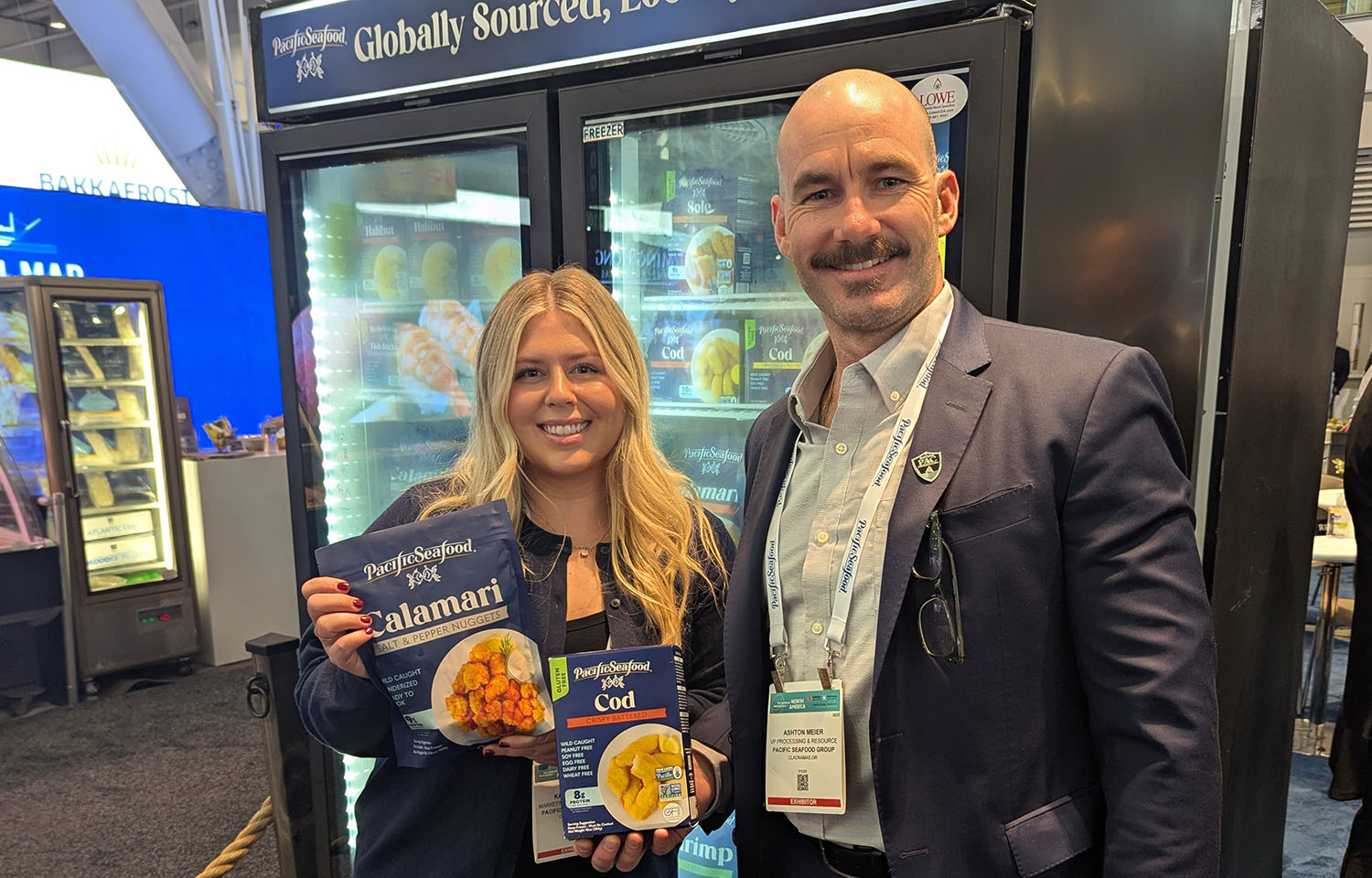
Pacific Seafood debuted a brand refresh at the 2025 Seafood Expo North America (SENA) as the company continues to focus on its initiative to double the size of its business by 2031.
The initiative, which Pacific dubbed “Mission 31,” was launched last year by its executive team to continue driving its growth. In 2024, the company created operating teams with the specific skill sets needed to achieve its growth mission, Pacific Seafood Vice President of Resource Sales and Processing Ashton Meier told SeafoodSource.
“We hit the ground running at the end of 2024,” Meier said. “We have essentially three operating divisions inside Pacific Seafood now.”
Meier said the processing division of Pacific Seafood has different aspirations from some of the other divisions, and in 2025 and 2026, it will be focused on investing in its team members and creating a platform for growth on skill development and for attracting new talent.
“It’s something that I really think is a highlight for Pacific Seafood and is [the result of] the investment that we’ve done in our culture over the years,” Meier said.
Meier said the company sees big opportunities within the current marketplace, especially amid increasing consolidation. Its recent acquisition of Trident Seafoods’ Kodiak, Alaska-based processing facility was one of those opportunities, and according to Meier, it gives the company growth opportunities immediately.
He acknowledged that acquiring more processing capacity in Alaska amid a period of struggle for the state's industry is a “bold move.”
“It’s not secret to most that the seafood industry in Alaska has had a couple of bad years,” Meier said. “It’s not easy, and right now with all the turmoil around tariffs, some challenges on the sales side and the markets, and suppressed pricing that we’re experiencing now, it’s not a great time. But, at the same time, we have to figure out how we use this as an opportunity to be better, to get leaner, to get more automated in our processes, and essentially get more efficient.”
Meier said the downturn will not last forever, and doubling down on added capacity and efficiency will allow Pacific Seafood to capitalize when the good times come.
“We’re focusing on what we can control right now – our culture, our people, and our efficiency,” he said.
The good news for Pacific Seafood is that in the first three months of ownership of the plant, it has already found some success.
“I’m very proud of our team, and it was a very diverse team from government affairs to marketing right through the supply chain through all aspects of our business. They managed to complete an acquisition at the end of December and were operational by the first week of January,” Meier said. “It’s a monumental task; we had to stand up a whole shop floor, processing flow, and it was all done incredibly well and we didn’t skip a beat. We’re processing at historic highs of capacity and production.”
The company also has eyes on future opportunities, but Meier said the core focus is on the company’s people and communities.
Alongside the push to expand Pacific’s processing capacity, it is also working to expand the reach of its products through a brand refresh.
At this year's SENA, the company unveiled the new design of its products, which Pacific Seafood Marketing Brand Manager Kady Freeze told SeafoodSource is a key part of the Mission 31 initiative.
Freeze said the company’s existing branding was a great model for the industry when it was developed, but trends and consumer preferences have evolved – and Pacific Seafood needed to evolve with them.
“We wanted to make sure that we were staying adept with market trends and aligning with consumers,” Freeze said.
The company also wanted to make sure that its branding aligned with what retailers wanted – which is why it worked directly with retailers that carry its products to see what was working and what would help ensure Pacific Seafood products got space on store shelves.
“We started connecting with the retailers firsthand. We got them up to speed on this change coming because we really wanted their buy-in from the start; we wanted them to feel like they were a part of this decision with us,” Freeze said. “We wanted to make sure that as we were bringing it to them, it was something that was going to work for them.”
Freeze said the company’s new branding went with a cleaner, more modern look with blue matte packaging.
“It’s bright; it pops out in the seafood case,” Freeze said.
It also features the phrase “serving the ocean since 1941” across all packaging.
“That was something that retailers specifically called out as giving us credibility,” Freeze said. “You tie that with the new look and feel, and it’s a modern approach but we’re also always tying back to our roots.”
Another goal of the new packaging is simplifying the process of buying and eating seafood for consumers. The packages all feature QR codes so that consumers can scan and obtain recipes quickly, and the company standardized the thawing, prepping, and cooking process across all of its retail items.
“If you pick up a piece of Pacific Seafood, you have an idea of the procedure to cook it,” Freeze said. “It’s a standard they can expect. With Pacific Seafood, we’re making it as approachable and easy for them as possible.”
The new packaging is currently hitting markets across the U.S., and Freeze said the company has over 200 items that will be transitioning and coming to market in 2025.
“We’ve had retailers asking to get it in ASAP because they love the new packaging, which is great,” Freeze said.
