






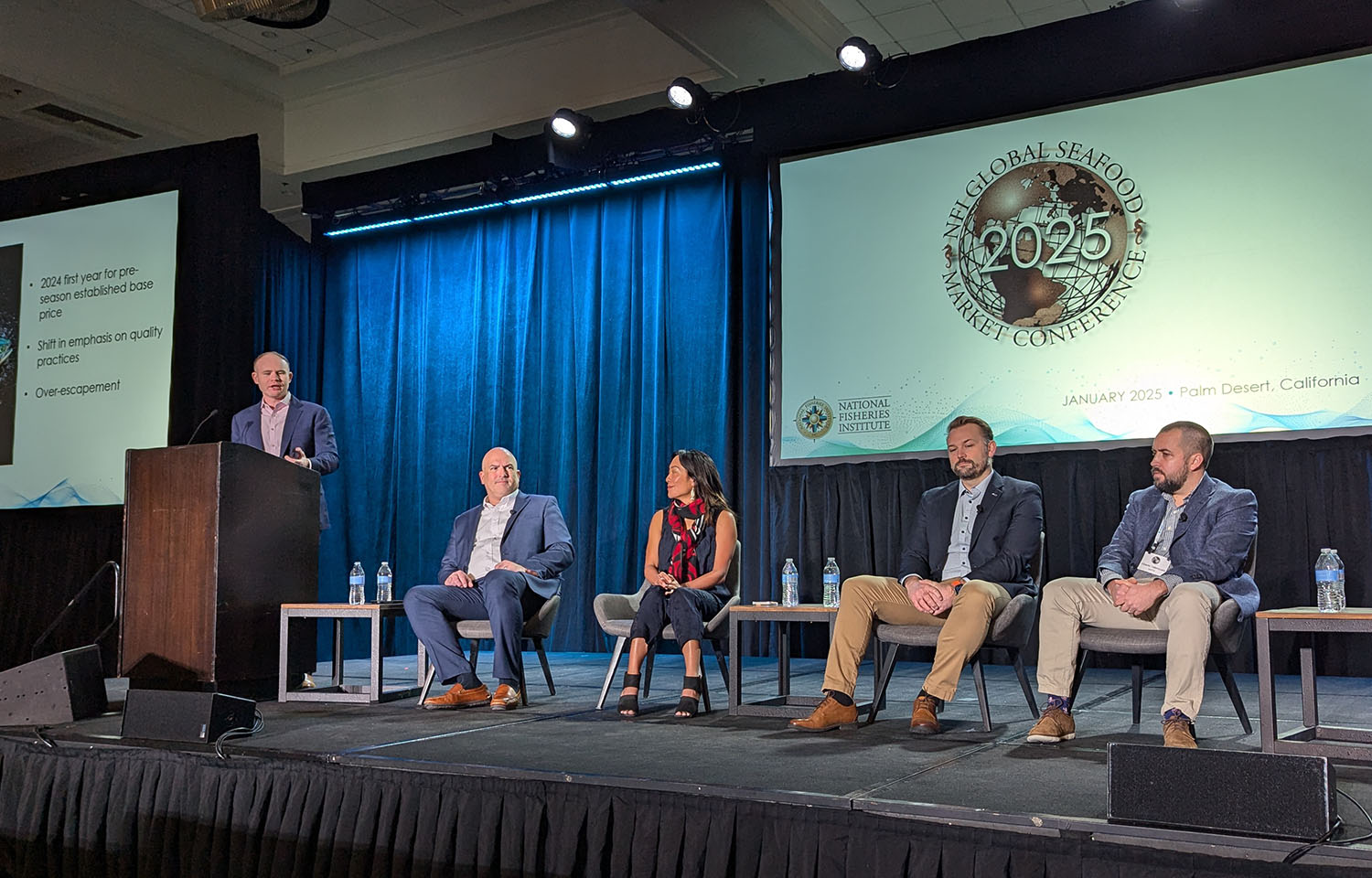
With the current projected catch of sockeye salmon indicating a lower supply in 2025 and an odd-numbered year bringing increases in the supply of pink and keta salmon, multiple companies are working to bring more attention to underutilized salmon species.
Bristol Bay Regional Seafood Development Association Executive Director Lilani Dunn, speaking at the 2025 Global Seafood Market Conference in Palm Desert, California, U.S.A., said the Alaska sockeye fishery will likely see lower volumes in 2025.
“The numbers are a little bit lower in quantity, but in size, they are expected to be bigger – which is great to hear,” Dunn said.
The past year was marked by shortages in wild salmon compared to the demand for the product, with global supplies down 55 percent compared to 2023. The decrease wasn’t entirely unexpected as pink salmon return in two-year cycles on odd-numbered years, but it was still a bigger decrease than it was in years past.
Jason Driskill, the vice president of seafood, sushi, and meal simple for H-E-B, said the decreases in sockeye salmon in particular had the company looking for other offerings for its customers.
“It definitely has an impact since it is a wild species. How do we look at other things that create value to our customers in the same supply chain?” Driskill said. “Sockeye has been a great item for us, but are there things we can do to bring good-quality keta and good-quality pink salmon to the market?”
Driskill said there are customers who frequently will prefer a wild species over a farmed one, and having alternative species to offer that are wild can help keep those customers purchasing salmon.
Dunn said there are companies – such as Circle Seafoods, which recently debuted a wild pink salmon in stores – are helping push those new products. According to Dunn, the average consumer of salmon frequently doesn’t know the difference between most species of salmon and is more likely to differentiate between wild and farmed than pink and sockeye.
“I want to applaud Circle Seafoods for what they’re doing for Alaska pink salmon. I know in our industry here, we have preconceived notions toward different species within the wild salmon category – consumers don’t always know if we’re all being honest,” Dunn said.
Circle Seafoods’ focus on producing a quality pink salmon product – that also happens to have an attractive price point – can help bring consumers into the salmon category.
“This is something I’m very excited about,” Driskill said.
H-E-B doesn’t sell a twice-frozen product, so having a once-frozen product that is caught and processed in Alaska and brought closer to the market is appealing, according to Driskill.
“The value proposition is a good price, great quality, and that’s something we would want to stand behind,” Driskill said. “This is something that’s very exciting, and I think it’s really bringing ketas and pinks to the market in a very pristine way. That is going to be great for expanding our customer base.”
