






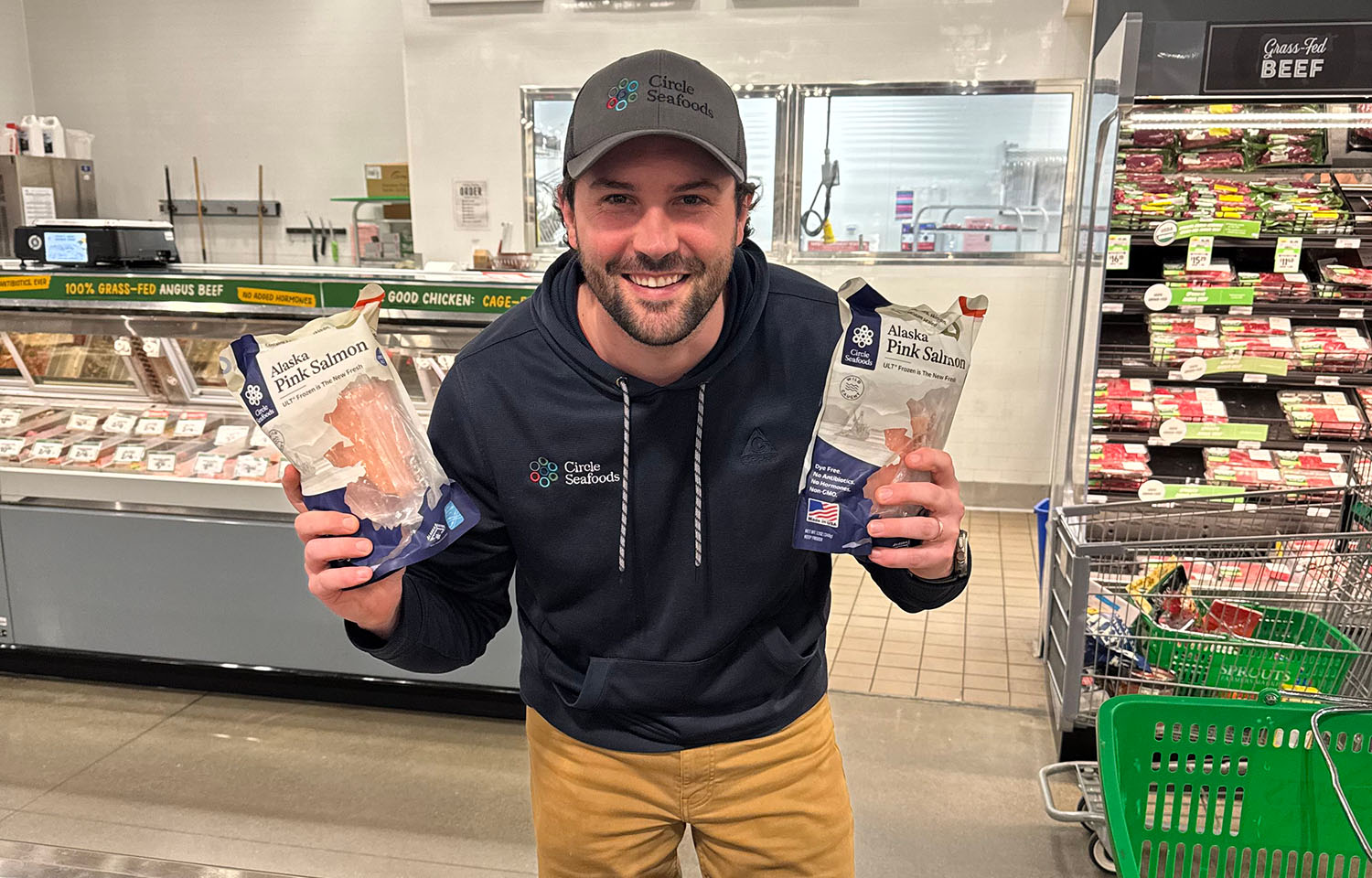
With the debut of its new Frozen Alaska Pink Salmon Fillets, Wild Alaska salmon processor Circle Seafoods is betting big on the “underdog” of the salmon world.
The company, which is working on a barge that will process and freeze salmon, is currently still working on getting that facility operational. In the meantime, Circle Seafoods Co-Founder Eren Shultz told SeafoodSource the company is using the Annette Island Packing Company facility to prove its processing methodology will produce a superior product at an affordable price.
Circle Seafoods, founded in 2022, aims to eventually build and operate a mobile barge where the company buys salmon direct from fishermen and freezes it on the water soon after they are caught. The idea is to buy and freeze millions of pounds of salmon, which the company can then process later on demand for companies to deliver a better-quality product.
Shultz said the original plan was to have the barge completed already – but the company decided to partner with the Metlakatla Indian Community at its Annette Island Packing Plant to build up the operational experience first.
“Could we get this barge done? Yes, but everything would need to go perfectly in order to get it done. We were a startup that was also doing a construction project. Neither of those two things have very good associations with ‘perfect,’” Shultz said.
Shultz said Pat Glaab – the company’s CEO – has done a lot of construction projects and recognized the challenges in getting a full processing facility on a barge ready and operational in a short amount of time.
“So we said, ‘Well, there’s this opportunity here that allows us to walk before we run and get a little product on the market,’” Shultz said.
The Annette Island facility would allow them to accomplish some of its core goals before having the full facility online – including buying fish and developing relationships with fishermen to build their trust in the company’s ability to make sure they get paid.
Another benefit of starting on an existing facility was building operational experience that can be transitioned over to the barge facility when it's complete – which was part of what the company did in the summer of 2024 as it prepared to launch its new pink salmon product.
“Hindsight is always 2020, but I think that everything happens for a reason, and we are in a much better position because we were able to do all of our three core things – buy fish, freeze fish, and then sell fish – to establish relationships with customers,” Shultz said.
As it developed the operational expertise through running a processing facility, it was building and completing its first barge – which should be ready for the 2025 salmon season. Having a mobile facility will allow Circle Seafoods to travel where the fish are, and so far, the business model is working.
“Obviously, past performance is not indicative of future results,” Shultz said. “But, we were able to pay very favorable prices to our pink [salmon] fishermen, and that’s really because we’ve been able to access what I would call a new part of the market, which is affordably priced, reliable quality, wild salmon. Pinks can really open that up if it’s properly taken care of.”
The success was great enough that Circle Seafoods has already purchased a second barge platform, and the company is already working to build it out. The first barge will operate in Southeast Alaska at the beginning of the 2025 salmon season – and the company will continue to operate the Metlakatla Indian Community facility with the barge alongside it.
Pink salmon was a deliberate choice on Circle Seafoods’ part due to its reputation as a lower-quality or less desirable species. Shultz said the product Circle Seafoods is delivering is not low quality and provides a wild alternative for customers looking for it at a more reasonable price.
“The idea was to find a universe of buyers who were excited about what we’re doing and where there was a product-market fit,” he said.
Shultz said developing its own branded product was a side effect of Circle Seafoods' methods. Initially, the company was trying to sell whole round fish – which he said have traditionally been looked down upon because that product type can have potential issues if improperly frozen.
“When we went out with the round product, people said, ‘I can’t pay that for a round product,’ so I said, ‘What will enable you to pay that for a round product?’” Shultz said.
The answer was having an end market – which is why Circle Seafood decided to create the end market itself by launching its product.
“That’s why we went into branded seafood, to be able to say, ‘Look, it is better, and there’s more potential here,’” Shultz said. “So, that’s where we are, and it’s selling very well.”
The new pink salmon product has already been shipped to multiple states, over 800 retail stores, and 11 countries.
Shultz said the support of the Alaska Seafood Marketing Institute (ASMI) has helped get additional attention to Circle Seafoods’ efforts, He also said Circle Seafoods is committed to making the business model work as a means of improving the industry in Alaska – and other members of the industry in Alaska have been backing up their goal.
“It’s such a collaborative group – ASMI, BBRSDA [Bristol Bay Regional Seafood Development Association] – all hands, people are really pulling together,” Shultz said.
