



The Newfoundland and Labrador Fish, Food, and Allied Workers Union (FFAW) Inshore Council has unanimously condemned Canada’s use of marine protected areas (MPAs), refuges, national marine conservation areas, and other area restrictions that it says unfairly limit the fishing industry.
“We demand that Prime Minister Mark Carney, [Fisheries] Minister Joanne Thompson, and [Canadian Identity and Culture] Minister Steven Guilbeault immediately dismantle these baseless closures and abandon all plans for new ones. These policies are a deliberate betrayal of our fish harvesters, wrecking livelihoods while masquerading as conservation,” FFAW Vice President Jason Sullivan said in a release. “The federal government’s obsession with these closures is a disgrace, prioritizing hollow environmental optics over the survival of our communities.”
Canada has been advancing plans to establish large MPAs off of both its Pacific and Atlantic coasts, building on existing protected areas. The push for new MPAs is in part due to Canada’s commitment to the “30x30” metric, in which a number of countries have committed to placing 30 percent of lands and oceans under protection by 2030.
The provincial government of British Columbia and the Canadian Department of Fisheries and Oceans (DFO) endorsed a conservation area in 2023, a move that the Underwater Harvesters Association (UHA) said would close nearly 40 percent of their fishing grounds. The final zoning of that project is still being worked on, but UHA Executive Director Grant Dovey told SeafoodSource during the 2025 Seafood Expo North America the impacts “could be devastating.”
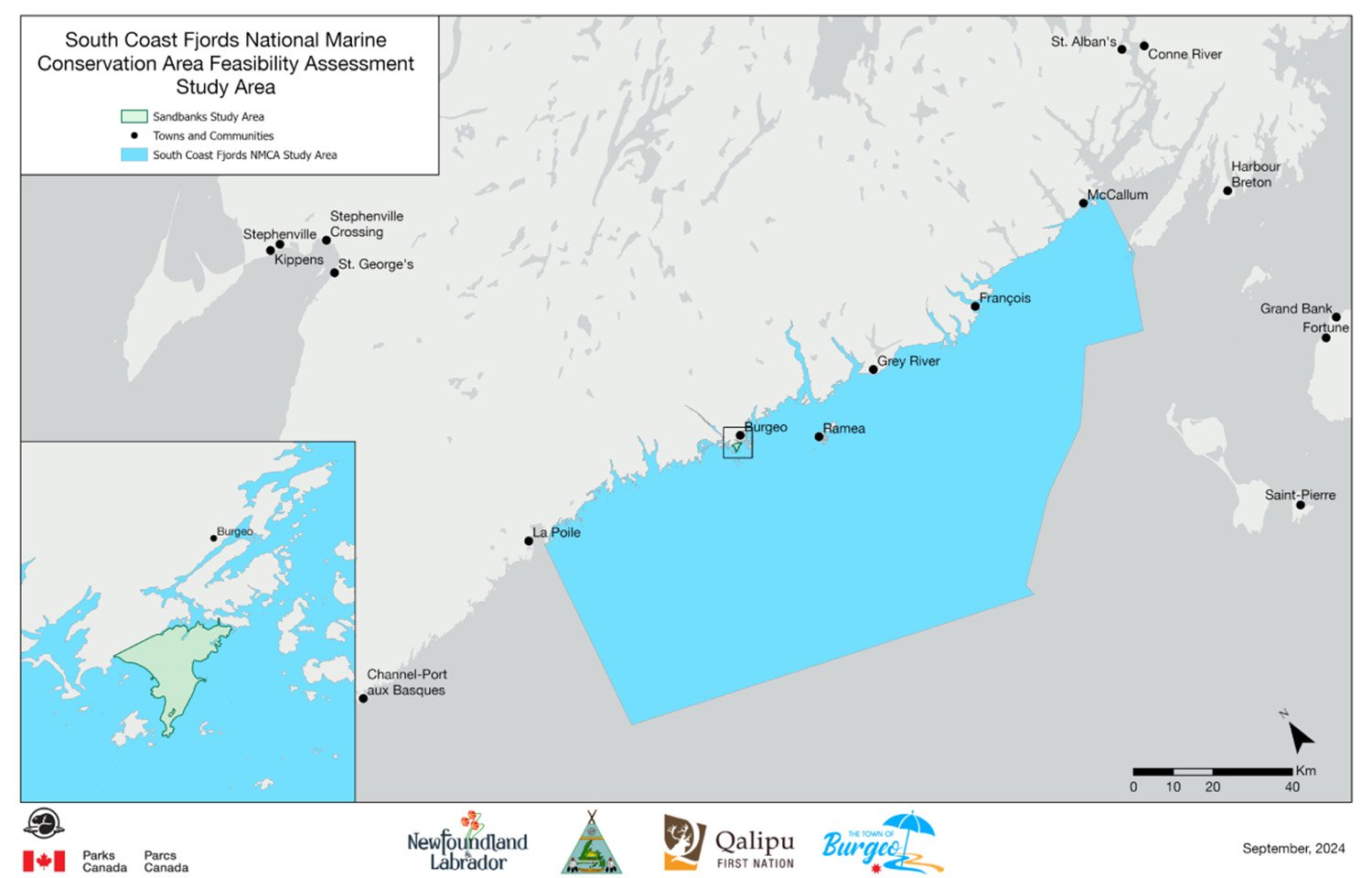
In Newfoundland, Canada’s federal government is examining similar proposals for MPAs that could close fishing and aquaculture activity. One proposal, located in the South Coast Fjords area of the province, would cover 6,538 square kilometers and has already seen opposition from the province’s aquaculture industry.
Another, the Torngat Marine Protected Area, could cover as much as 17,000 square kilometers and is currently in the negotiation stage to establish boundaries.
The FFAW said MPAs and other areas like them are targeting the fishing industry, despite its track record of sustainability.
“For years, our province’s fisheries have been unfairly targeted by meaningless conservation targets. Our fisheries are already managed sustainably in collaboration with harvesters and DFO,” FFAW President Dwan Street said. “Alarmingly, these MPAs and refuges exclude fish harvesters, while energy and industrial activities are allowed to persist.”
Street said the FFAW and the fishing industry have also been given “no evidence” that the MPAs and closures are helping the country achieve conservation goals or benefitting ocean life in a way that makes the fishing closure justified.
“The only thing these restrictions seem to accomplish is the unfair exclusion of the owner-operator fishery,” Street said.
Whether an MPA benefits marine life, or has knock-on economic benefits for nearby fisheries, is still being debated.
Some papers suggest MPAs have an overall economic benefit for fisheries located near the restrictions, and other studies found MPAs could be key to marine species recovery or claim links between protecting key ocean areas and fighting against climate change and preserving biodiversity.
However, University of Washington Professor of Aquatic and Fishery Sciences Ray Hilborn has long argued those studies are frequently flawed and make assumptions that lead to the wrong conclusions.
“Fundamentally, all MPAs are doing is regulating fishing and maybe oil exploration and mining,” Hilborn said in 2021. “It’s just the wrong tool. The illusion that you’re protecting the ocean by putting in MPAs is a big lie.”
Hilborn has continued to make that argument, asserting that properly regulated fishing with the right gear types is not detrimental to the environment.
The FFAW said harvesters are becoming frustrated with a lack of any measurement of the conservation impacts of the existing MPA closures, specifically citing the example of the Funk Island Deep Closure – a 7,274-square-kilometer MPA in the Atlantic Ocean intended to protect bottom habitat for Atlantic cod.
“In the years since its enactment, it has had devastating unintended consequences, as the area has become overrun by predators of snow crab, further disrupting the ecosystem,” FFAW said. “Such outcomes clearly contradict the principles of sustainable management and marine conservation that these closures claim to uphold.”
FFAW said fish harvesters have actively participated in efforts to contribute to sustainability but continue to be punished by marine closures with unclear benefits.
“From DFO to Parks Canada to the environmental NGOs that are angling to eliminate our fishing industry without scientific basis, the pervasiveness of these so-called conservation efforts are causing significant harm to our sustainable fishing industry,” FFAW Secretary-Treasurer Jamie Baker said. “This is the industry that sustains rural Newfoundland and Labrador, and our federal government must take a hard look at what these closures have achieved and what harm they’ve caused.”
