


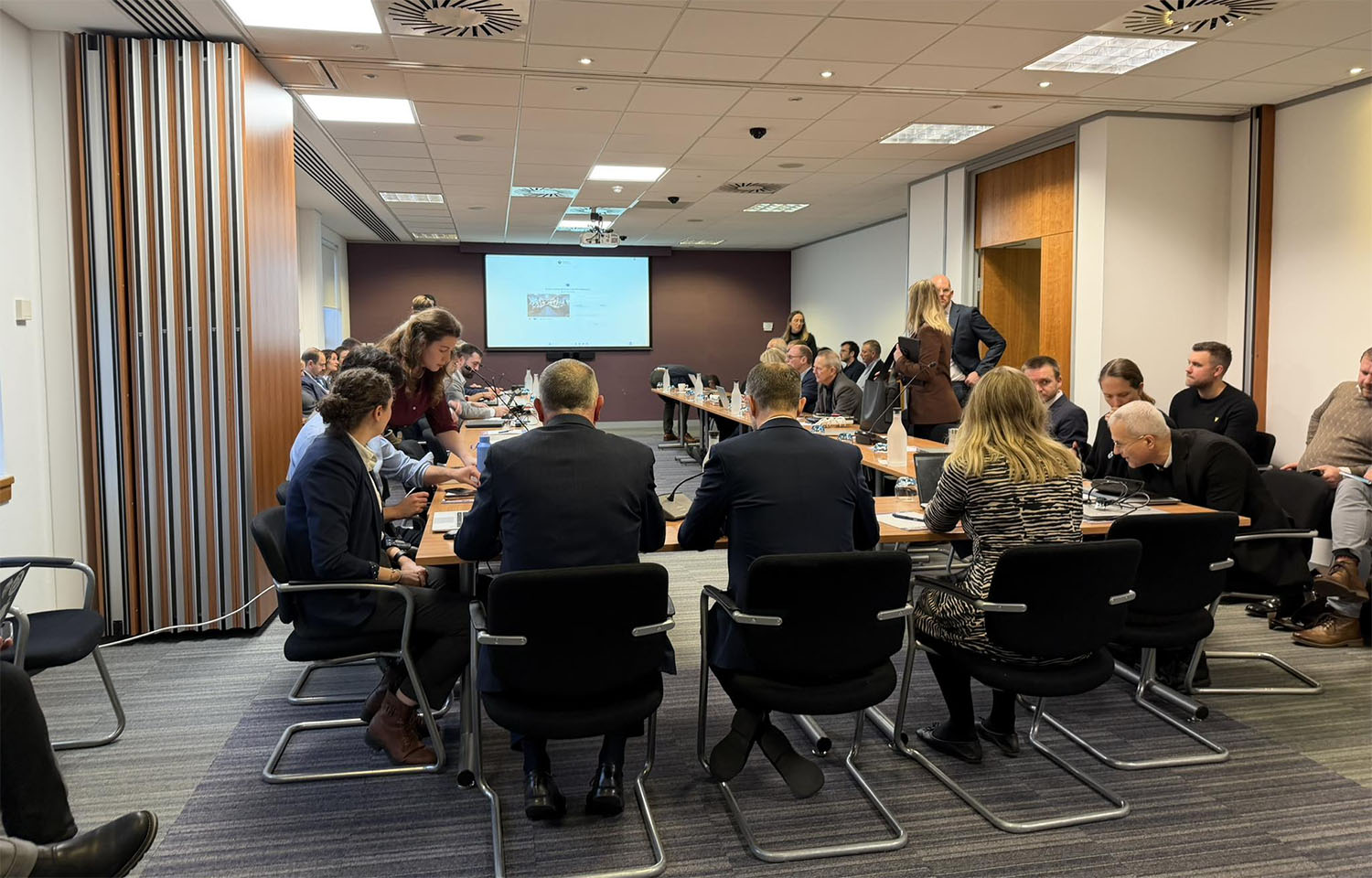
Norway, the European Union, and the United Kingdom have agreed to quotas on jointly managed stocks in the North Sea and have chosen to preserve a fishery for cod despite International Council for the Exploration of the Seas (ICES) advice.
ICES recommended no cod catch at all in 2026, finding that any harvesting of the southern substock of cod would result in it dipping below biomass limits. It said 1,280 metric tons (MT) of the other two substocks could be fished sustainably, but the risk of overfishing the southern substock led it to recommend no catch at all.
That news was met with heavy skepticism from the fishing industry relying on the stocks, who said a complete closure of the fishery would deal a devastating blow to the industry. Groups like the Shetland Fishermen’s Association (SFA) said the move would be “fleet-ending madness.”
“Governments cannot expect fishing businesses, surrounded by cod, to tie up for a year and still be here in 2027,” SFA Chair James Anderson said in a release after the ICES advice was published.
According to the Norwegian Ministry of Trade, Industry, and Fisheries, that result has ultimately been avoided as the three member states have agreed to fish cod in 2026. According to the ministry, the parties agreed to a total quota for all areas of 14,034 MT, a 44 percent cut compared to 2025.
That quota includes cod west of Scotland, with the total allocated to the North Sea standing at 11,164 MT and the Norwegian quota of that number standing at 1,898 MT.
“The Parties agree to continue and expand the closure of cod-spawning grounds in 2026,” the ministry said. “The Parties also agree to consider additional measures to strengthen the protection of cod, beyond the already comprehensive measures. This may include other area closures and more selective gear.”
The ministry also said the division of cod into multiple sub-stocks has complicated the management of the species and that work is now being done to assess future management.
SFA Executive Officer Daniel Lawson said that despite the fishery avoiding the worst-case scenario of a total closure, 2026 will still “be a hard year for fishing crews across all fleet sectors.”
"Our internal analysis – shared with governments in advance of negotiations – estimates that the 44 percent cod cut alone will mean losses of GBP 16 million [USD 21.3 million, EUR 18.3 million] for Shetland’s local economy next year,” Lawson said. “Numbers in government spreadsheets have real life consequences. For a population of only 23,000 folk, that economic impact will be felt strongest in communities such as Shetland – with family-owned vessels and shareholder crews.”
Scottish White Fish Producers Association (SWFPA) Chief Executive Mike Park also said 2026 would be challenging but added that “as a responsible industry, we have to recognize the role we play in stock recovery.”
“The outcome takes into consideration the downturn in this stock and the added protection it requires, especially so in the southern component,” Park said.
Alongside the cuts to cod, Norway, E.U., and U.K. officials also agreed to a 20 percent cut to the quota of North Sea herring, setting the quota to 328,566 MT. Other stocks will also be seeing cuts, including saithe which is dropping to 59,662 MT – a drop of 25 percent – and haddock, which is dropping to 108,301 MT – a decrease of 3.7 percent.
The Scottish Fishermen’s Federation (SFF), in a statement sent to SeafoodSource said the year will be difficult but could have been significantly worse.
“We said when ICES published their advice in the autumn that there are problems with how their scientific advice is formulated, and there is work underway seeking to address that. In the meantime, however, we are relieved that negotiators have found a way forward in setting a TAC and agreeing to a series of measures to protect the stock,” SFF Chief Executive Elspeth Macdonald said. "Thanks to the work done by the Scottish and U.K. government negotiators, the outcome on cod, while a significant reduction from this year’s TAC that will inevitably have an impact on the sector, is less damaging than anticipated, with a balance struck between the need to allow the stock to recover, particularly in the southern North Sea, and the sustainability of the fleet.”
