






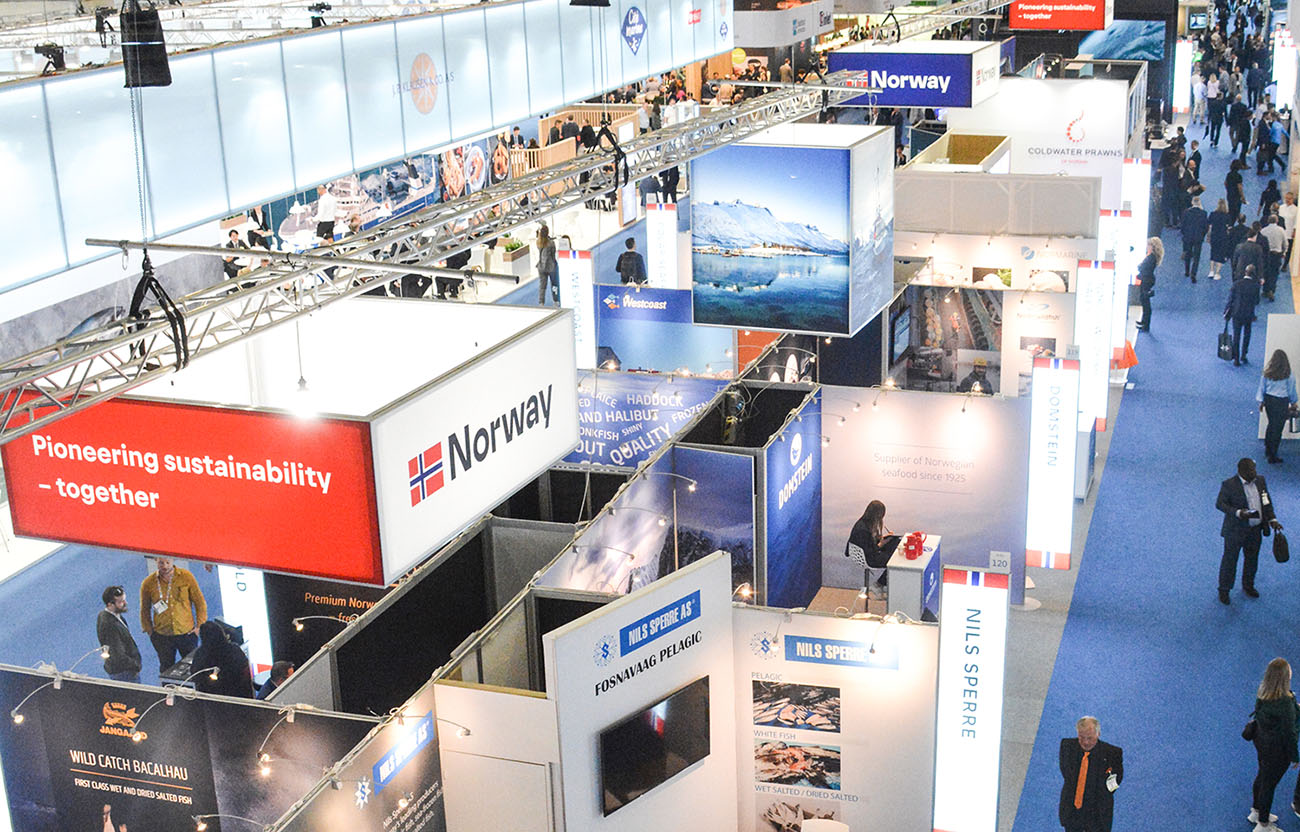
Norway once again posted a record-breaking month in terms of seafood export value in February largely thanks to a big increase in salmon export volume.
Norway exported seafood worth NOK 14.2 billion (USD 1.3 billion, EUR 1.2 billion) in February 2025, an increase of NOK 853 million (USD 78 million, EUR 72 million), or 6 percent, compared to February 2024.
"We have never before experienced such a high export value in the month of February,” Norwegian Seafood Council CEO Christian Chramer said.
According to Chramer, part of that increase is thanks to a weak Norwegian krone, which was similarly a driver of value growth in the start of 2023 and in 2024. The other main driver of the value growth was a big increase in exports to the U.S., which saw its highest-ever export value for the month.
NSC data indicates Norway’s seafood shipments to the U.S. in February 2025 were worth NOK 548 million (USD 50 million, EUR 46 million), or 52 percent, more than they were in February 2024. Total exports to the U.S. were wroth NOK 985 million (USD 90 million, EUR 83 million), made up of shipments of multiple different species.
“February was the best ever month for exports to the U.S. This was primarily due to increased value for salmon, snow crab, king crab, trout and mackerel,” Chramer said.
Chramer also said the big increase in value was largely unrelated to fears related to tariffs on exports. Rather, big increases in salmon exports by both volume and value, and increased harvest volumes of fish sizes preferred in the U.S. market, both provided big boosts to U.S. exports.
Other exports, like king crab, are benefitting from the U.S. having sold all of its domestic catch and Russia remaining sanctioned.
“Norway is now the only supplier of king crab to the U.S.,” NSC said. “This has led to record-high export prices for frozen king crab.”
According to the NSC, 11 percent of all Norwegian seafood products went to the U.S. in February, making it the best month for seafood exports to the country since the 1980s.
While tariff threats weren’t a main driver of value growth, Chramer said they still have an impact.
"There is still a great deal of uncertainty surrounding the introduction of customs barriers. Together with the Norwegian authorities, we are closely monitoring developments," he said.
Outside the U.S., the other top markets for Norwegian seafood were Poland and Denmark, with the E.U. as a whole taking in 62 percent of all Norwegian exports, and Asia taking in 21 percent.
By species, salmon exports increased in value by NOK 185 million (USD 17 million, EUR 15 million), or 2 percent, in February 2025 to NOK 9.1 billion (USD 833 million, EUR 772 million). By volume, exports reached 89,177 metric tons (MT), an increase of 14 percent.
That increase is largely due to the big increase in shipments to the U.S. Export value to the U.S. increased by NOK 340 million (USD 31 million, EUR 28 million), or 50 percent, in February 2025 compared to February 2024. Volume increased even more, reaching 6,539 MT – 57 percent higher than the same period last year.
NSC Seafood Analyst Paul T. Aandahl attributed the volume growth to better production conditions in Norway.
“Higher sea temperatures and fewer winter ulcers have resulted in increased harvesting volumes and a higher quality of fish compared with February last year,” he said. “This has had a positive effect on exports to overseas markets such as Asia and the U.S.”
While the U.S. boasted the largest increase, China also saw big increases in the month. Exports increased NOK 109 million (USD 10 million, EUR 9.2 million), or 25 percent, by value to China in February 2025, and total salmon exports to China reached NOK 537 million (USD 49 million, EUR 45 million) for the month.
“There is underlying growth in the Chinese market. In addition, Norwegian salmon has gained market share, partly because there is more availability of large salmon from Norway,” NSC Envoy to China Sigmund Bjørgo said.
The next most valuable species in Norway after salmon was Mackerel, in part thanks to a big increase in value for the month. Norway’s mackerel exports were wroth NOK 567 million (USD 52 million, EUR 48 million) in February 2025, an increase of NOK 88 million (USD 8 million, EUR 7.4 million), or 18 percent, compared to February 2024. That big increase was in spite of a volume decrease of 11 percent to 18,067 MT.
NSC attributed the increase to a tight supply of both Atlantic and Pacific mackerel in the main markets – which for Norway were South Korea, Vietnam, and China.
“This is driving prices upwards, and in February the average price for mackerel under 600 grams, which accounts for the vast majority of exports, passed NOK 30 [USD 2.74, EUR 2.54] per kilogram,” NSC Head of Pelagic Species Jan Eirik Johnsen said. “This has never happened before.”
NSC Envoy to Japan Johan Kvalheim said the extremely high prices are starting to pose a challenge in Japan and South Korea, where he said people are worrying the average price is becoming too high for most consumers.
“Not only has the price of imported Norwegian mackerel increased significantly, but local mackerel has increased even more as a result of low catches and small sizes that are not suitable for local consumption,” he said.
The other major pelagic species, herring, also saw big increases in value in February 2025. Norway exported 26,666 MT of the species in the month, worth NOK 504 million (USD 46 million, EUR 42 million) – increases of 44 percent and 56 percent respectively.
“Major contracts were delivered to the German canning industry in February, resulting strong growth in exports to Germany,” Johnsen said. “There was an increase of 533 percent in volume and 564 percent in value compared with February last year.”
The third-most-valuable species for Norway in February 2025 was farmed trout. Norway exported 5,979 MT of trout worth NOK 563 million (USD 51 million, EUR 47 million) in the month, increases of 29 percent and 26 percent respectively. Ukraine, the U.S., and Thailand were the three largest markets for the species, while the largest growth market was Poland.
“The lower price of trout compared with salmon makes it more attractive as a raw material for both smoked and fresh products in Poland,” NSC Seafood Analyst Paul T. Aandahl said.
Norwegian exports of clipfish also saw big growth in February 2025, with the country exporting 7,090 MT worth NOK 520 million (USD 47 million, EUR 44 million), increases of 32 percent and 46 percent, respectively. Portugal, the Dominican Republic, and Brazil were the three largest markets for the month.
Fresh cod, meanwhile, defied the positive trends of most other species. Norway exported 4,815 MT of fresh cod in February 2025, a drop of 35 percent. Value dropped slightly less, falling NOK 65 million (USD 6 million, EUR 5.5 million), or 14 percent, to NOK 398 million (USD 36 million, EUR 33 million).
"Lower landings combined with a Norwegian onshore industry that is fighting an increasingly tough battle for raw materials for the production of fillets, salted fish, clipfish and stockfish contributed to a sharp decline in the export volume of fresh wild cod in February," NSC Seafood Analyst Eivind Hestvik Brækkan said.
The volume decline was largely expected thanks to the big decrease in cod quota for 2025.
Fresh farmed cod exports, meanwhile saw a 27 percent increase in volume to 1,514 MT, and a 69 percent increase in value to NOK 102 million (USD 9.3 million, EUR 8.6 million). Farmed cod made up 26 percent of the total export value in the month.
Frozen cod, meanwhile, posted a positive month. Norway exported frozen cod worth NOK 407 million (USD 37 million, EUR 34 million) in February 2025, an increase of NOK 93 million (USD 8.5 million, EUR 7.9 million), or 30 percent, compared to the same month last year. The increase was in spite of a drop in volume of 8 percent.
Across every species, the largest growth in value occurred for king crab. Norway exported king crab worth NOK 183 million (USD 16 million, EUR 15 million) in February 2025, an increase of NOK 87 million (USD 7.9 million, EUR 7.4 million), or 91 percent, compared to the same month last year. Volume also grew to 223 MT, up 32 percent.
That value makes it the second-highest month on record for the species, with the U.S., China, and Canada representing the species’ largest markets.
"Americans don't seem to be losing their appetite for king crab, even with sky-high prices and much turmoil in the market,” NSC Envoy to the U.S. Anne-Kristine Øen said. “Many would probably like to secure volumes from Norway before we enter a two-month break in regulated fishing before it resumes in May.”
