






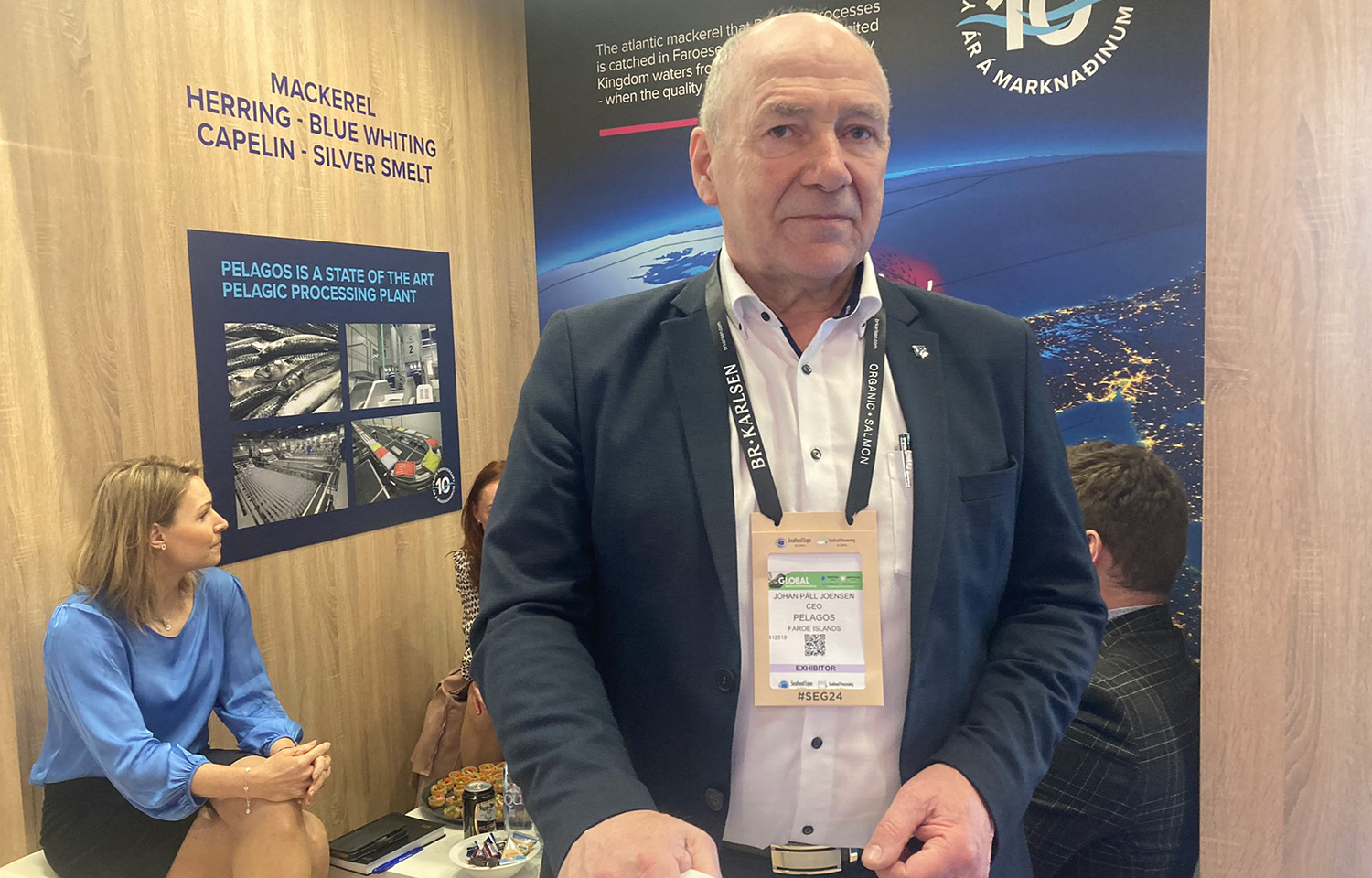
Pelagos is the Faroe Islands’ largest pelagic species processor, concentrating on mackerel, herring, capelin, blue whiting, and silver smelt.
Founded in 2014 by several of the country’s largest pelagic players as a means of producing more food-grade pelagic products for export, Pelagos has had a great first decade in business, according to CEO Jóhan Páll Joensen.
“Big quotas, high prices, big demand – everything has been fantastic,” he told SeafoodSource.
Pelagos is based in Fuglafjørður, considered the pelagic capital of the Faroe Islands – a country advantageously located between Scotland and Iceland, giving it unique access to pelagic species migrating across the North Atlantic Ocean. Its facility has state-of-the-art technology, meaning most of its processes are automated, and it has the capacity to process more than 45,000 metric tons of fish within the tight, four-month domestic fishing season.
Much of Pelagos’ inputs originate from the fleets of its owners, including Framherji and Palli hjá Mariannu. Also holding a minority share in Pelagos is Havsbrún, one of the main fishmeal and salmon feed producers in the North Atlantic, which operates the Faroe Islands’ largest processing facility. Faroese investment company Enni, which is operated by service providers to the seafood industry, is the fourth and final member of the company’s ownership group.
In December 2023, Pelagos acquired Faroe Pelagic and its processing facility in Kollafjørður from previous owner Parlevliet & van der Plas, increasing its production capacity.
Pelagos has thrived by segmenting its markets, with high-end product going to Western Europe and Asia and lower-quality fish sold to Eastern Europe and West Africa – Nigeria in particular. However, Russia’s invasion of Ukraine disrupted its trading, and potential sanctions on Russia could do further damage to its business, according to Joensen.
“Russia was a big part of our business, but last year, sales to Russia were down,” he said. “We always felt it is better not to be too dependent on one market, so we have tried to split it, but we are still selling a lot to Russia. We have good cooperation with some companies there. The Faroe Islands is supporting all the sanctions against Russia, but seafood isn't a part of these sanctions, so we will see what happens. But right now it is totally legal.”
The government of the Faroe Islands, which is a self-governing nation under the external sovereignty of Denmark, has performed a delicate dance in its dealings with Russia, issuing sanctions in May 2022 while exempting the seafood industry and conducting successful fishing catch negotiations. Joensen said he has mixed feelings about any potential move by the Faroese government to restrict seafood trading with Russia. But he said unequivocally that it would be bad for business.
“We wouldn’t do it on our own, as I don't think that we as a single company can take ourselves out of the market when other companies are continuing to operate there. And so it's a problem. It's a challenge for us,” he said.
While Russia remains a sticky issue, Pelagos’s top threat is coming from nations with which the Faroe Islands maintains otherwise friendly relations – Norway and the United Kingdom.
The three countries recently concluded a set of fisheries arrangements for Northeast Atlantic mackerel stock that gave the Faroes a national quota of 98,708 metric tons (MT), or 13.35 percent of the 739,386-metric-ton total allowable catch (TAC) of mackerel agreed to by coastal states in October 2023 – which is in line with advice from the International Council for the Exploration of the Seas (ICES). That’s important, Joensen said, because Northeast Atlantic mackerel was one of several pelagic species that lost Marine Stewardship Council certification in 2020 after continued overfishing. Multiple organizations have issued repeated calls for action, and some retailers have made pledges to stop purchasing Atlantic mackerel if the coastal states fail to reach an agreement that aligns with ICES advice.
The coastal states fishing for Northeast Atlantic mackerel have clashed for years over quota distribution, and the European Union and Iceland criticized the recent deal since it reserves 72 percent of the total allowable catch for the Faroes, the U.K., and Norway. Still, all the signatories to the agreement are abiding by it thus far.
Joensen said the highly migratory mackerel only travel through Faroese and international waters in the summer months, when their quality is sometimes inferior, meaning the domestic catch is often graded for fishmeal. Some of that production finds a domestic market via Havsbrún, which supplies local salmon farmers Bakkafrost and Hiddenfjord. But Pelagos is forced to import higher-quality mackerel, with up to 40 percent of its product coming from Denmark, to ensure year-round production, Joensen said.
“Our production all depends on the quota system, and the situation we have now, with no agreement, our fish is lower-quality and goes to Africa and Eastern Europe. But if we get an agreement, we can get fish in the autumn when the quality is better and send it for higher prices to Asia,” he said.
Joensen said everyone in the industry is frustrated over the continued absence of a unilateral agreement, which some scientific experts have pinned on rapidly migrating stocks due to warming waters caused by climate change. A recent survey by ICES found declining stocks, which will likely result in smaller quotas in the future, but none of the parties involved in the negotiations wants to give up what they have historically had.
“The hold-up is impeding our business development,” he said. “Everyone is fighting over what they give up and not thinking about what they can get.”
Asked who is to blame for the lack of an agreement, Joensen demurred.
“I don't know whose fault it is – all parties, I imagine, carry some blame,” he said. “How do we still achieve the same value for the fishery? That is the question they're speaking about, I can imagine.”
The North Atlantic Pelagic Advocacy (NAPA), a group of retailers established to push for improved regional fisheries management covering Atlantic mackerel and other species, recently extended its fishery improvement project (FIP) through April 2026. NAPA's mackerel FIP is focused achieving a functional coastal states agreement to ensure the stock is fished sustainably.
"Despite the obvious challenges in securing coastal state agreement, there is still very much a need for NAPA, as the voice of the supply chain, to continue to advocate for improvements in the management of these fisheries," it said.
