






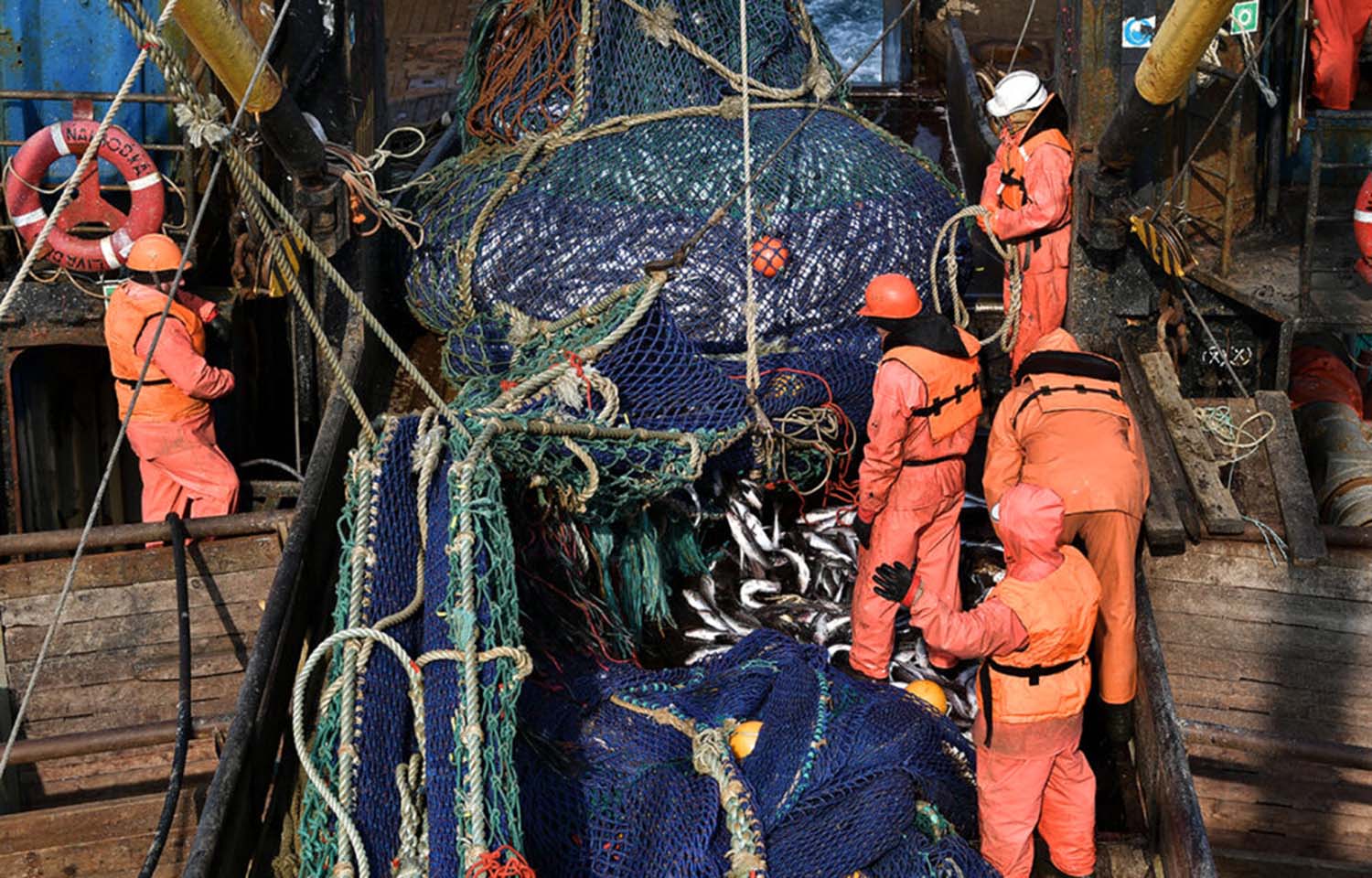
The Russian government is continuing to work on legislation that would extend deadlines on requirements contained in its fish quota auctions as companies struggle to meet them.
Russia revealed the results of its first quota auctions in 2018 after proposing the idea as a way of renewing the country’s aging fleet. Those auctions gave companies access to quota after a monetary investment and a promise to build either a new vessel or a new processing facility by a certain date.
Russia's shipbuilding industry started seeing potential problems with meeting deadlines as early as 2020, and earlier this year, Russia began suggesting it could extend deadlines on vessel building to avoid penalizing companies who were facing shipbuilding delays.
Companies planning investments in processing facilities have also been running into delays, and Fishnews reported the government has also been working on amendments that would allow for a one-year reprieve on deadlines. Those amendments would result in changes to how it calculates the volume of production at facilities to assess whether it met requirements.
“In order to ensure the possibility of high-quality adjustment of technological processes in production facilities, the draft resolution proposes not to hold investors liable for the payment of fines in the first calendar year after the commissioning of investment facilities until they reach their design capacity,” the amendment states.
The reprieve comes as Russian senators recently pushed for the chance to protect coastal processing facilities from fines, as the industry grapples with falling exports and a decline in prices.
Companies are also dealing with export duties on frozen fish that were implemented on 1 October 2023. The duties are tied to the exchange rate between the U.S. dollar and the ruble and can be as high as 7 percent.
Fishnews reported that the latest draft of the country’s main financial document includes language suggesting the export duties will remain in place.
Simultaneously, the Russian Federal Fisheries Agency (Rosrybolovstvo) reported that the total catch across the entire country amounted to 3.87 million metric tons (MT) as of 1 October 2024 – down roughly 8 percent from the 4.2 million MT that the agency reported in October 2023, though that total was itself 12 percent up from the catch in 2022.
In the Far Eastern Fishery basin, more than 2.9 million MT of fisheries products have been caught, with the pollock fishery remaining steady at 1.7 million MT, the same total the agency reported last year. The herring catch so far in 2024 has increased by over 47,000 MT to 329,300 MT – up from 282,000 MT in 2023. Flounder has decreased from 68,300 MT to 54,800 in 2024, while the catch of Iwashi sardines has continued to grow, reaching 278,900 MT so far in 2024, up from the 230,500 MT caught in 2023.
The Northern Basin has seen a slight decrease overall, with 367,200 MT of catch across multiple species, down from 378,000 MT a year prior. In 2024 so far, Russian fishermen in the Northern Basin have caught 191,200 MT of cod, down from 220,500 MT; 46,000 MT of haddock, down from 63,200 MT; and 51,700 MT of capelin, up roughly 28,700 MT from the 23,000 MT caught in 2023.
In the Western Basin, Russian fishermen have caught 56,100 MT in total in 2024, down from the 60,200 MT caught last year. According to Rosrybolovstvo, fishermen have caught 30,500 MT of sprat, down from 32,200 MT, and 18,800 MT of Baltic herring, down from 20,300 MT.
In the Azov-Black Sea Basin, fishermen have caught 25,100 MT total, down from 31,700 MT caught in 2023. However, the catch of anchovy there has increased to 9,200 MT – up from 8,500 MT in 2023.
The country’s salmon catch, however, is drastically lower in 2024 than the 600,000 MT catch fishers hauled in in 2023 – but largely in line with predictions. Russia typically compares even-numbered and odd-numbered years to each other, as the largest species by volume – pink salmon – is on a two-year cycle.
