



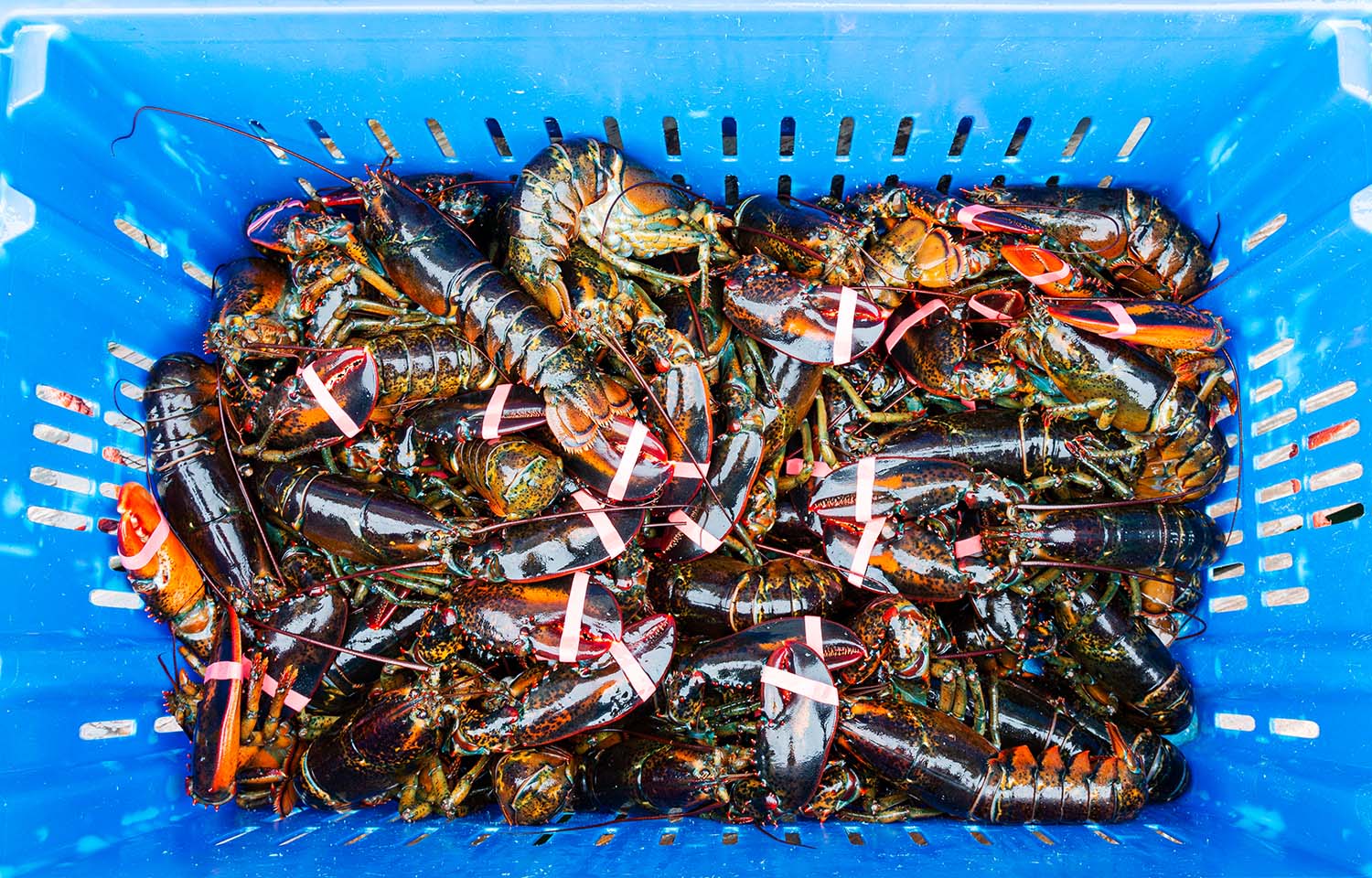
A recent stock assessment by the Atlantic States Marine Fisheries Commission (ASMFC) indicates lobster stock on the East Coast of the U.S. is depleted to record low abundance in Southern New England (SNE), and overfishing of the stock is occurring in the Gulf of Maine and Georges Bank (GOM/GBK).
The lobster benchmark assessment found the stock in GOM/GBK – which accounts for the vast majority of lobster landings in the U.S. – has declined 34 percent since peak levels in 2018. According to the ASMFC, the GOM region in particular has accounted for an average of 82 percent of annual landings since 1982, while the GBK fishery accounts for 5 percent.
The SNE stock, meanwhile, has seen steady declines in landings since a peak of 21.8 million pounds in 1997 and hit a record low of 1.7 million pounds in 2023. According to the ASMFC, the SNE stock now accounts for 1 percent of all U.S. landings, and the fishery has shifted from a mainly inshore fishery to a predominantly offshore fishery “as inshore abundance declined at a faster rate.”
“The Benchmark Stock Assessment is a considerable advancement in our understanding of the U.S. American lobster resource. It was fully endorsed by an external panel of fishery scientists as the best scientific information available to manage the lobster resource,” ASMFC Lobster Board Chair Renee Zobel said.
The vast majority of U.S. lobster is caught by the U.S. state of Maine, and the fishery in the state brought in USD 528.4 million (EUR 458.2 million) in 2024. The state’s fishery hit an all-time-high value in 2021, bringing in USD 724.9 million (EUR 628 million) on a catch of 108 million pounds, which marked 12 straight years of catches over 100 million pounds a year. That streak was broken in 2022 with a catch of 97.9 million pounds, and in 2024, the catch dropped to 86 million pounds.
ASMFC said its analysis found that despite the drops in catch, exploitation of the stock is “just above” the overfishing threshold, and the Stock Assessment Subcommittee is encouraging the start of a management strategy to address any concerns and identify some tools that could be supported by the lobster industry.
Maine Department of Marine Resources (MR) Commissioner Carl Wilson said the level of overfishing found by the assessment didn’t prompt any immediate action.
“MR will continue to engage industry in discussions about the stock assessment and the future of the fishery,” Wilson said. “This fishery is the most valuable in Maine that supports thousands of hardworking fishermen and is an economic driver for our coastal communities. I'm confident in the commitment of this industry to conservation of this resource and look forward to continuing this important work."
The lobster industry had been grappling with a proposed gauge size increase – which effectively increases the size a lobster has to be to be a legal catch – that it said would have caused huge catch declines, but the ASMFC ultimately repealed that proposal in May.
The lobster board said the assessment found that the declines in the population were largely related to environmental factors, with water temperature the “primary influence” on the species’ abundance and range. The Gulf of Maine has been known to be warming faster than the world’s oceans for over a decade, and the assessment said that considering those factors is key to assessing the lobster stock.
“Therefore, the assessment incorporated environmental data time series including water temperatures at several fixed monitoring stations throughout the lobster’s range, average water temperatures over large areas such as those sampled by fishery-independent surveys, oceanographic processes affecting the environment, and other environmental indicators such as lobster prey abundance,” the lobster board said.
