






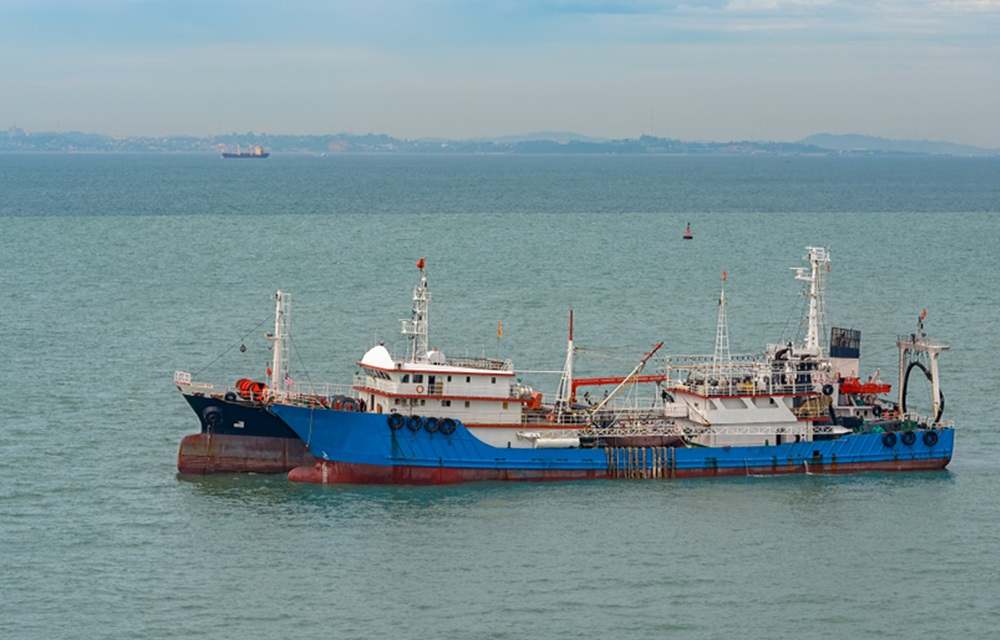
The U.S. House Select Committee on Strategic Competition between the United States and the Chinese Communist Party has released an investigation accusing China of being “the world’s largest perpetrator of illegal, unreported, and unregulated (IUU) fishing.”
The committee made several strong claims about China’s distant-water fishing fleet, accusing the Chinese government of using the fleet of roughly 16,000 vessels for intimidation and control.
“Communist China’s fishing fleet is not a commercial enterprise; it is a weapon of the Chinese Communist Party [CCP],” said U.S. Representative Carlos Giménez (R-Florida), who is the chair of the House Homeland Security Committee’s Transportation and Maritime Security Subcommittee. “The CCP commands the world’s largest fishing armada like a military force, using it to strip resources from nations, exploit forced labor, destroy marine ecosystems, and dominate global seafood supply chains. The Communist Chinese strategy to monopolize food systems, while devastating economies from West Africa to Latin America, has directly impacted our national security. Our laws were written to regulate fishermen, not to confront a subsidized, state-run fleet designed to evade enforcement and project power. This investigation exposes the reality: The CCP is using seafood as a tool of coercion, and the United States must treat this threat for what it is, a direct threat to our national security and economic sovereignty.”
Established in 2023, the Select Committee on China was formed by lawmakers to provide policy proposals and recommendations to combat perceived threats posed by China’s government. The committee has weighed into fisheries policy multiple times over the years, calling for a crackdown on Chinese fishing and seafood processing. Shortly after its formation, the committee recommended giving China a special designation making all of the nation’s seafood products subject to the U.S.'s Seafood Import Monitoring Program (SIMP).
The committee has also issued condemnations of China’s seafood sector following several allegations raised by the Outlaw Ocean Project. Beginning in 2023, the independent investigative journalism outfit issued several reports documenting forced labor and other forms of abuse within China’s fishing and seafood-processing industries. Allegations include the use of North Korean laborers at seafood-processing plants – an act that is considered forced labor under U.S. law – the use of forced labor from the persecuted Uyghur minority in China, and a litany of unethical labor practices aboard the nation’s distant-water fishing fleet.
The Select Committee’s latest report continues to put a spotlight on China’s seafood sector, highlighting the impact of its distant-water fishing fleet on economies around the world and how its dominance in seafood processing allows it to manipulate global markets.
“The Select Committee has documented how numerous American industries have supply chain concerns that leave the United States vulnerable to China, and the food supply is no exception. This investigation details how the CCP turned unregulated fishing to its advantage and manipulated the world’s food supply in the process. Working with allies, we can address vulnerabilities to the food supply the American people rely on and put a stop to China’s exploitation of the oceans,” U.S. Representative John Moolenaar (R-Michigan) said in a release.
The report makes five core claims about China’s fishing and seafood sectors:
- China developed a global system that removes distance as a limit on fishing;
- China has monopolized the processing of global seafood supplies through Chinese hubs;
- China engineered a permanent, state-supported cost advantage across all major production inputs;
- China converted seafood processing dominance in global seafood processing power; and
- China manipulates global seafood markets to eliminate U.S. processing capacity and increase American dependence.
According to the committee, those findings support its claim that China’s government is using its fleet “to achieve maritime dominance, monopolize food systems, and undermine the rules-based international order.”
The report includes several policy recommendations to counter China’s dominance, which the committee said poses a direct threat to U.S. national security and the nation’s economy. The committee calls for expanded funding for the U.S. Coast Guard to address IUU fishing, an interagency study on connections between Chinese commercial fishing and illegal activities, an increase in maritime domain awareness and intelligence sharing by the Office of the Director of National Intelligence, requiring unique identities for all international fishing vessels, and empowering the U.S. Interagency Working Group on IUU Fishing to lead a 'Fish for Security' coalition.
U.S. lawmakers have introduced several bills to restrict Chinese seafood, including banning Chinese seafood from military commissaries and dining halls, imposing sanctions, and outright banning seafood from China.
