


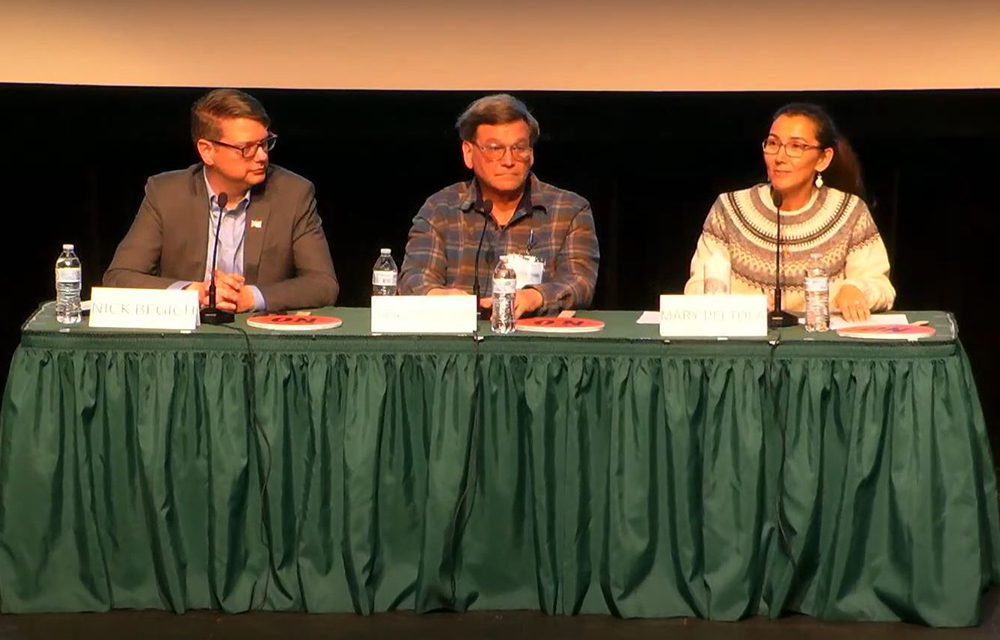
Candidates for the sole U.S. House of Representatives seat up for election in Alaska were able to make their positions on the state’s struggling seafood industry heard during the 2024 Alaska Fisheries Debate, hosted by the Kodiak Chamber of Commerce.
Incumbent U.S. Representative Mary Peltola (D-Alaska) touted her record on providing support to the state’s commercial fishing sector while pointing to the bills she has sponsored as a path forward for the industry.
“The work on fisheries that my team, both our senators, and I have done over the last two years is extensive and robust, and it will never be enough; it will always be my priority,” Peltola said.
Peltola replaced long-serving U.S. Rep. Don Young (R-Alaska) in an August 2022 special election, which was called following Young’s unexpected death in March 2022. Peltola won her second congressional race later that year in the November regular election, securing 55 percent of the vote.
Joining Peltola at the 2024 Alaska Fisheries Debate were Republican Nick Begich III, who ran against Peltola in the 2022 race, and third party candidate John Wayne Howe of the Alaska Independence Party.
Peltola began the debate by recounting the Alaska congressional delegation’s accomplishments in recent years, including securing fishery disasters funding, increasing U.S. Department of Agriculture purchases of seafood, and the closing of a loophole that allowed Russian seafood to enter the U.S. via third-country processors.
“The only way you can succeed in Congress is by forging relationships,” Peltola said. “No one is ever going to help you if they can’t stand you or if you’ve double crossed them, and I have a long, successful history of being very easy to work with and getting things done.”
Begich agreed that bipartisanship is key to improving domestic fisheries.
“Fish is not a Democrat or Republican issue,” Begich said. “This is one of the few issues at the moment we should be able to work in a bipartisan fashion in Washington, D.C.”
One area of difference between the two major party candidates was an emphasis on who should be managing U.S. fisheries.
In June, Peltola was one of a handful of lawmakers who introduced the Sustaining America’s Fisheries for the Future Act, a bill that would reauthorize the Magnuson-Stevens Act (MSA). Although the lawmakers behind the bill were cautious about the bill’s likelihood of passing into law in the current Congress, they argued that the MSA – which was last reauthorized 18 years ago – was in desperate need of an update.
A complicating factor is the U.S. Supreme Court’s recent ruling ending the Chevron deference and limiting fisheries regulators’ authority to interpret congressional directives. The fallout from that ruling could see federal lawmakers taking a more direct role in fisheries management than it typically has, Peltola said.
“After the Supreme Court's recent decision on the Chevron case, which was actually brought about by East Coast fishermen regarding observers on their boats, I think Congress is going to be much more involved in a lot of the work that NOAA does,” Peltola said. “There are some things that excite me about that, and there are some things that make me very nervous about that.”
Begich advocated more local input on fisheries management, emphasizing the role of regional councils in making regulatory decisions.
“I think that it's important for everyone in Alaska that's involved in fisheries to recognize that you really don't want Congress coming in and starting to set policy,” Begich said. “If you think that the council process is slow, try Congress; it’s a process that's going to be a lot slower and a lot less responsive to the needs of the fisheries.”
Begich called for more state control of Alaska fisheries, but he didn’t point to a specific proposal that would transfer authority from the federal government to the state beyond increasing Alaskan representation on the North Pacific Fishery Management Council.
“The state of Alaska is closer to the fisheries than people thousands of miles away in D.C. are ever going to be, so it's important to me that people who are closest to the issues and have a greater stake in the game are the ones that are involved in setting policy and enforcing that policy,” he added. “In my view, it should be the state that has jurisdiction, whether we're in times of abundance or in times of scarcity, and I think anytime that you ask the federal government to get involved in in a local issue, you're asking for trouble.”
Howe offered a stark contrast to the two major party-endorsed candidates, acknowledging that when it came to fisheries issues, he was “at a loss on this somewhat.”
“I am not a biologist. I don’t know that much about it. I know that fishermen kill fish, and that’s good because then we get to eat them,” Howe said, admitting that he was willing to listen and “find out what is the best.”
Howe, who has a background in Alaska’s mining communities, took time in his opening remarks to suggest fisheries priorities be balanced with mining priorities.
Howe characterized himself as an “Alaska first” candidate, taking time during his responses to fisheries-related questions to denounce the U.S. dollar as a “phony” currency and criticizing, among other historical grievances with the federal government, U.S. President Franklin Roosevelt’s position on handguns.
Whereas Peltola and Begich agreed that Alaska fisheries needed more support in the renewal of the U.S. Farm Bill – a major piece of legislation that guides the federal government’s agriculture policies – Howe called for an end to the decades-old legislation.
In addition to the MSA reauthorization bill, Peltola pointed to the legislation she’s introduced in the U.S. House of Representatives, including the Bristol Bay Protection Act, to block large-scale mining from the area, as evidence of her efforts on behalf of Alaskan fishers.
Begich, however, criticized Peltola for not introducing those bills earlier or securing more cosponsors.
“No bill is going to move through the Congress late in the session; no bill is going to move through the Congress with no cosponsors,” Begich said.
Peltola responded to Begich’s criticism later in the debate, noting that even if she had submitted those bills earlier, they likely would not have moved forward because the current legislature is not actively passing legislation.
“If I had submitted all bills without talking with fishermen first, right out of the gate, those bills wouldn't be going anywhere,” Peltola said. “This Congress has the fewest bills passed of almost any Congress in history. This has been a do-nothing Congress; even if I was in the majority and a ranking member, my bills probably wouldn't go forward because not much is happening.”
During her time in the debate, Peltola highlighted the plight of Alaska’s subsistence fishers.
“It's not their goal to be rich people; they're happy living in the bush, living off the land, but that is becoming almost impossible to do with the severe lack of abundance that we have,” Peltola said, noting that subsistence fishers are seeing their already meager quotas cut to nothing.
Begich used his time in the debate to call on the federal government to take stronger steps to stop foreign countries from dumping cheap, subsidized seafood into the U.S. market.
“We’ve seen that with Russia. We’ve seen that with China,” Begich said.
Begich also said that international sustainability standards need to be raised to ensure that foreign fisheries are held to the same environmental standard as U.S. fisheries, ensuring the competition doesn’t have an unfair advantage.
The full debate can be viewed on the Kodiak Chamber of Commerce’s YouTube page.
