






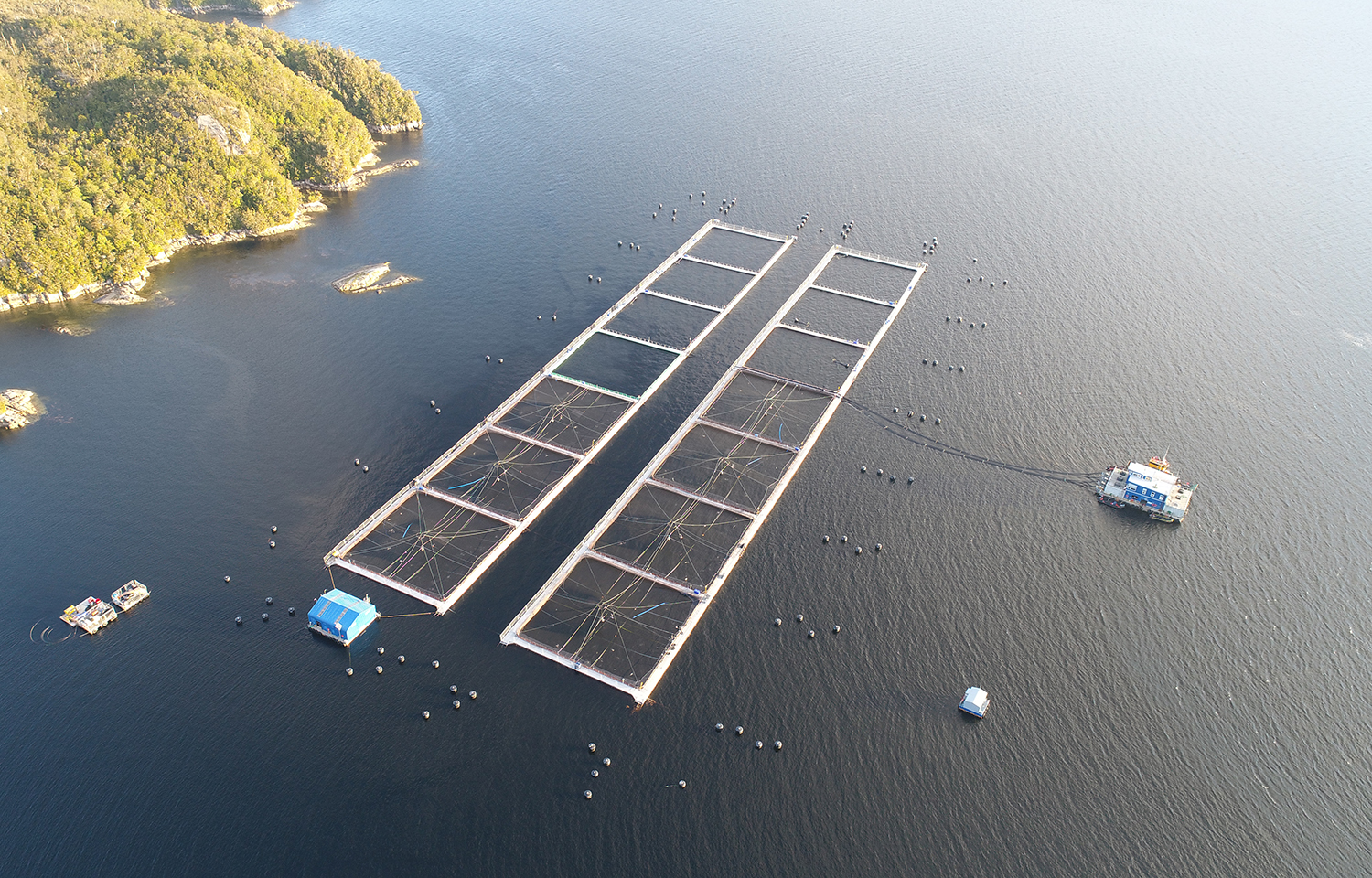
Export volumes of Chilean farmed salmon slipped year over year in the first quarter of 2025, and the Chilean Salmon Council is warning the trend might worsen due to U.S. tariffs coupled with continuous domestic regulatory issues.
The country exported 218,355 metric tons (MT) of salmon between January and March 2025, marking a decrease of 2.8 percent when compared to the same quarter of 2024, per data from the Chilean National Customs Service.
“The main challenge facing this industry is to install and consolidate a development model that complements sustainability with significant growth in the medium term,” Chilean Salmon Council Executive President Loreto Seguel said. “Chilean salmon farming cannot withstand stagnation. This requires … a state policy because in a global competitive scenario, those who do not grow disappear.”
The slowdown in production has been most apparent in the southern Magallanes region of Chile.
According to Carlos Odebrecht, the president of the Association of Salmon Farmers of Magallanes, regional production in recent years has dropped 44 percent from 180,000 MT to around 100,000 MT a year, taking with it more than 1,500 direct jobs.
Odebrecht attributed the production drop to regulatory issues, including unfinished zoning of the nation’s coastline, fish farm concession holdups, disagreements with Indigenous people over maritime zones, and technical studies that end up lacking institutional validation.
According to newspaper La Prensa Austral, the red tape has directly resulted in projects being unable to advance.
“This is not a blind defense of salmon farming. Like any productive activity, it must be subject to strict regulations, serious environmental assessment, and respect for the environment and communities,” the paper said in an editorial. “But, one cannot govern from immobility. Magallanes needs to clearly define what it wants to do with its coastline, its protected areas, its native peoples and its economic matrix. It is not a question of choosing between conservation and development but of taking on the challenge of doing both well … The call is clear: organize, decide, and act because lost time is also measured in unproduced tons, in unrecovered jobs, and in opportunities that may not return.”
Though the overall volume of Chilean farmed salmon exports was down in Q1, export value increased 5.1 percent year over year in the period to USD 1.8 billion (EUR 1.6 billion) thanks to higher international prices. Chile mostly exports Atlantic salmon, but in the first quarter, it also sent 88,482 MT of coho salmon abroad – a Q1 record.
Another silver lining to the Q1 data for the Chilean salmon industry was that trade jumped with non-traditional markets in the period; exported volumes jumped 91.1 percent to Vietnam and 46.5 percent to Russia.
Though it made gains in some markets, 10 percent tariffs introduced by the United States – a market that buys about 40 percent of all Chilean salmon – that are set to take effect in July have salmon farmers concerned.
“What we have to seek is for this 10 percent tariff to be annulled,” SalmonChile President Arturo Clément said on a LinkedIn post, adding that SalmonChile has been working hard to address the situation, including holding meetings with institutions such as the Chilean-U.S. Chamber of Commerce (Amcham), the Economic Committee of Chile’s Lower House, and Finance Minister Mario Marcel and his team to evaluate next steps to take.
Marcel also recently traveled to Washington, D.C., to hold bilateral meetings with his peers from the U.S. regarding the trade situation.
“The situation is complex… [and] uncertainty is very high,” he said.
Nevertheless, he expressed confidence that Chile was in a good position to discuss lowering tariffs based on the standing free trade agreement the U.S. established with Chile in 2004.
SalmonChile said that the industry cannot face two sets of tariffs – “an external, visible one imposed from [the U.S.] and another internal, silent, but just as limiting … regulatory system that stifles potential.”
The industry association called for public and private agreements that protect the competitiveness of Chilean salmon.
“Chile today has the tools to turn this around, to unblock a strategic sector, generate sustainable investment, and promote the development of regions that urgently need it. The opportunity is there, and we are working for it,” SalmonChile said.
