



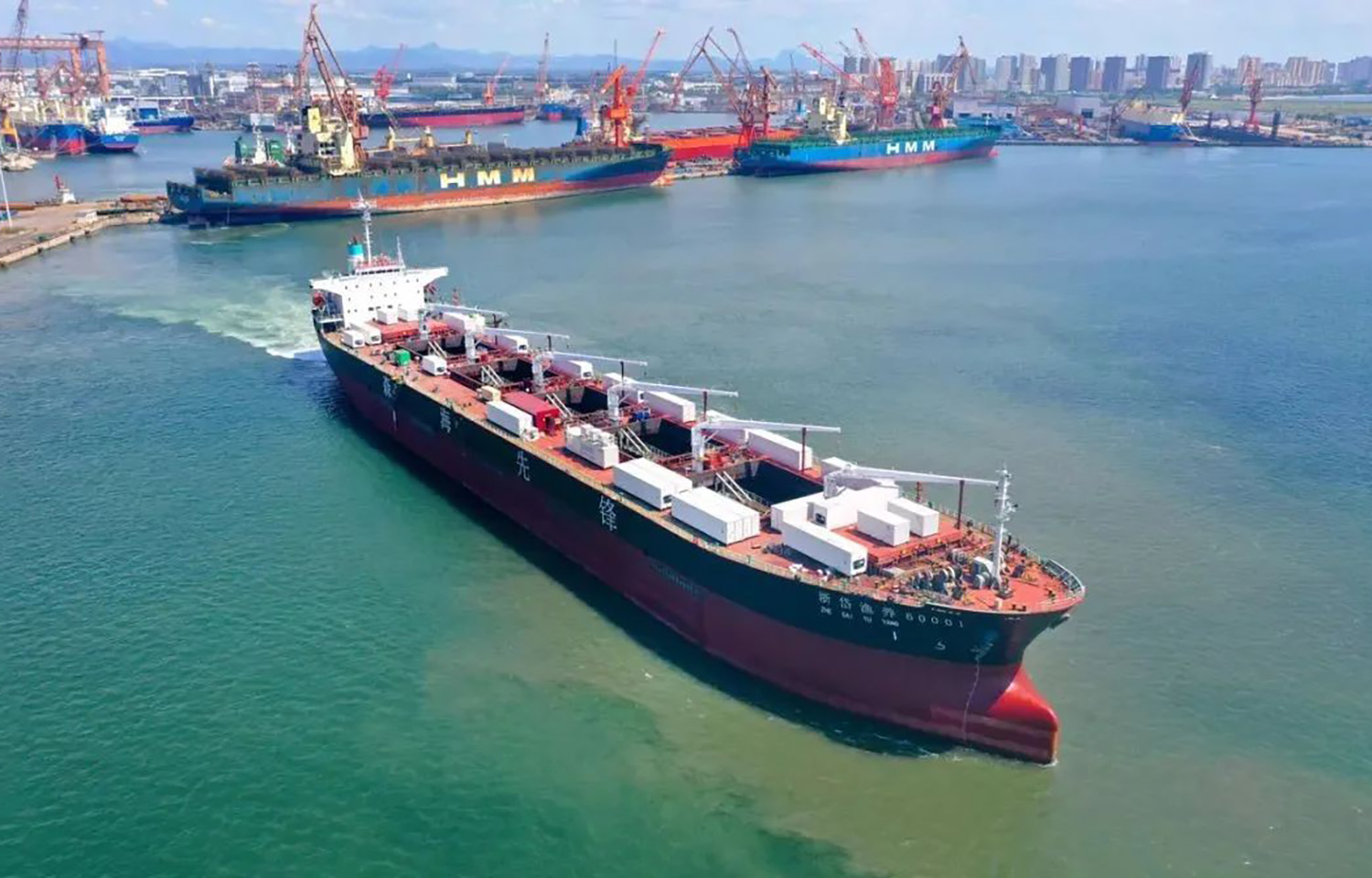
A Chinese company has transformed a nearly 20-year-old cargo vessel into a mobile salmon farm in a process that offers significant cost savings compared to operating a land-based salmon farm.
Alan Cook, who has served as the COO of New Zealand King Salmon and the managing director of Mowi Canada East, among several other roles in the seafood industry, told SeafoodSource that the Zhedai Yuyang 60001 may be just one of many similar vessels to come that offer an easily replicable alternative to land-based fish farming.
“These vessels are far more cost-effective to develop than land-based salmon farms – likely half the cost per kilogram of production – so if the land-based guys can appeal to shareholders, I'm not sure why these projects wouldn't,” he said.
Not only does it save on operating costs, but Cook said that the cost of converting a tanker like Zhedai Yuyang 60001 is around 70 percent lower than the cost of constructing a land-based salmon recirculating aquaculture system (RAS) project, suggesting the figures represent a “direct attack” on the “cost‑and‑time floor” set by Western salmon producers.
“I think what the Chinese are doing has lots of historical precedent and, to the best of my knowledge, uses mainly off-the-shelf technology, but the combination of the elements is fairly out-of-the-box thinking compared to the current development paradigm in the salmon industry,” he said. “The kinds of bulk tankers they are using are currently operating in every ocean on the planet; as a working platform, they are tried and true and supported by a very mature network of financial groups, operations support, port services, etc.”
Senhai Mako Marine Science and Technology Co., which owns the vessel, aims to produce 2,800 metric tons of salmon per year aboard the ship. This is set to bring in an estimated CNY 120 million (USD 16.8 million, EUR 14.4 million) in annual revenue, and the company already has plans to launch two more converted tankers for aquaculture purposes in addition to Zhedai Yuyang 60001.
Speaking to local media in July, Pan Yongjun, chairman of Senhai Mako, said that Zhedai Yuyang 60001 will be staying in Chinese waters, but its mobility allows it to move to the warmer south in winter months and vice versa in the summer, ensuring a constant water temperature range of 14 degrees to 28 degrees Celsius.
Though Senhai’s vessel is staying in Chinese waters, Cook said he believes future vessels will sail beyond territorial seas, opening the door to myriad sales opportunities and the ability for countries in various locations to mimic the practice.
“Vessels of this type are required to meet International Maritime Organization vessel discharge standards, which specify filtration and disinfection requirements, so if international maritime law is respected, they should be able to travel almost anywhere,” he said. “Local laws around discharge, fish health, and environmental impacts will vary and will need to be met, but assuming it is a closed-containment, biosecure design, it should be eligible for use in many regions.”
Previous vessels and offshore platforms in China have been developed largely with governmental aid, but Cook said the model should be commercially viable without assistance from the government.
“While it can't be denied that the Chinese government is supporting the development of offshore aquaculture, I don't think it is entirely correct to state that it would only happen with government funding,” he said. “The most recent vessel launched is entirely for-profit; the government of China is not, as I understand it, involved.”
Still, China has heavily encouraged and helped fund the development of the nation’s offshore mariculture sector over the past decade.
For instance, state-run shipyard firm Shandong Caixin Wanzefeng Marine Technology completed its first harvest of Atlantic salmon grown in its Sea Granary 1 farming system off the coast of Rizhao in the Yellow Sea last year.
Additionally, Qingdao, China-based, state-owned Guoxin Development Group farms yellow croaker grown aboard its Guoxin 1 aquaculture vessel, which originally launched in March 2022. Three years after that vessel’s launch, the company introduced an updated 150,000-metric-ton (MT) version.
Guoxin also has announced that preparatory work is underway to launch two more vessels designed to cultivate coldwater fish such as Atlantic salmon, like Senhai Mako.
