



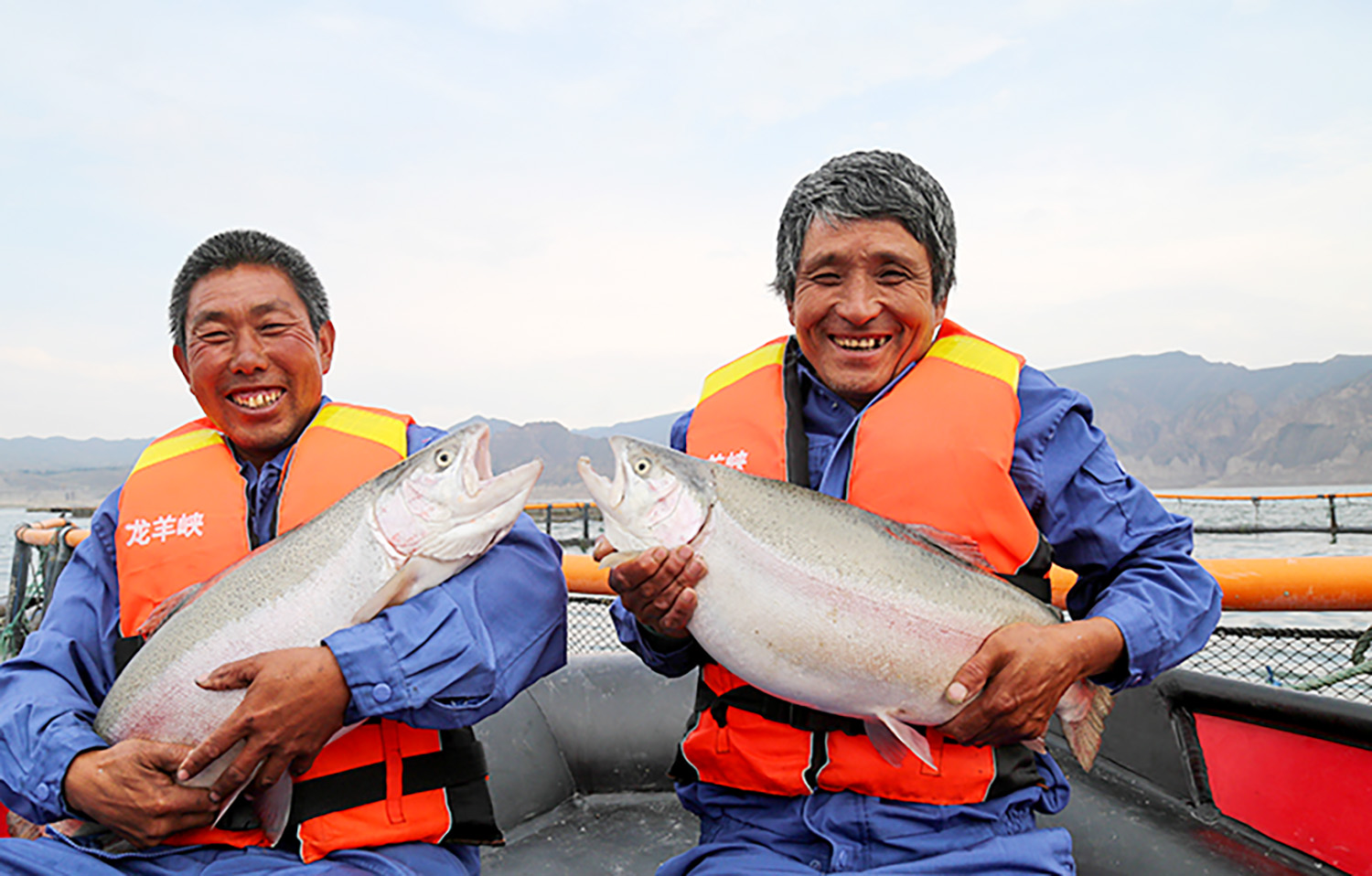
Chinese trout-farming firm Longyang Zhixian recently announced that its 2024 export totals increased 10-fold year over year, rising to CNY 300 million (USD 42.1 million, EUR 35.9 million) worth of rainbow trout.
Located in the sparsely populated Chinese province of Qinghai, vertically integrated Longyang’s trout farm sits on a glacial lake on the Tibetan Plateau and features more than 200 cages. The farm produces over 10,000 metric tons of fish annually.
The farm also includes an automated feeding system, as well as wind- and wave-resistant net pens, developed by Norway-based aquaculture technology firm AKVA group.
“We absorbed, digested, and adapted the technology,” Longyang Head of Production Li Mingrui told Hong Kong-based media firm Beyond Headlines.
Though demand for salmonids continues to increase in Longyang’s home country of China, the firm still exports the vast majority of its products, mostly to Western markets.
This is largely due to the fact that Chinese consumers seem to prefer imported salmon.
A study published in late 2024 titled “Consumers’ Preferences Towards Farmed Salmon in China: Integrating Sensory and Choice Experiments” showed that while Chinese consumers were unable to tell the difference between domestically produced salmon/trout and imported products, there was a marked preference among Chinese consumers for imported salmon.
“In comparing the Chinese and European markets, European consumers often value local products for their freshness and environmental benefits, but Chinese consumers tend to prefer international salmon, likely due to concerns about local food safety,” the study said. “Improving the perception of domestic products in China will require enhanced quality controls and greater supply chain transparency to address these concerns. Emphasizing the safety and unique qualities of local products could build consumer trust and increase willingness to pay for domestic aquatic food options.”
Many Chinese seafood firms struggle with overcoming local perceptions of domestically produced fish.
For example, in marketing its new partnership with restaurant operating group Yum China, Chinese seafood firm Zhangjiang Guolian Aquatic Products referred to its products as “export-ready” to describe their quality.
Those perceptions do not align with reality, according to Didier Boon, the head of Beijing, China-based East China Seas, which sources shrimp and tilapia for export.
“[China’s] laws ruling the food industry have improved dramatically over the last 15 to 20 years. The expectations of sanitary quality are now the same for domestic products as they were and are for export products,” Boon told SeafoodSource.
The challenge of assuring customers of the high quality of domestic products comes at a difficult time for many Chinese seafood producers, who now face increased trade uncertainty abroad.
