





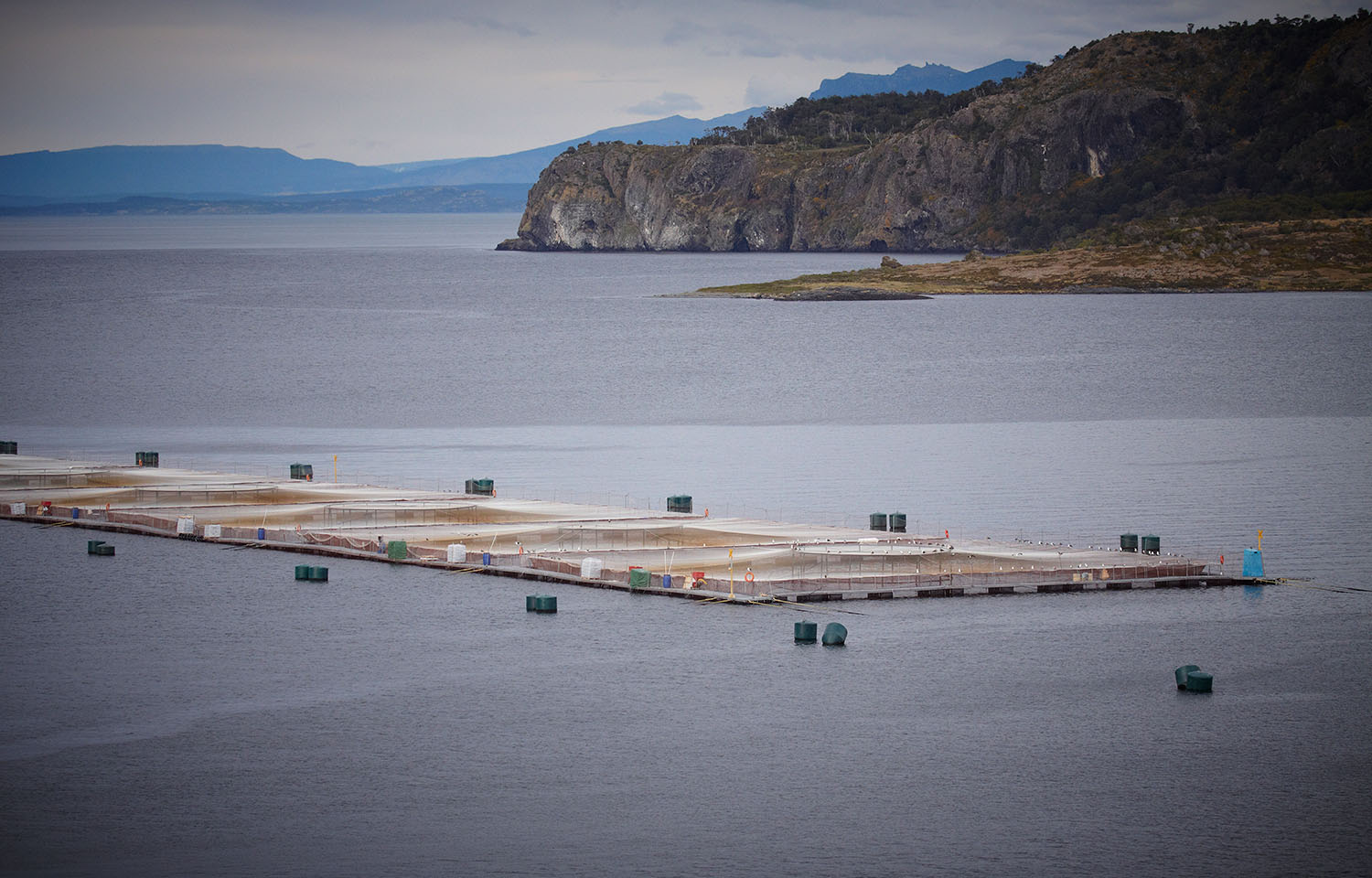
Chile’s Undersecretary of Fisheries and Aquaculture (Subpesca) is preparing a new aquaculture law to regulate the nation's multi-billion-dollar salmon-farming sector and other fish-farming operations in the country.
“There is a commitment from this government to work on a General Aquaculture Law that is the result of an open and transparent debate, that addresses and responds to sector challenges for the coming decades, and that continues to contribute sustainably to national and global food security,” Subpesca told SeafoodSource.
Public participation and discussion of the law is well underway, and the bill is expected to be submitted to congress in 2025. Under the public participation process, any interested stakeholder can directly upload proposals via the homepage of the Subpesca website through 31 October.
In addition to online proposals, Subpesca also partnered with the Universidad Austral de Chile’s (UACh) Institute of Aquaculture and Environment to launch a series of workshops and coordinate territorial discussion, mostly in the south of Chile where the vast majority of aquaculture takes place, including in cities such as Puerto Natales, Temuco, Puerto Aysén, Puerto Montt, Castro, Hornopirén, and Quellón, as well as the north central city of Coquimbo.
Authorities convened small, medium, and large aquaculture companies, as well as sector workers, residents of the communities where aquaculture takes place, and others to these regional workshops to learn about the needs, problems, and proposals of each area.
Partnering with UACh is not the first time Subpesca has turned to an academic institution to spur local dialogue and gather information for the law.
At the end of 2023, the Universidad de Valparaíso helped to organize participatory dialogues in public consultations for small-scale aquaculture, resulting in the publication of a document highlighting important issues to be taken into account for the development of the law.
The government has agreed to group the collection of proposals gathered for the General Aquaculture Law based on eight pillars: access, aquaculture territorial planning, environmental, animal health and welfare, research for decision-making, supervision and sanction, production and sales chains, and governance.
Some in the aquaculture sector have decried governmental antagonism toward salmon farming in Chile, with some saying authorities have ignored salmon farmers in the debate to form the aquaculture law. Subpesca, in response, said the opportunity for participation is open for everyone, including industry players, to send concerns and proposals directly to authorities.
Sector players have always been able to request meetings with the authority through the Lobby Law, and they have made use of this channel, Subpesca added.
Subpesca also pointed to the aforementioned workshops held in conjunction with UACh where aquaculture companies were invited to attend, particularly pointing to a recent meeting in Puerto Montt as proof of the government’s openness to discussion. In that meeting, Economy Minister Nicolás Grau participated in an event titled "Challenges and opportunities in salmon industry regulations: the Aquaculture Law and Lafkenche Law," organized by the Multi-Union of Salmon Workers.
Another industry criticism is that the government has been painfully slow in authorizing new permits, an issue Subpesca claims is already being addressed.
“It should be noted that the government is already making a significant legislative effort to improve efficiency in the processing of permits, both in the environmental assessment of permits and in other sectoral permits outside the Environmental Impact Assessment System (SEIA),” Subpesca said. “Likewise, an indication has just been presented to the Maritime Concessions bill, which seeks, among other things, to reduce its processing times. All these are clear signs of a path toward substantive improvements in terms of permits.”
That is precisely why one of the pillars, according to the undersecretariat, is access, which will seek to address all the procedures and authorizations required for farming.
While the current General Fisheries and Aquaculture Law is functional, it fails to fully address sector complexities and needs, Subpesca said.
The new legislation will look to recognize the diversity and particularities of each sector, such as small-scale aquaculture; integrate current and future technological advances, which allow the implementation of new and better types of aquaculture; improve efficiency and provide greater certainty in access to the activity; incorporate emerging challenges such as climate change adaptation and disaster risk reduction; promote the efficient use of national assets for public use and adequate spatial planning of aquaculture; and strengthen the scientific basis of farming to ensure ecological balance and animal welfare.
Chile’s aquaculture sector moved USD 7.12 billion (EUR 6.58 billion) of product during 2023, according to Subpesca, with 27 species cultivated commercially - principally salmon, trout, mussels, oysters, and algae - for a total harvest of 1.49 million metric tons (MT).
Of that total, Chile exported 929,000 MT to 92 markets around the world, led by the United States, Japan, Brazil, Russia, China, and Mexico. Currently, the total aquaculture surface area in the country reaches 31,520 hectares, corresponding to 3,246 aquaculture concessions and 344 hatcheries and fish farms.
