





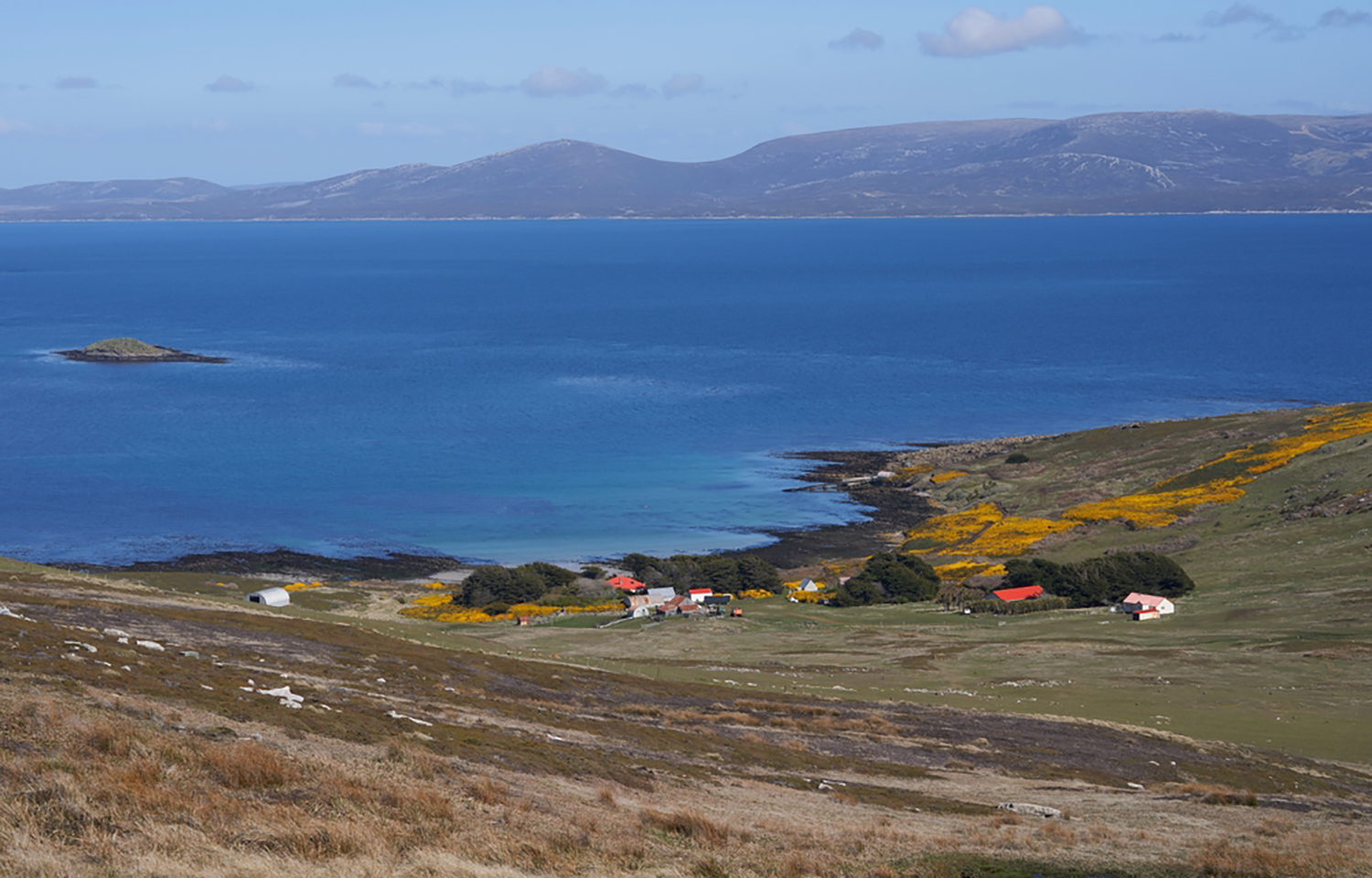
A joint fish-farming venture has submitted a proposal to the Falkland Islands government to produce up to 50,000 metric tons of Atlantic salmon per year off the waters of the remote South Atlantic archipelago.
Unity Marine, a joint venture between Danish consultancy F-land ApS and Falklands Islands-based seafood brand Fortuna, is now awaiting government approval of its plans.
“We are asking the Falkland Islands government to introduce enabling legislation as it has for the hydrocarbon industry, along with a licensing system that requires operators to fund proper [environmental assessments] and scientific research so we can assess and manage environmental risks,” Unity Marine Managing Director James Wallace told SeafoodSource. “Our company or other interested parties could then apply for licences, judged on individual merit and subject to environmental impact assessments.”
The idea of farming fish on the islands, which are 300 miles northeast of Argentina, has been tossed around for several decades. A pilot project for open net-pen salmon farming was carried out on the islands between 1987 and 1992, proving that salmon could be grown at a commercially acceptable rate in Falkland waters. The Falkland government then introduced a Fish Farming Bill in 2006 that provided a legislative framework to enable licensing and regulation of the practice, but it was not until 2017 that Unity Marine was formed and aimed to prove the viability of a sustainable large-scale project.
Initially, the island territory’s government engaged external consultants to review global best practices in salmon farming in the context of the Falkland Islands’ existing legislation. The review led the policy-making body of the government to disallow large-scale fish farming and refuse a public consultation on Unity Marine’s proposals.
That decision was revised last year.
A public and stakeholder consultation on the economic benefits and environmental impact of salmon farming in the Falklands is now underway, with its findings expected to be published later this year.
Unity Marine has touted conditions off the Falkland Islands as ideal for salmon farming and plans to spend GBP 5 million (USD 6.6 million) on an exploration phase of the project if granted permission to do so. It has also stated its commitment to diversifying its shareholders to enable local companies and individuals to benefit more widely from the industry.
“Developing a vibrant sector would help to diversify the economy, contribute to the public purse through taxes and license fees, and create future security and prosperity for the community,” Wallace said.
Initial investigations by Unity Marine have identified eight suitable sites for cage farms, located between 3 and 7 kilometers from shore in sparsely populated areas. The firm said anti-predator nets would be used around the cages to ward off sea lions, which is a major problem for South American aquaculture operations.
The company would also build two recirculating aquaculture smolt units to hatch and rear imported eggs.
The firm’s road to success has been met by vociferous counterlobbyists, however, led by Salmon Free Falklands (SFF), an organization that describes itself as a “collective voice for the widespread public concern about bringing inshore, open-pen salmon farming to the Falkland Islands.”
“Our recent discussions with stakeholders reflected a cross-section of local sentiment, with some vocal opposition countered by a more traditional Falklands outlook, which sees natural resources, used responsibly, as the lifeblood of our remote nation,” Wallace said. “It's deeply disappointing that some of our leaders continue to be influenced by activist outrage and hostile media pressure. The government now has a responsibility to inform itself properly and act on facts, not fear.”
Nevertheless, the Falkland Islands has dealt with issues such as low population and lack of financial opportunities outside of its capital of Stanley. Unity Marine hopes that its proposal could go some way toward ameliorating this.
“For decades, the Falkland government has told us that economic diversification is essential and never has that been truer than now,” Wallace said. “Projections show that if government income remains flat while infrastructure spending continues as planned … we will breach our own liquidity threshold. The government’s policy is clear in that this cannot be allowed to happen, which means cuts to services, quality of life, and opportunity.”
The territory has heavily relied on revenue from its squid fishery, but in November 2024, the Falkland government canceled all fishing activities for Patagonian squid (Doryteuthis gahi), also called loligo, for the rest of the year, making revenue diversification in its seafood sector even more essential movingh forward, according to Wallace.
“Salmon farming has the potential to transform the Falklands economy, particularly in rural areas. It could generate as much, if not more government income, than the wild fisheries we depend on today. Together with its supporting supply chain, this new industry would boost GDP and provide career incentives for young islanders to return home after international studies, much as young Faroese return from studying in Denmark to work in their flourishing fish-farming industry,” Wallace said. “To block that process based on ideology, particularly from a fringe group with little stake or interest in the Falklands economy, would be indefensible. We cannot let those with no accountability, no mandate, and no plan for the future override those working to build one.”
