



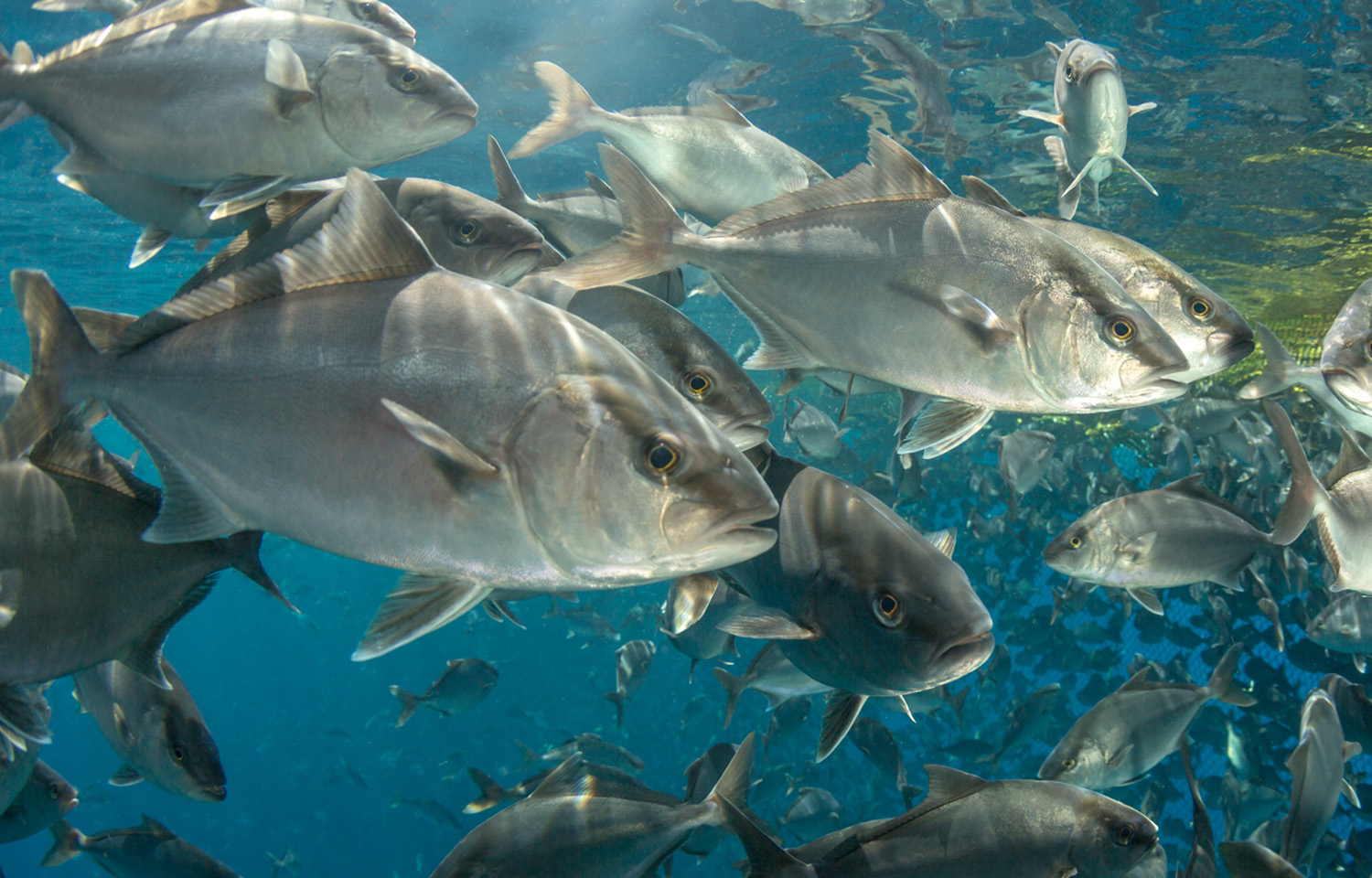
La Paz, Baja California Sur, Mexico-based aquaculture firm Omega Azul raises fish of the Seriola rivoliana species, which comprise yellowtail, amberjack, and kanpachi. It began raising fish in 2000 in the Sea of Cortez, together with fellow farmer King Kampachi, with which it merged in 2023.
After two decades of learning industry lessons and having made it through the troubling times of the Covid-19 pandemic, the company is forecasting USD 6.3 million (EUR 5.9 million) on 450 to 500 metric tons (MT) of sales in 2024, with sights set on that doubling to around USD 13 million (EUR 12.1 million) in 2025, according to Omega Azul CEO Roderick Chrisman. Within five years, the company expects to be producing 5,000 MT a year and has set the goal of becoming a global leader in the emerging yellowtail segment.
In an interview with SeafoodSource, Chrisman discussed the company’s history, operations, and expectations for the future.
SeafoodSource: How did Omega Azul come to be?
Chrisman: Our founder is a Canadian salmon fisherman named Terry Morris. In the 1990s, he saw [the government] was limiting catch, and he didn’t see this as sustainable in the long term. So, he got interested in farming and took a look at the salmon industry in Canada, which arose in the 1970s and ‘80s. He’d always had an interest in Latin America, having previously done a consulting trip to Nicaragua. Around that time, he got invited to get involved with one of the bluefin tuna farms that got rolled up into Baja Aquafarms.
This is how I tie in; they were looking for funds to increase production. I’m formally from an investment bank, and we ended up being the ones raising USD 20 million [EUR 18.6 million] for that farm.
Terry remembered us, and he went to La Paz to raise farmed yellowfin tuna in 2000. But, I think it was a little bit before the time for that. With bluefin tuna, when you farm it, it doesn’t lose its flesh color; it’s still that deep red that you recognize with tuna. But farmed yellowfin tuna gets white flesh, so people didn’t recognize it when he was trying to sell it. He tried everything, such as putting krill into the feed like salmon farmers do to increase coloring, but it didn’t work.
His plan was always to do amberjack after yellowfin, but he just went straight to amberjack. He gave us a call to raise money in 2007, and he advanced that until 2014.
On the other side of the bay, there was another actor named Michael Bullock, who was starting King Kampachi. Both of them received funding to go commercial in 2017; they both took off at about the same time and had a good ramp-up. Covid-19 hit both companies really hard, though, and King Kampachi had a lot of fish in the water. They had to pull them out of the water and freeze them.
At Omega, we had just doubled our farm size, so we stuck it out through the pandemic. Both companies realized there were two companies in the same bay trying to make it, so we ended up doing a merger a year ago. King Kampachi is now a brand, and Omega is the company name.
King Kampachi had purchased a machine to employ the ikejime quality method of harvesting – a set of Japanese techniques used to cull fish humanely, preserving and maximizing the natural eating quality of the fish. We didn’t do that at Omega, and during the merger, the investors asked us to carry both brands; we kept the ikejime style with the King Kampachi brand while under Omega’s Baja Kanpachi brand, we pull the fish out of the water and put them on ice.
SeafoodSource: You’re projecting significant growth over the next few years. How will you achieve that?
Chrisman: Initially, when we started out, marketing and placement of the fish was an issue. People didn’t know what the fish was; it basically had to be given away at the beginning. This is a wonderful, top-of-menu fish that’s close to bluefin-type quality, and it’s sustainable. It has a great story behind it.
Here we are in 2024, and we’ve got USD 6.3 million [in projected sales], and the only thing keeping us from that number is if we can produce that much biomass. We see the same for 2025, and this is just for Mexico and the United States.
For future growth, we are looking at both Europe and Asia. Other Latin American countries would be after that, if needed. For Europe and Asia, we are planning to ship super frozen fillets. We have a super-freezer that can freeze 20 MT at a time.
In Europe, we’ve had sales before to Great Britain, and Mexico has a free trade agreement with Spain, so those would be our initial targets. In Asia, we sampled in China pre-Covid and Hong Kong, and the product was very well-received at good prices. We expect there to be good markets in those places once we have the supply.
An interesting point is that we sell two-thirds of our fish here in Mexico, and we can probably double [sales] here. In the U.S., we see an opportunity developing there, but it depends on what happens with our competitor in Panama. We believe there will be quite a bit of market opening up in the second half of the year.
SeafoodSource: Can you go into more detail on the market for seriola and the competition in the space?
Chrisman: This fish has been referred to as a Ferrari; it grows really fast. In fish farming, that is great if you can sell it, but if not, this fish just eats and eats and gets expensive. In the tropics, you have issues with neobenedenia [parasite infections] and other issues that don’t come with salmon farms. The other company produced too much fish – the same story that King Kampachi had.
From what I’ve seen, the biggest challenge in producing this fish is in balancing the market with production. We’ve been able to do that, but Panama has a very large amount invested; investors [there] are venture [capitalist] guys, so they look for that hockey-stick revenue return. If that’s not achieved, they are going to pull out. On the other hand, our investors are sustainable ocean impact funds, eco-impact funds, which I think have blessed us over the years, and they’ve stuck with the project as we’ve taken the hits and learned how to do things.
We hope the [competition] can stay afloat and [fundraise successfully] because it’s not good for the industry when these things happen.
SeafoodSource: What do you expect to change in the U.S. for this increased demand to occur?
Chrisman: Right now, we’re selling only one-third of our production there, but for us to get back to where we were on a combined basis in terms of kilos, it’s quadruple what we’re doing now. We’ve seen that the competitor out of Panama has expanded the market even further.
Now, there are big seafood companies buying this product – Santa Monica, Fortune, and Samuels are all buying it. The product has really become known, even before we fully get into the U.S. The last time we were fully in the U.S. was pre-pandemic.
SeafoodSource: Are you supplementing that with commercial activities such as marketing? Or, is the word already out, and you’re taking advantage of the demand?
Chrisman: I’d like to say the word is already out, and it is a bit, but I know we’re going to reach a point – I’m forecasting mid-2025 – when we need to push a little harder. There are other yellowtail variants coming up; we’re not the only one, but for now, we as a company can basically do the push based on previous sales.
I’m getting calls from both former and new customers. They’re seeing what’s happening with the supply in terms of who will be able to keep going and who’s not. We think we can sell some in the near term, but we’re going to need the marketing in the longer term. We need to maintain price and presence. Right now, we’re looking to see if the investor community knows about us, and we want to tell that story.
SeafoodSource: You mentioned sustainable production, but ramping up production can carry environmental issues with it. How are you considering this to continue producing sustainably?
Chrisman: We’re Aquaculture Stewardship Council-certified, and we have to stay under a certain FFDR [forage fish dependency ratio]. They give us certain leeway for it being a relatively new species, and for us, we want to continue making money as a business. For this fish in particular, we’re only doing densities of 15 kilos per cubic meter, which is low density.
This fish forces us to be sustainable, which keeps us honest. It feeds voraciously and sucks up a lot of oxygen, which is one of the reasons we like to keep the densities low, and it likes to move. We don’t do antibiotics, steroids, or hormones.
One of Omega Azul's key differentiators is our environmentally friendly transportation methods. Being able to access most of our markets via land transport versus air freight sets Omega Azul apart from our competitors while also minimizing carbon footprint.
Also, the fish are native to the area. We caught them locally and breed them locally, so it’s not a different genetic pool. Seriola rivoliana is found all over the world, but even so, there are little differences between them.
SeafoodSource: Are there any regulatory issues causing issues for your operations or growth? Does increasing production just mean putting up more pens? Has the Mexican government given you the go-ahead?
Chrisman: We have three ocean concessions, and we’re only using one at the moment. We can do 7,500 MT annually, so we have a way to go on the growth side. They’re all approved, and the Mexican government does put a limit on the number of cages you can put on each site, so when we consider the 7,500 MT annually, it’s based on the number of cages.
The current concession that we’re using is located on the eastern part of the bay, which is the only concession on that side since we’ve been here so long. It’s a stone’s throw away from Playa Balandra, which is a UNESCO World Heritage site.
As we get bigger, we need to make sure that the [seabed] is clean and that we’re not affecting the local flora or fauna, which is very rich here. We’ve performed studies, and they show that so far, there has been no affectation of the seabed.
