




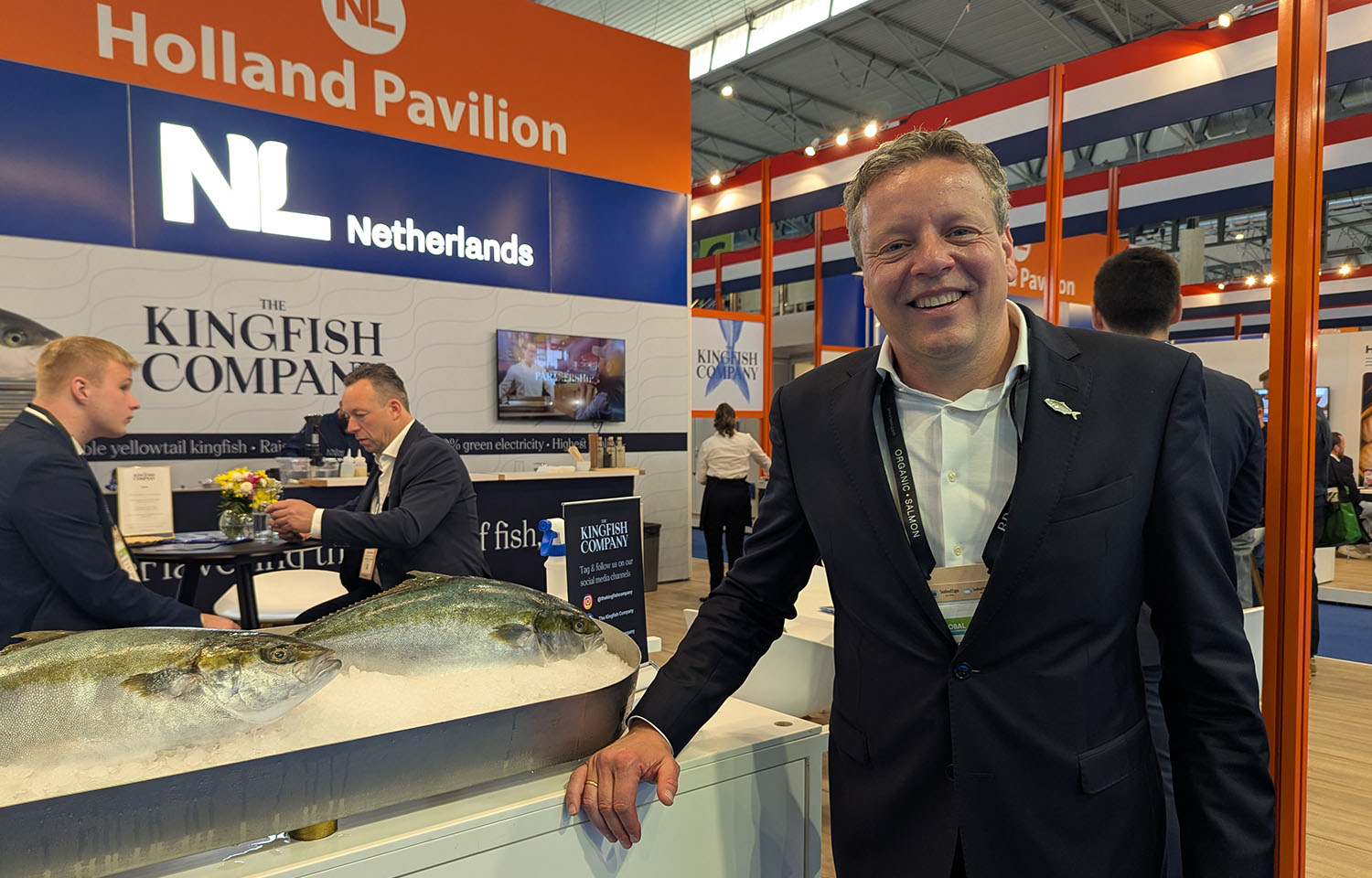
Zeeland, Netherlands-based The Kingfish Company is continuing to hone in its yellowtail recirculating aquaculture system (RAS) as it works to become a major producer in its second decade as a company.
Kingfish has been continuously developing a land-based yellowtail RAS, beginning with an initial Phase 1A module that produced 500 metric tons (MT), gradually building that up to its current maximum capacity of 3,500 MT.
Kingfish Commercial Director Gudo Klein Gebbink told SeafoodSource during the 2026 Seafood Expo Global – running from 21 to 23 April in Barcelona, Spain – that the company is now fully focused on maximizing the efficiency and consistency of its RAS.
“Ten years ago, there was just a view, a vision, to create sustainable farmed fish on land, and we are now with a fantastic group of passionate people producing 3,000 MT of fish,” Gebbink said.
The company has continuously developed its aquaculture operations, steadily working to create a strong genetic line of yellowtail.
“As things develop, you always run into developmental issues that you need to look at, but we see that our team has really done an amazing job of finding this balance between biology, innovation, and putting a system in place that creates consistent, good quality fish,” Gebbink said.
Consistency of the supply is also one of the advantages that the company has, Gebbink said. Because it is a RAS supplier and can manage its harvests year-round, it can consistently deliver yellowtail to its customers.
Gebbink said the company has continued to scale quickly as production has increased. The decision in 2025 to scale back its fresh sales to the U.S. was largely related to the exchange rate with the U.S. dollar and tariffs, which made it difficult for its products to gain a foothold. However, the frozen side of the company’s product portfolio is still doing well, and it is also working to target more customers in the Middle East.
“Most of the market at this moment is the European market, where we’re growing fast, and we have great partnerships that we’re trying to expand as we’re going along,” Gebbink said. “We’re trying to reach every restaurant and retail chain that can take our fish.”
There’s still work to be done to have consumers think of yellowtail as a dining option. The fish is versatile and can be used for a number of products, but many times customers don’t know what it is.
“We put a lot of emphasis and a lot of time and effort into developing the market,” Gebbink said. “It’s a fish we believe has a place in a lot of different cuisines, we need to be sure people know it and get it.”
