

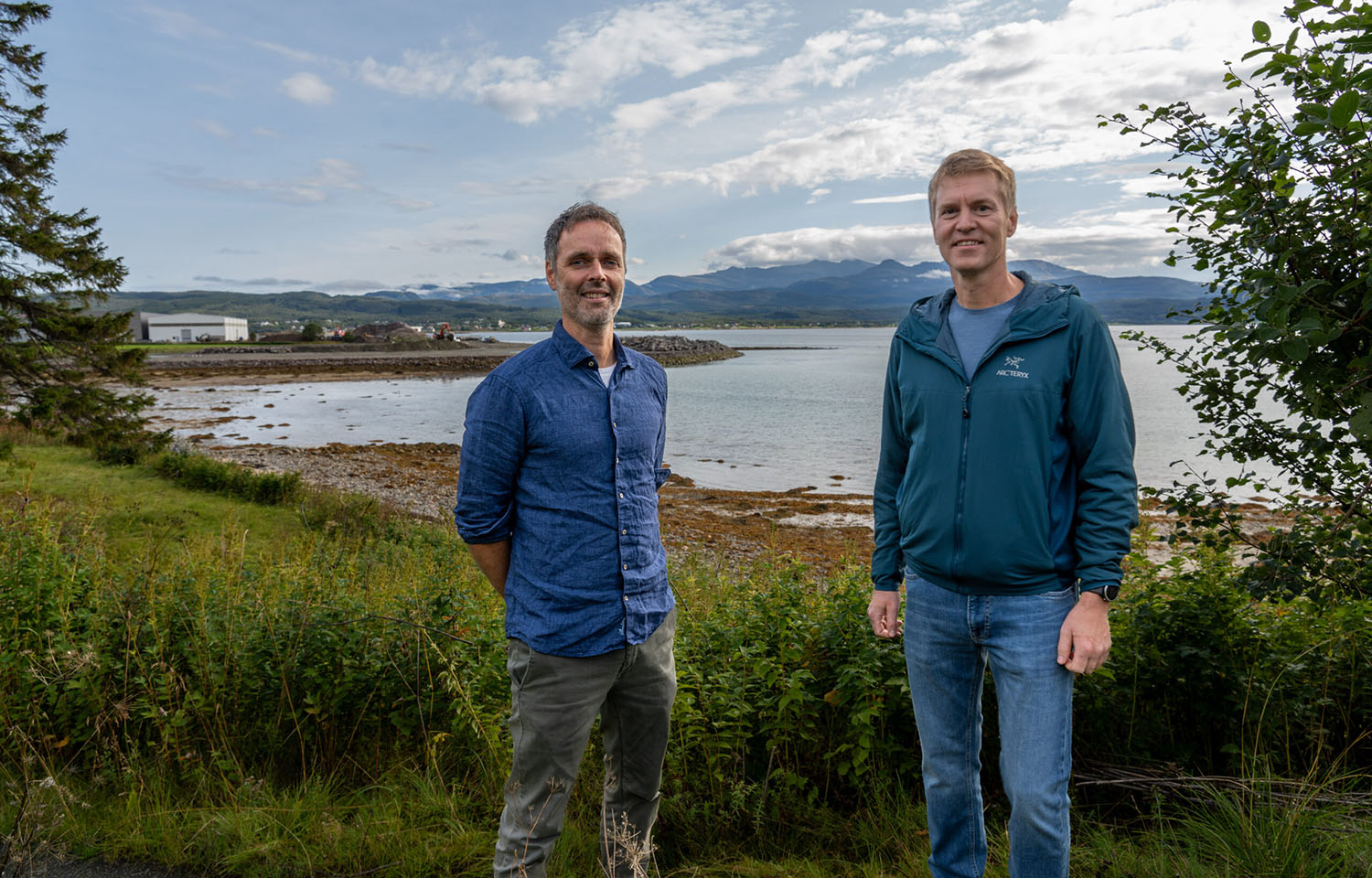
Family-owned Norwegian salmon farmer Nordlaks Group has purchased a 70-acre plot of land in Rødskjær, Norway, for NOK 143 million (USD 13.5 million, EUR 12.2 million) as the first step toward constructing a new smolt facility.
The company said it signed the contract for the land on 23 September, and will begin working to prepare the plot for construction soon. The company said the new facility will add to its three existing smolt facilities in Innhavet, Mørsvika, and Nusfjord. The new facility will be larger, with capacity to house several million fish, according to Nordlaks Executive Director Eirik Welde said.
“If we manage to achieve what we want here at Rødskjær, it will have major ripple effects,” Welde said.
According to Nordlaks, the project will cost at least NOK 1 billion (USD 94.6 billion, EUR 85.7 million).
Nordlaks said the facility will allow it to raise larger smolt on land before they are released to the sea. The company said the goal is to grow smolt of between 500 grams and a kilogram – up from the industry standard of 150 to 200 grams.
“By allowing the salmon to grow larger on land, we reduce the time the salmon live in the sea. This reduces the risk of disease and the salmon is less exposed to lice,” Nordlaks Smolt Operations Director Øivind Skjevling said. “It simply provides better fish welfare. To achieve this, we need more smolt facilities.”
The strategy of releasing larger smolt into the sea is being adopted by a number of different salmon aquaculture companies in Norway, including Mowi and Grieg.
Nordlaks said the strategy will allow it to make better use of its existing locations, and increase its overall salmon production.
The company said it is now starting the planning and application process for all relevant sectors and agencies to begin constructing the facility. It estimated the work will take two to three years, and construction will start in 2027 at the earliest.
In its most recent results report, Nordlaks said its salmon production decreased slightly to 45,000 metric tons (MT) in 2023, down from 54,000 MT in 2022, due to biological challenges.
“It has been a challenging year. We have had attacks by string jellyfish, a high incidence of lice due to the hot summer and winter sores,” Welde said in the company’s 2023 results. “That's not how we want it to be and when it comes to lice and winter sores, we work purposefully with lice lasers and vaccine development.”
The company posted NOK 4.82 billion (USD 456 million, EUR 412 million) in revenue in the period, an increase of NOK 370 million (USD 35 million, EUR 31 million) from 2022. However, its profit after tax was NOK 560 million (USD 53 million, EUR 47 million) – down NOK 469 million (USD 44 million, EUR 40 million) from 2022.
Nordlaks paid NOK 436 million (USD 41 million, EUR 37 million) more in taxes in 2023 compared to 2022 as the result of the Norwegian government implementing a salmon-farming tax.
“The consequences of a significantly larger share of the profit going to tax is that planned investments are delayed, we reduce the scope, or put them away altogether,” Welde said.
Welde said higher taxes led the company to reduce its original plan of buying 100 acres down to 70 acres.
“When our investment capital is so significantly reduced, there are of course consequences, but we are still very happy to take a step forward in realizing this project,” he said.
