



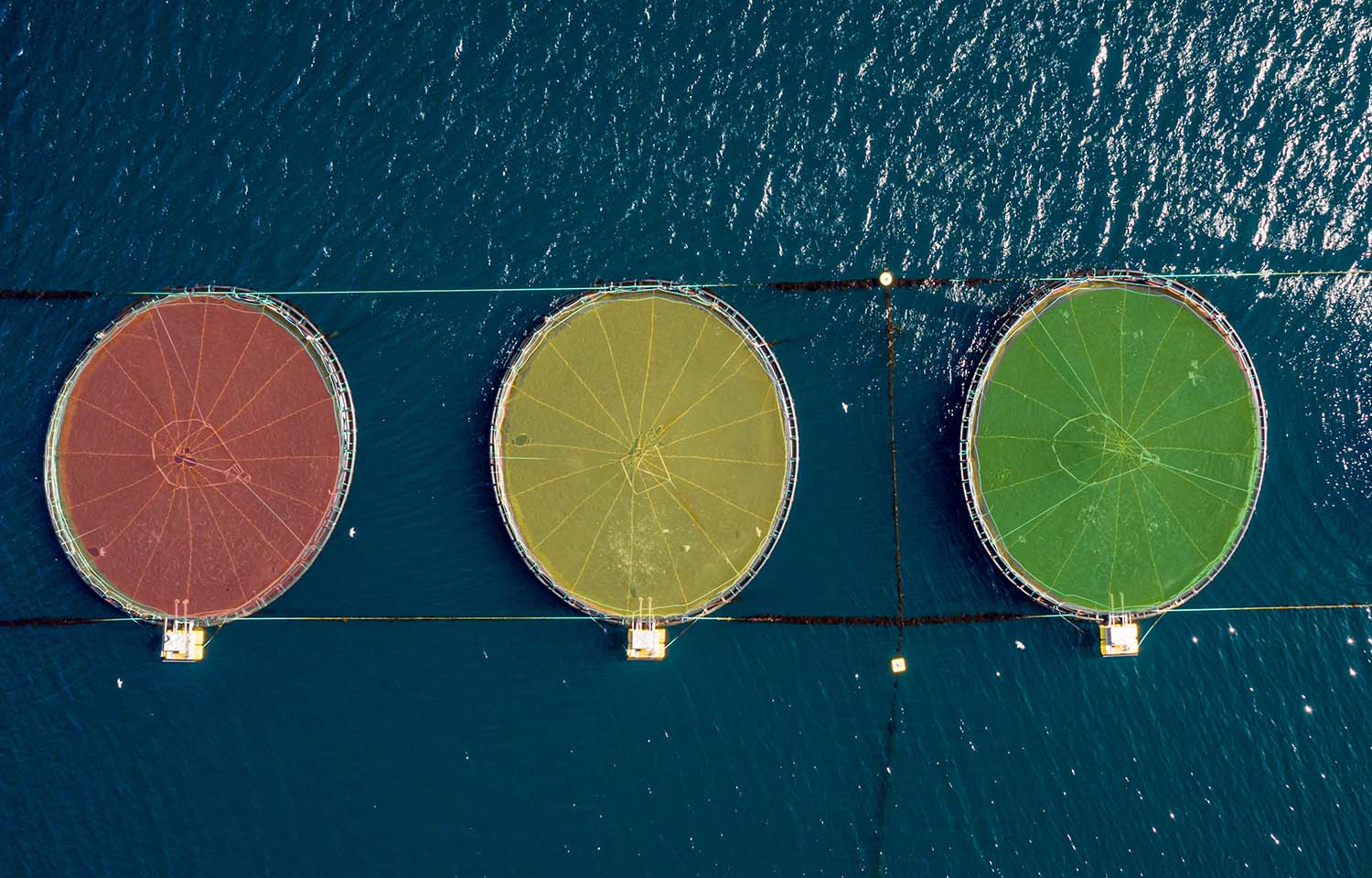
The Norwegian Ministry of Trade, Industry, and Fisheries has established new colors for the 13 production areas covered by its traffic light system of managing salmon farming.
Norway uses the traffic light system as a means of managing salmon production based on the risk of sea lice to wild salmon, dividing the coastline into 13 production areas that each get assigned either green, yellow, or red. The system was put in place in 2017, and production capacity of farms in the regions has been determined by the colors since then, with green lights allowing for growth of up to 6 percent, yellow freezing production, and red requiring downward adjustments of 6 percent.
According to the ministry, for the period spanning 2026 and 2027, production areas 1, 12, and 13 have been given the green light; areas 2, 4, 5, 6, 7, 8, 9, 10, and 11 have received a yellow light; and Area 3 has received a red light.
The latest announcement marks the third time capacity has been reduced in Area 3.
Seafood organizations protested the new capacity restrictions and reductions, saying the ministry’s decision will impact the industry.
“The government is painting Karmøy and Øygarden (Production Area 3 – PO3) red for the third time,” Seafood Norway said on its Facebook page. “This means thousands of lost jobs, several billion kroner in lost value creation, and many hundreds of millions of kroner in lower revenues for the municipalities.”
Seafood Norway pointed to the current regulation system and said there’s nothing in it that currently requires red lighting and that any time the government decides to hit a region with a red light, it is a “political choice.”
The move also comes soon after the Norwegian Institute of Food, Fisheries, and Aquaculture Research (Nofima) put out a report on the socioeconomic impacts of red traffic lights, indicating Western Norway has lost 2,000 jobs as a result of previous capacity cuts.
“Downsizing is not a theoretical exercise in a ministry office. It has already led to the loss of thousands of jobs and several billion in annual value creation,” Seafood Norway CEO Geir Ove Ystmark said.
The organization said the latest cuts will cause a loss of 500 jobs and NOK 700 million (USD 71 million, EUR 62 million) in economic value creation.
“As mentioned, there is nothing in the regulations or legislation that states that the government must impose red coloring on coastal communities and the aquaculture industry,” Seafood Norway said. “On the contrary, the socioeconomic consequences of different choices may be relevant to the ministry's assessment. It does not seem to have mattered, not this time either.”
Norwegian Minister of Fisheries and Oceans Marianne Siversten Næss published a whitepaper in 2025 with proposals to revise the traffic light system, which would have tied allowable biomass at farms to the prevalence of sea lice at farming sites. That proposal was put on hold, and salmon companies filed a class action suit in October 2025 demanding an end to the traffic light system, though that lawsuit has not yet been heard.
Norway also released a review of the traffic light system in December 2025, indicating that Area 3 had a high potential impact on wild Atlantic salmon – the driving reason behind the red light.
