



The Norwegian salmon-farming industry is grappling with what authorities have called an “explosive” growth in sea lice, as the industry continues to struggle with biological issues.
A recent press release from the Norwegian Institute of Marine Research (IMR) said sea lice numbers have never been higher in northern Norway than they are now.
“In the north, we saw an explosive increase and doubling of the number of louse larvae this summer,” IMR Researcher Anne Dagrun Sandvik said.
Certain areas of Norway saw massive increases in sea louse larvae, IMR said. Production Area 12 saw its sea louse larvae levels jump to levels many times higher than seen in the last three years, and while other areas were not quite as extreme, many northern areas saw higher than normal lice levels.
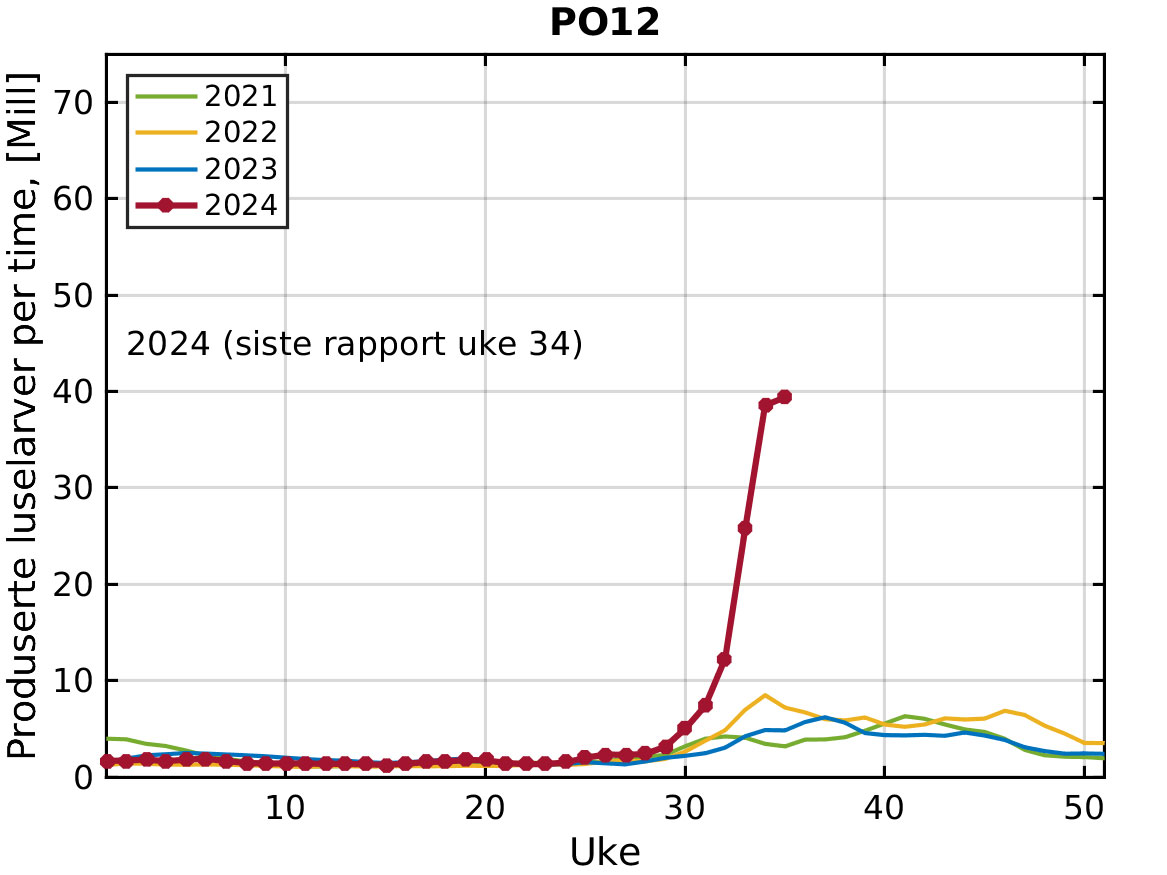
Sandvik placed the blame for the explosion in lice production on warmer water and said salmon farmers measuring the temperature in the north at a depth of 3 meters found temperatures to be much higher than normal.
“The temperature at 3 meters has been 3 to 4 degrees [Celsius] above what is usual in the north, which has given the lice a huge advantage,” she said.
At higher temperatures, sea lice life cycles progress faster, allowing lice to become adults sooner and multiply, IMR said.
“This, in turn, leads to more lice, both adults and young, at the same time,” IMR said.
The increased lice levels come as Norway is already facing challenges with its biology. Throughout early 2024, Norway was producing a high percentage of “production-grade” farmed Atlantic salmon, the lowest-quality type of salmon. Under Norwegian regulations, production-grade salmon is illegal to export.
Salmon-farming companies Grieg and Mowi have faced challenging conditions in 2024 – whether it be string jellyfish incidents or parasites. The issues came after a 2023 which saw multiple outbreaks of infectious salmon anemia (ISA) and pancreatic disease.
Antibiotic sales to Norwegian salmon farms were also higher in 2023, reaching 548 kilograms – up from 123 kilograms in 2022.
Norway’s health authority also recently denied expansion to Froya Laks to operate a salmon-farming facility, citing disease issues in the area it requested for expansion, and on 9 September, the Norwegian Food Safety Authority established a restriction zone for combating ISA in the Froya and Hitra municipalities after Masoval notified it discovered the presence of the disesase on its salmon – signs the industry’s battle with ISA continues.
Aud Skrudland, a technical director with the Norwegian Food Safety Authority, reportedly said the industry is facing a challenging period at the recent AquaNext aquaculture conference in Norway.
Dagbladet reported that Skrudland said the industry is heading in the wrong direction, with too many fish having poor welfare. She also criticized the traffic light system Norway uses, claiming it has failed to bring about the necessary changes to prevent issues.
According to Dagbladet, she said open wounds on salmon were a main reason that many of them had to be downgraded to production fish, and the traffic light system – which mainly uses sea lice concentrations – has failed to maintain conditions for salmon farms.
“The big mistake that happened is that the only indicator here is salmon lice not measured in the individual facility but indirectly on lice on wild fish,” Skrudland said.
Skurdland’s criticisms of the traffic light system were echoed by Firda Seafood Group President Ola Braanaas, who said the traffic light system has failed in a LinkedIn post.
“It does not take fish welfare into account, on the contrary, those farmers who have the best welfare and who stay within the framework of the lice regulations are punished the hardest,” he said. “This happens at the same time that others with poor fish welfare are rewarded by being able to buy growth.”
