





Tilapia-farming firm Regal Springs has unveiled a new large-format product it believes can help address tightening global whitefish supply.
Simultaneously, the firm released an open industry standard designed to scale production beyond its own operations.
Regal Springs currently produces between 60,000 and 90,000 metric tons (MT) of tilapia annually, with CEO Graham Ellis describing the company as “the world’s largest fully integrated producer of premium tilapia.” Ellis also said the company has around 1,000 nets currently in the water and noted that it was the first such firm to achieve Aquaculture Stewardship Council (ASC) certification.
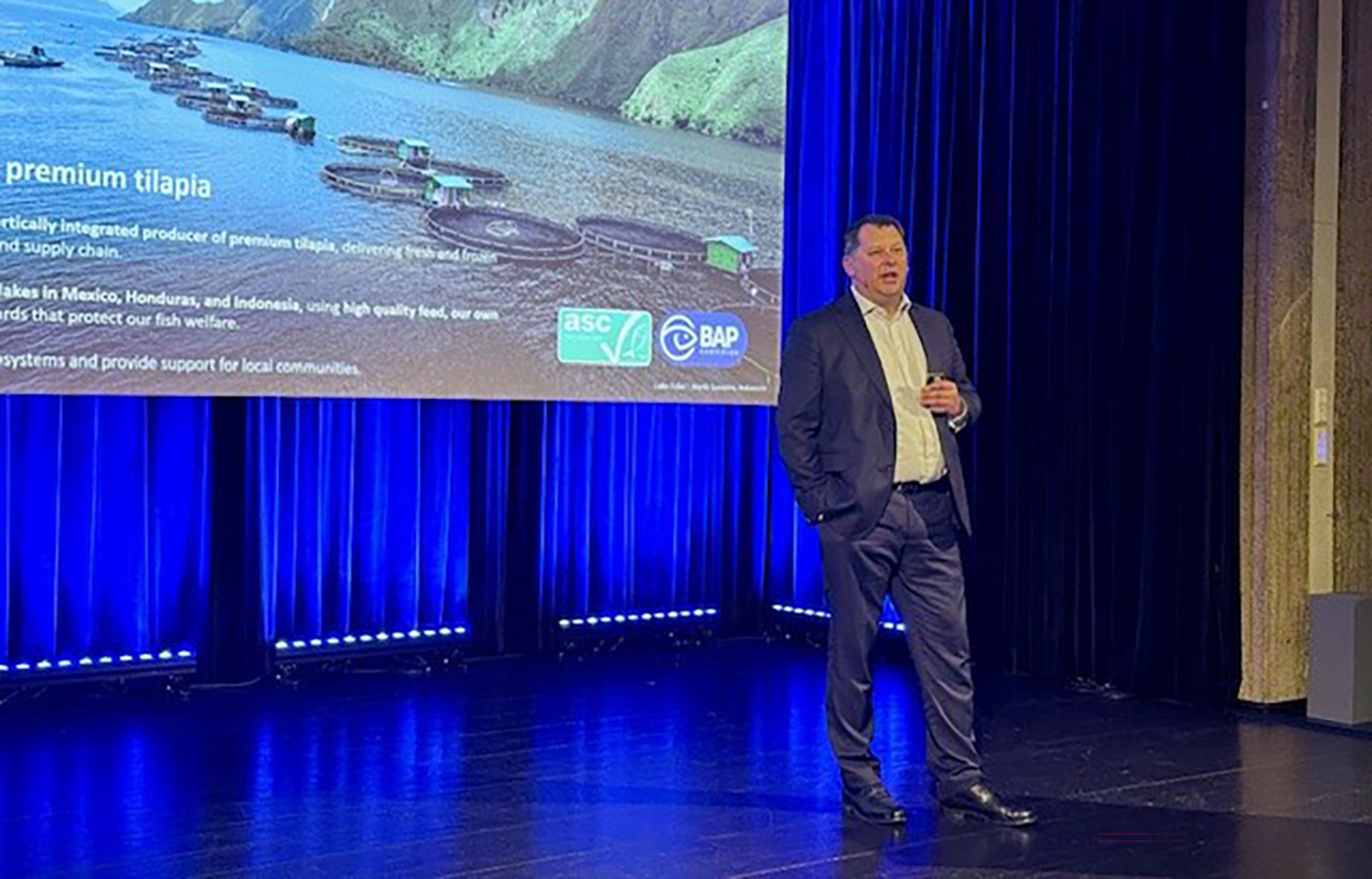
Speaking at the 2026 North Atlantic Seafood Forum (NASF), Ellis introduced “King Tilapia,” a 1.5-kilogram fish positioned as a premium, versatile alternative to wild-caught species such as cod and haddock, which are experiencing quota cuts in key locations.
“The reality is pretty tough to avoid,” he said. “Whitefish is under pressure. Long-term menu planning, if you're a buyer, is getting harder and harder.”
Ellis explained that Regal Springs’ strategic focus in the near term is now firmly fixed on closing the widening gap between global whitefish supply and demand.
According to Ellis, rising prices for traditional whitefish species are leading buyers and consumers to consider alternatives. Commodity tilapia, though, has largely failed to fill the gap due to quality compromises associated with low-cost pond farming, uncontrolled feeding, stress, and post-harvest handling, he said.
“That lowest-cost system does not necessarily create a high-quality outcome,” Ellis said, explaining that Europe and North America are unwilling to accept flavor, texture, and yield trade-offs.
Regal Springs’ answer is a fundamentally different production model, he said. Its tilapia is farmed in deep-water net pens in clear, oxygen-rich freshwater environments, using high-quality floating feed, genetics programs that allow fish to reach larger sizes, and electrical stunning to protect flesh quality. Furthermore, all its fish are processed and frozen within 90 minutes of harvest.
The latest result of these upgrades, Ellis said, is the King Tilapia: “a 1.5-kilogram giant – almost double the size of the largest size you see in the industry.”
The larger fish enables production of thick, 4-ounce loins, comparable in size to a chicken breast and opening up new culinary applications.
“It delivers a thicker cod-like loin,” Ellis said. “It cooks perfectly white. It flakes. It cooks beautifully in curries, poaching, and frying.”
Critically, the flavor profile is clean and neutral, Ellis added.
“There is no way we can get a vegetable taste because we know our fish has been eating,” he said.
Meanwhile, recognizing that Regal Springs alone cannot meet European demand, Ellis also announced the launch of an open “King Tilapia” standard. This covers feed benchmarks, animal welfare, size and grading, processing, and taste and texture and is open for other producers to adopt.
“We’re very happy to invite anyone who wishes to join us in the industry to do more of this,” he said, adding that two such companies have already joined the initiative.
Regal Springs expects to place around 10 million pounds of King Tilapia into the market this year, volumes of which are “virtually all sold out,” with strong interest already extending into next year.
“This is clearly a product which the industry is interested in looking at,” he said.
