



University of Stirling postdoctoral researcher Simão Zacaria – who won the 2020 Global Aquaculture Innovation Award for his research on shrimp eyestalk ablation – has now demonstrated that alternatives to the practice could be cost neutral or even cost saving for shrimp farmers.
Eyestalk ablation, a common practice where shrimp farmers remove one or both eyestalks from a female shrimp to encourage her to lay eggs, has been coming under increasing criticism from retailers and animal rights groups. In August, Tesco outlined a new policy banning the practice as nonprofit groups called on the shrimp farming industry to move away from it.
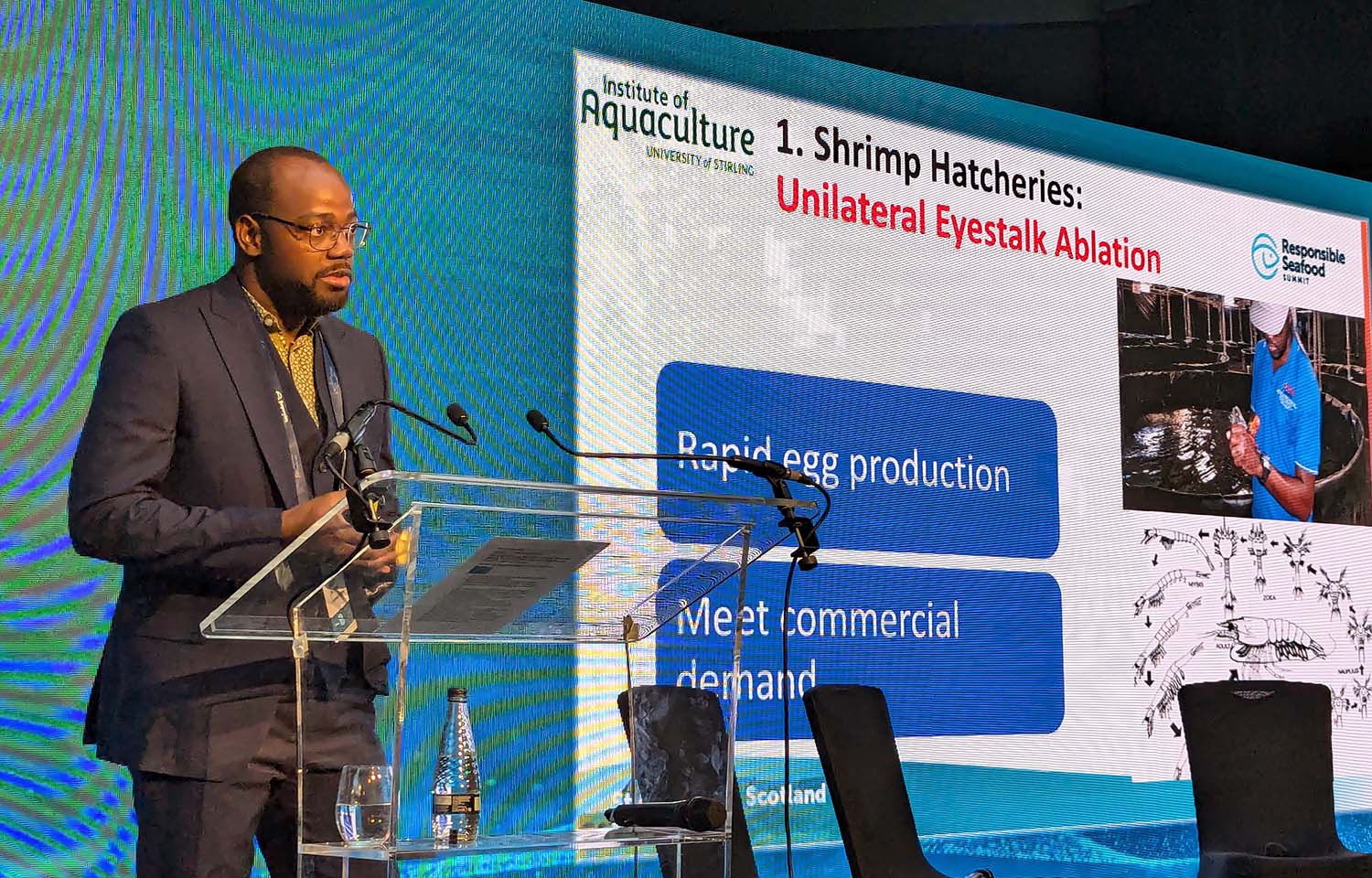
During the 2024 Responsible Seafood Summit, Zacaria revealed that his continued research shows that shrimp farmers can move away from eyestalk ablation in ways that will benefit their businesses in the long run.
According to Zacaria, proper feeding and nutrition for shrimp broodstock can allow them to mature faster and generate the hormones needed to induce egg production. Essential fatty acids like EPA and DHA played an important role in the rapid maturation and spawn of non-ablated females, he said.
Zacaria's also said that proper nutrition is necessary for males, as his research found healthier males also result in healthier shrimp in the hatchery and better results.
Another important factor in moving away from eyestalk ablation is a solid genetic line that is more domesticated. Zacaria said research has found certain strains of broodstock perform similarly to ablated animals under the right commercial conditions.
Other hatchery practices are still important for farms moving away from ablation, Zacaria said. Good water quality, the photoperiod used, the hatchery design, and staff training will continue to be as important as they were when eyestalk ablation was used.
“It’s important for the hatcheries to improve the protocols, and these protocols can be site specific,” Zacaria said.
The long-term benefit of moving away from eyestalk ablation – aside from the avoiding criticism from certain nonprofits and retailers – is the better results from broodstock. According to Zacaria, shrimp that were spawned from a non-ablated female outperformed shrimp from an ablated female.
“We’ve demonstrated, and the industry who have adopted non-ablation, they’ve seen that the offspring from the animal produced without eyestalk ablation usually have a higher survival rate,” Zacaria said.
The non-eyestalk ablation shrimp are more resilient in the face of stress or disease and perform better during farming – which in the long run brings them into parity with farms using eyestalk ablation.
Zacaria said farms in Honduras, Ecuador, around Asia, and at Unima in Madagascar have all successfully established good breeding programs and are viably raising shrimp without using eyestalk ablation.
When a farm is moving away from eyestalk ablation, it doesn’t need to do it all at once, Zacaria said. He recommends ending the practice in phases, to make sure that hatchery protocols can be dialed in a little at a time. According to his research, it could take three years to fully optimize hatching protocols – but in the long run, it is beneficial both economically and from an animal welfare standpoint.
“We can do it, we really can move from ablation to non-ablation,” Zacaria said.
