


Land-based salmon-farming company Atlantic Sapphire has stabilized production at Phase 1 of its Miami, Florida, U.S.A.-based recirculating aquaculture system facility, but the company still needs an additional USD 94 million (EUR 84 million) to build out infrastructure to allow it to become profitable.
During its Q2 2024 and H1 2024 results presentation, Atlantic Sapphire CFO Gunnar Aasbo-Skinderhaug said the company needs USD 11 million (EUR 9.8 million) for development of Phase 2 of its RAS facility and USD 25 million (EUR 22 million) will help remove bottlenecks at the facility.
Specifically, the money will be used for "further optimization towards Phase 1 proven state through further fine-tuning of the facility for a safer production environment and improved biomass gain."
The company's losses widened in Q2 2024, with its adjusted earnings before interest, taxes, depreciation, and amortization (EBITDA) dropping to a loss of USD 46 million (EUR 41 million), from USD 33.4 million (EUR 29.9 million) in losses in Q2 2023.
Atlantic Sapphire's earnings increased, reaching USD 11.2 million (EUR 10 million), up from USD 8.1 million (EUR 7.3 million) in Q2 2023. It harvested 2,395 metric tons of gutted-weight salmon, up from 870 MT in the same period of 2023. And it recorded a better EBIT per kilogram, but still took a loss of USD 20 (EUR 18) on each kilogram of gutted-weight salmon it produced.
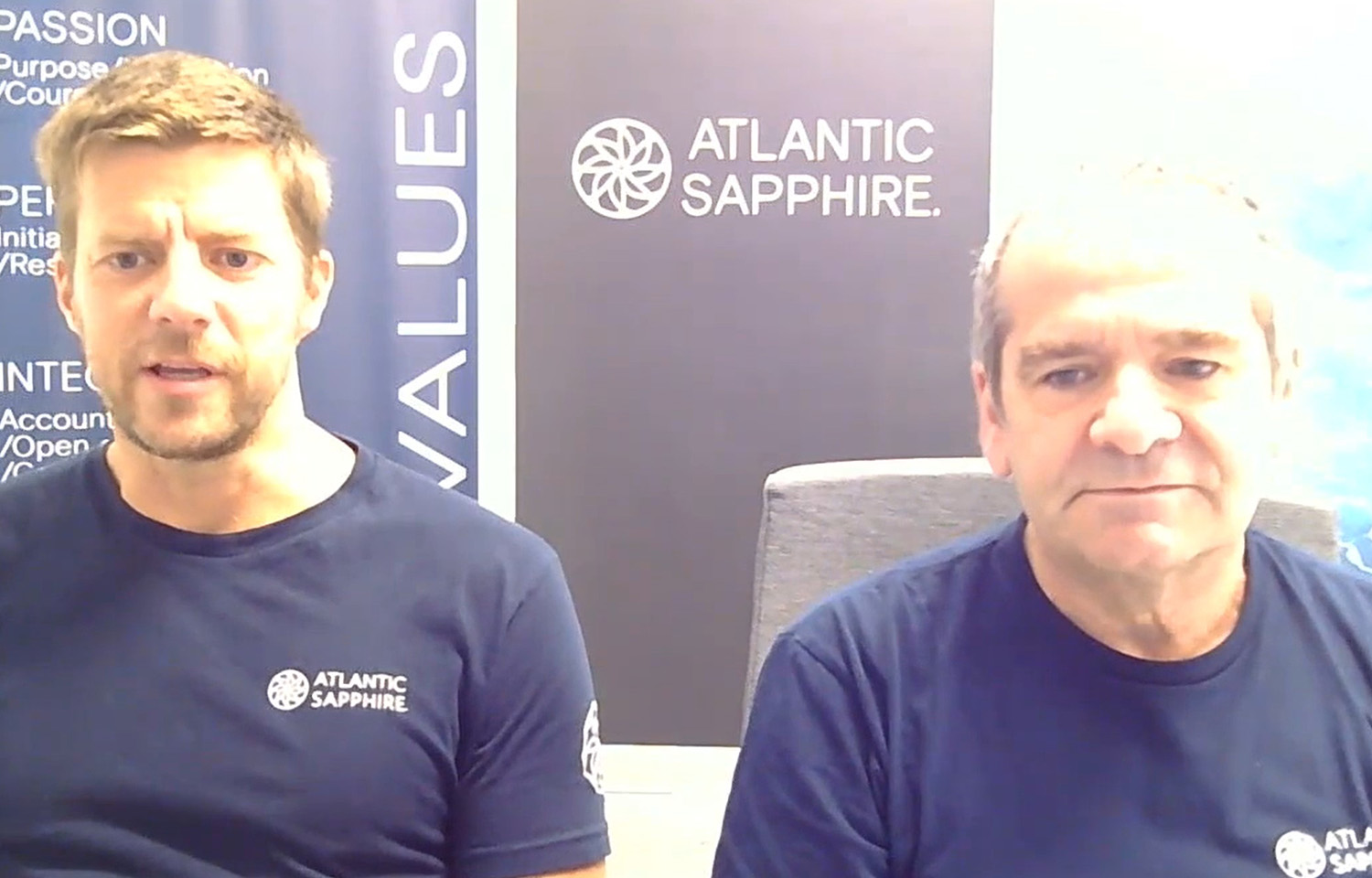
According to Atlantic Sapphire CEO Pedro Courard – who took the role in May, replacing longtime CEO Johan Andreassen after he stepped down on October 2023 – the company is poised to post a profit for the first time.
“We are starting a period where we plan to achieve full utilization of Phase 1 while we prepare the next step by finishing the Phase 2 decision process,” he said. “Our plan, together with better sizes of fish, as well as constant consistent production, is to increase our prices and at the same time optimize the operation in terms of performance and cost.”
Courard said Phase 1, as a proof of concept, will have an output that proves Atlantic Sapphire can raise fish to be sold at a premium price in the American market. Once operational, Phase 2 will reach an EBITDA of above USD 100 million (EUR 89.6 million) – if the company achieves an EBIT of USD 5.00 (EUR 4.48) per kilogram of fish.
Atlantic Sapphire has achieved lower mortality rates since it changed protocols in October 2023, achieving stable water qualities and temperatures. The company struggled with water temperature in Q3 2023, which caused the company to undershoot its biomass targets.
“This situation produced bad-quality fish, both in terms of color and average size, affecting sales price,” Courard said.
Atlantic Sapphire said its average sale price was USD 4.60 (EUR 4.12) per kilogram.
“The lower sales price have given lower revenue and thus lower cash flow for operation,” he said. “This is the main negative deviation compared to earlier plans.”
Courard said that with the operational changes and new equipment, fish quality has improved. The company has produced salmon averaging three kilograms head-on gutted for the past four consecutive weeks, he said.
Aasbo-Skinderhaug acknowledged that the company “is in a bit of a paradox, with good biological performance, stable growth, increasing fish weights, stable conditions, while the financial situation is a very challenging one for the first half of 2024.”
Aasbo-Skinderhaug and Courard said that the company has a path to profitability – but it will take investment to achieve it. To that end, the company announced a proposed underwritten rights issue of up to USD 60 million (EUR 53 million) on the Oslo Børs, subject to approval at an extraordinary general meeting of the company’s board of directors on 17 September.
So far, certain shareholders including Nordlaks Holding, Condire Management, and Strawberry Capital – along with external investors – have underwritten the equivalent of USD 60 million (EUR 53 million). The company is also obtaining a convertible loan, and the combination of the rights issue and the loan will be USD 80 million (EUR 71 million), Aasbo-Skinderhaug said.
Courard said his firm had a “longer challenging period than expected,” but said it is now in a new chapter as it attains stable production and ramps up harvests.
“In addition, we plan to finalize the design and engineering for Phase 2 in the first quarter of 2025,” he said. “Once Phase 2 is fully implemented, Atlantic Sapphire should reach a very healthy profitability, compensating the shareholders that have had the courage to invest in the most advanced land-based company and in a technology that will probably be the future of the salmon industry in the world.”
