



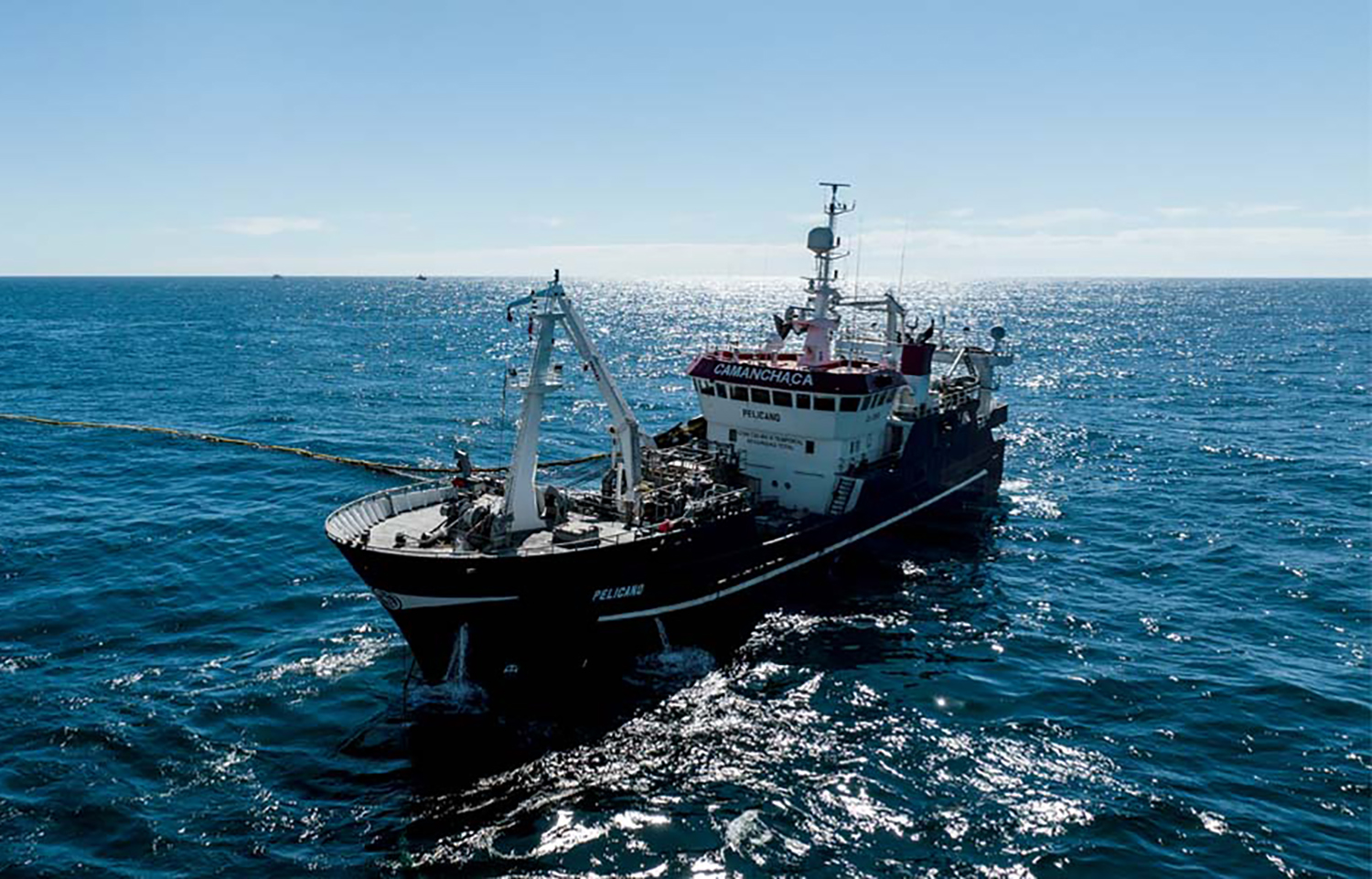
Following up on a positive 2024, Chilean fishing and salmon-farming firm Camanchaca saw its profits jump 95 percent year over year during the first quarter of 2025, largely thanks to higher sales of frozen horse mackerel coupled with lower costs of operation in its salmon-farming division.
In the three-month period, the company’s top-line revenues inched up 1.4 percent to USD 218 million (EUR 193 million) from the USD 215 million (EUR 190 million) posted in the first quarter of 2024, as the higher horse mackerel sales helped to offset a 7 percent decrease in salmon sales.
Camanchaca’s Q1 2025 EBITDA before fair value jumped 80.6 percent year over year to USD 41.9 million (EUR 37.1 million), which was evenly split between its fishing and salmon divisions. The fishing division’s EBITDA contribution was 17 percent higher compared to one year ago, while the input from its salmon-farming division increased four times over from the first quarter of 2024.
Net profits for the quarter reached USD 12.5 million (EUR 11.1 million), compared to USD 6.4 million (EUR 5.7 million) posted in the first quarter of 2024. The company also highlighted that it had brought its net debt down to USD 151 million (EUR 134 million).
Broken down by business, the fishing division’s pelagic catches – including horse mackerel, mackerel, sardines, and anchovies – processed at the company's plants reached 173,000 metric tons (MT), which was 49 percent higher than the 116,000 MT processed in Q1 2024.
In Camanchaca’s salmon-farming division, Q1 harvests of Atlantic salmon reached 12,600 MT whole fish equivalent (WFE) – 27 percent higher than that harvested in the first quarter of 2024. Sales volumes of Atlantic salmon increased 11 percent year over year in the period, while costs of operation in the division fell 14 percent over the same period to USD 4.51 (EUR 3.99) per kilogram WFE thanks to healthy fish, a recovery of average weights, and a drop in the cost of feed.
Camanchaca CEO Ricardo García was upbeat about the results, but he cast doubt on the future owing to external factors affecting both salmon farming and wild-caught operations in Chile.
“The recovery of the results is a reflection of our efforts to be more efficient and take good advantage of our aquaculture concessions and fishing licenses, processes that have been developing for some time now, reducing our indebtedness to be more competitive and less vulnerable to the risks we face,” he said. “We are cautious about the development of the second half of the year due to the obvious regulatory risks that exist in Chile, to which commercial risks in international markets have been added.”
In regards to salmon farming in Chile, stakeholders have called on the nation’s government to more clearly define its stance on the future of aquaculture.
“Chilean salmon is the second-most exported product by our country, at about 1 million MT per year, with returns of USD 6.5 billion [EUR 6 billion] per year, generating more than 70,000 jobs and representing an average GDP of 18 percent in the [southern salmon-farming] regions of Los Lagos, Aysén, and Magallanes,” Chilean Salmon Council Corporate Director Rodrigo Pinto told SeafoodSource. “However, public policy for growth and development is clearly lacking. That must be corrected, soon, and with the participation of everyone.”
The current lack of a unified plan for aquaculture in Chile is seen by the industry as a source of multiple complications, especially as there is an overlap of interests between the Indigenous population, conservationists, the salmon-farming industry, and artisanal fishers over the use of the nation’s waters.
Similar anxieties exist in the country’s wild-caught industry as Chile recently introduced a new fishing bill that would see more quotas go to the artisanal sector if passed.
He noted that Camanchaca would wait to see the final version of the new fishing quota bill to evaluate the measures the company would take.
“The fishing quota bill’s serious impact on private property and legal certainty is like dynamite on the spirit of companies that want to progress in Chile,” García said. “The future of fishing is being defined … and if the bill is approved as is, it will have very serious repercussions on the activity and employment of the sector and will force us to sue the state.”
Camanchaca, together with fellow industrial fishing firms Blumar and Austevoll, have previously said they would consider legal recourse if the bill passes because they believe the proposed reduction of their quota, to favor artisanal fishers, is a form of expropriation.
