






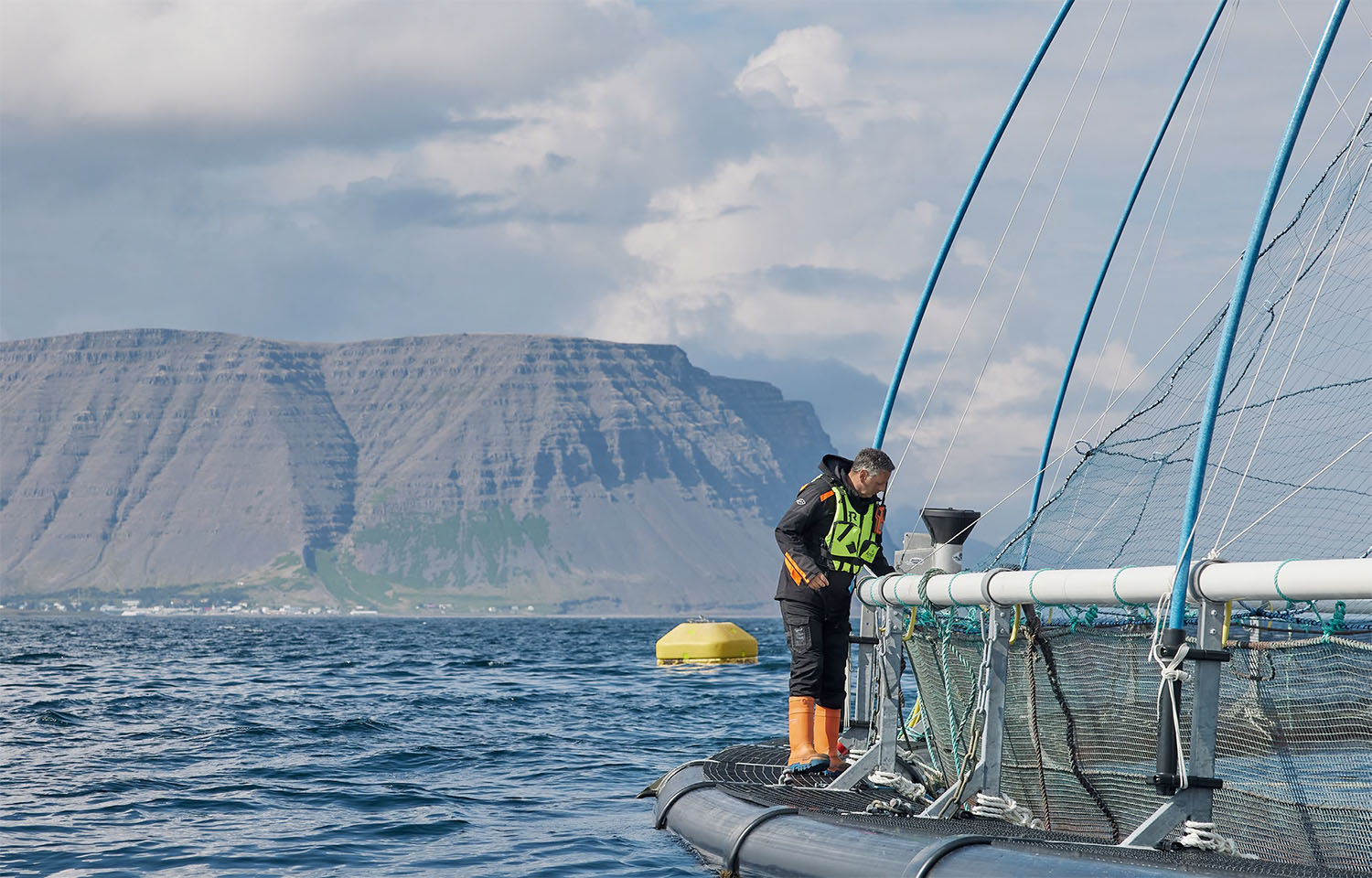
Bíldudalur, Iceland-headquartered salmon-farming firm Icelandic Salmon reported drops in its revenue, EBIT, and harvest volume as the company continues to recover from challenging biological conditions.
Icelandic Salmon, the parent company of Arnarlax and other salmon-farming and -processing subsidiaries, first listed on the Oslo Børs in October 2023 and, soon after, ended up struggling due to biological challenges. In Q1 2024, the company confirmed it faced biological issues, unusually high mortality rates at sea, and high costs.
In its Q3 2024 results, the company – which is majority-owned by Norwegian salmon-farming company SalMar – said it is on the path to recovery and it has stabilized its conditions after a difficult winter and spring.
"Consistent efforts by our entire team have driven operational improvements across our value chain, from sea to land. We have focused on growing our biological assets,” Icelandic Salmon CEO Björn Hembre said. “Strong smolt performance, a reduction in underlying costs in the beginning of Q4, and solid price achievement underscores that we are on the right way."
The company reported a harvest of 1,750 metric tons (MT) in Q3 2024, less than half the 4,040 MT it harvested in the same period of 2023. That low harvest was in part due to the company prioritizing a build-up of its biological assets after being forced to harvest a significant portion of its standing biomass for biological reasons.
Due to the lower harvest, Icelandic Salmon’s revenue also dropped to EUR 14.3 million (USD 15 million) in Q3 2024, down from EUR 41.9 million (USD 44.1 million) in Q3 2023. The company also posted a drop in its EBIT, falling from a positive EBIT of EUR 3 million (USD 3.1 million) in Q3 2023 to a loss of EUR 3 million in Q3 2024.
Icelandic Salmon said the year-over-year decline was largely driven by the lower volumes and biological challenges it had, which led to a one-off cost of EUR 400,000 (USD 421,000). The company’s EBIT per kilogram for the quarter fell to a loss of EUR 1.71 (USD 1.80), compared to an EBIT per kilogram of EUR 0.73 (USD 0.76) in Q3 2023.
Despite the lower revenue and EBIT, the company said its outlook is positive, given the strong demand it saw for the salmon it did harvest. According to Icelandic Salmon, the company achieved a superior grade of as high as 95 percent in the quarter for its salmon, and it achieved good results in North America.
“Icelandic Salmon has a competitive advantage in the North American market, as it can transport its fish by sea,” the company said. “This means lower transport costs and a lower CO2 footprint, which is highly appreciated by key customers. For the third quarter, 25 percent of sales was to the North American market.”
Icelandic Salmon also said it lost a license for Ísafjarðardjúp, Iceland, because the Icelandic Food and Veterinary Authority “had not provided a sufficiently comprehensive, weighted assessment of the potential risk of the spread of fish diseases and parasites before the license was issued.” Icelandic Salmon said it is working with Icelandic authorities to remediate the situation and regain the license.
Looking forward, the company said that the biological challenges will continue to impact its results into 2025 and will affect its harvest volumes next year. The majority of its harvest volume will come in Q3 and Q4 in 2025. Its harvest guidance for 2024 remains 13,000 MT, and it expects to harvest 15,000 MT in 2025.
"For the longer term, we see significant growth potential of up to 26,000 MT on our current licenses and are confident in our ability to reach this ambition.” Hembre said. “This ambition aligns with our stakeholders' vision, and we have a close dialogue with the authorities, lenders and other partners to drive this growth going forward.”
