





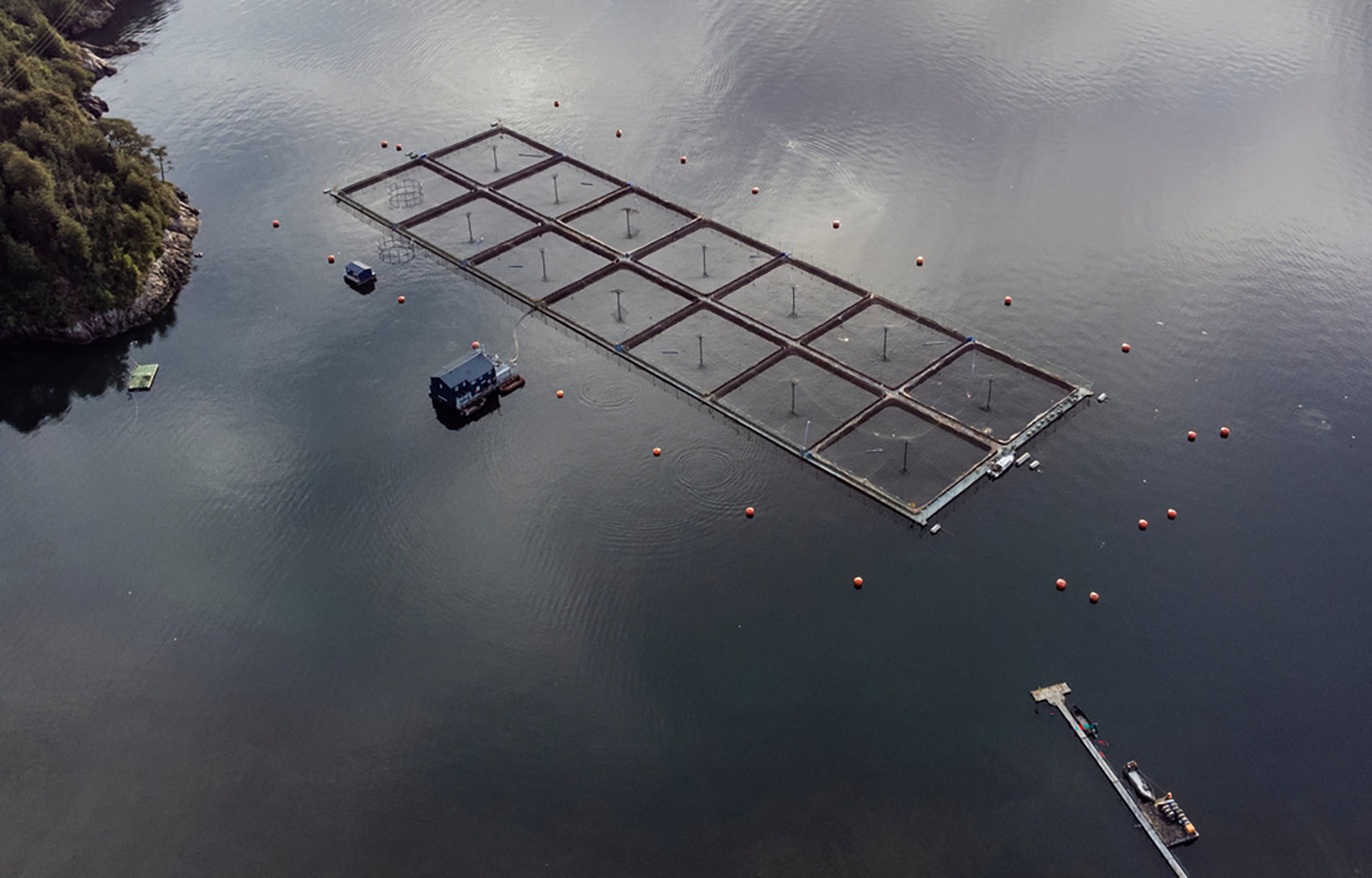
A constitutional court in Chile recently struck down a bill that would have allowed salmon-farming firms to forgo additional environmental assessment reports when moving their operations short distances.
If approved, that procedure – known in Chile as “micro-relocations,” where a firm might attempt to move operations as little as a few meters to take advantage of more favorable variables such as depth, currents, waste dispersion, and oxygenation – was expected to improve salmon farms’ productive, sanitary, and environmental performance without altering their authorized area or increasing biomass limits.
Just before the constitutional court ruling, Chilean salmon-farming association SalmonChile noted that the ability to relocate had been “trapped” in the system for over 15 years, with only two relocations approved out of more than 1,000 submitted applications.
“Unblocking it will provide legal certainty, promote sustainability, and make productive development compatible with environmental protection, in addition to safeguarding more than 86,000 jobs and the activity of more than 4,000 SMEs that are part of the aquaculture chain in the southern regions of Chile,” it said.
SalmonChile President Patricio Melero further noted that “micro-relocations … make it possible to reconcile environmental stewardship with the well-being of farmed salmon.”
The constitutional court’s decision to strike down the procedure represents a direct blow toward the sector’s ambitions.
The Chilean Salmon Council said it respected the constitutional court’s institutionality but noted the initiative achieved broad support as it made its way through Chilean Congress, with backing from different sides of the political spectrum and significant consensus in both the lower and upper houses.
“As a council, we fully respect the institutionality, and we will analyze the ruling in its entirety. At the same time, the broad support that this measure achieved in Congress shows that there is a shared diagnosis: Chile needs solutions that allow it to produce better, generate employment, and take advantage of the capacities it already has,” Salmon Council Executive President Loreto Seguel said.
Following the ruling, the council made a presentation to the lower house’s Fisheries, Aquaculture, and Maritime Interests Committee outlining measures that could be taken to recover efficiency while driving sector growth.
For its part, the government pledged to analyze the constitutional court’s decision while exploring administrative and legislative alternatives – including new proposals within the constitutional framework – “to provide certainty, unblock investments, and generate jobs in the sector.”
“The decision to declare unconstitutional the possibility of exempting the micro-relocation of up to 350 meters from environmental assessment is not good news for the country's fisheries and aquaculture,” Economy Minister Daniel Mas said. “As government, we respect the decision of the constitutional court, but we reaffirm a very clear commitment, especially for the workers in the south of our country, that our government will work tirelessly to reactivate this sector by taking measures to promote job creation, increase production, and continue to promote Chile as an aquaculture power.”
The Economy Ministry emphasized that the challenge now is to find ways to reconcile the constitutional court's ruling with the need to provide certainty, advance the recovery of investments, and increase productivity.
Chilean salmon farming has experienced a period of lower productive dynamism during the last decade compared to its historical trajectory of expansion. Overall annual harvests remain at about 1.1 million metric tons (MT), with no new concessions granted since 2020, the Chilean Salmon Council said.
“Chile cannot afford to miss opportunities for growth that’s within reach,” Seguel said. “Specifically, we are talking about resolving restrictions that today prevent the better use of existing capacities and transforming that potential into development for the [Southern] regions and for the country.”
She also reiterated previous calls for Chile to implement an updated strategic plan for salmon farming development, driven by public-private collaboration and long-term considerations.
