

The California Department of Fish and Wildlife (CDFW) plans to inject 350,000 Chinook salmon eggs into the North Yuba River this fall as the state government looks for new ways to help struggling salmon populations recover.
This is the second year CDFW has taken this approach, collecting eggs fertilized at the Feather River Fish Hatchery in Oroville and then hydraulically injecting them into the river’s gravel substrate in November.
The department said the program is a “multiagency, multifaceted effort to bring the state and federally listed threatened species back to its historic coldwater spawning and rearing habitat” that has been blocked by dams for centuries. During the first year, CDFW, the Yuba Water Agency, NOAA Fisheries, and the U.S. Forest Service injected roughly 300,000 fertilized spring-run Chinook salmon eggs in the North Yuba riverbed. In the spring, 42 hatchery-raised adult spring-run Chinook salmon were also released into the river.
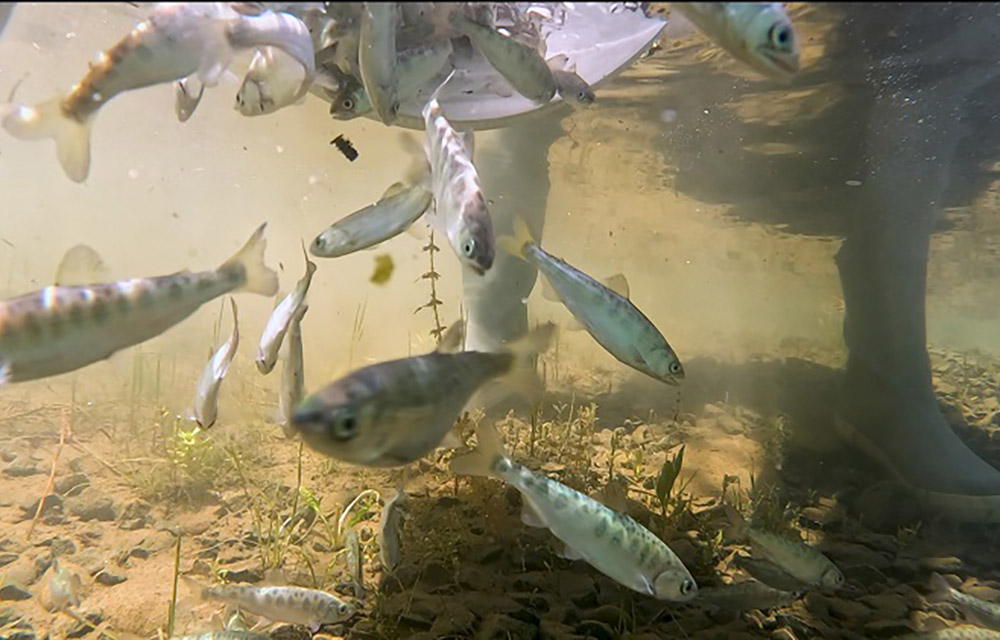
CDFW has since detected juvenile salmon spreading out through the river and expects a natural spawn to take place this fall.
“The return of adult salmon to the North Yuba River is an exciting milestone, but it’s just one piece of the larger reintroduction strategy,” said Michelle Forsha, a senior environmental scientist with CDFW’s North Central Region. “Our goal is to evaluate multiple approaches that can help reestablish a self-sustaining population in this watershed.”
Salmon populations have struggled in California rivers as they face rising temperatures and fish passage blockages like dams.
Earlier in 2025, federal regulators canceled commercial salmon fishing along the California coast for the third straight year, and recreational fishing has also been limited.
Despite that, the federal government has aimed to cut salmon recovery spending under U.S. President Donald Trump.
Over the last several months, the administration has proposed defunding the Pacific Coastal Salmon Recovery Fund – which directs tens of millions of dollars toward salmon conservation annually – cut funding for salmon hatcheries, and pulled out of a salmon recovery agreement with Pacific Northwest states and Tribes.
Last month, CDFW announced it would be halving production at the Nimbus Hatchery on the American River due to decreased federal funding.
Still, the California state government has continued to put resources into salmon recovery.
In 2024, California Governor Gavin Newsom introduced the California Salmon Strategy for a Hotter, Drier Future and invested USD 50 million (EUR 43 million) in salmon recovery and habitat restoration. Earlier this year, CDFW made the decision to inject 3.5 million hatchery juvenile fall-run Chinook salmon directly into the Sacramento River for the first time.
“The naturally spawning Sacramento River salmon populations have been the primary driver of California’s commercial and recreational salmon fisheries for decades,” CDFW Fisheries Branch Chief Jay Rowan said in a statement. “The extra effort by our hatchery staff to maximize production has allowed us to take measures this year to speed up the rebuilding of these critical Sacramento River natural spawning areas. This significant shift in strategy speaks to CDFW’s long-term commitment to boosting these important salmon populations.”
