


Construction on an installation meant to block invasive Asian carp from entering the U.S. Great Lakes has finally begun, despite more than a year of back and forth between state officials and the administration of U.S. President Donald Trump on funding for the project.
“Construction is officially underway on the first phase of the USD 1.15 billion [EUR 987.3 million] Brandon Road Interbasin Project!” the U.S. Army Corps of Engineers, Detroit District said in a 20 May social media post.
Invasive carp are a major challenge to U.S. waterways, with the voracious fish outcompeting local species and spreading into new areas. Experts warn that they could cause major damage to the Great Lakes ecosystem if they are able to access it, sparking federal and state efforts to stop the carp’s northward march.
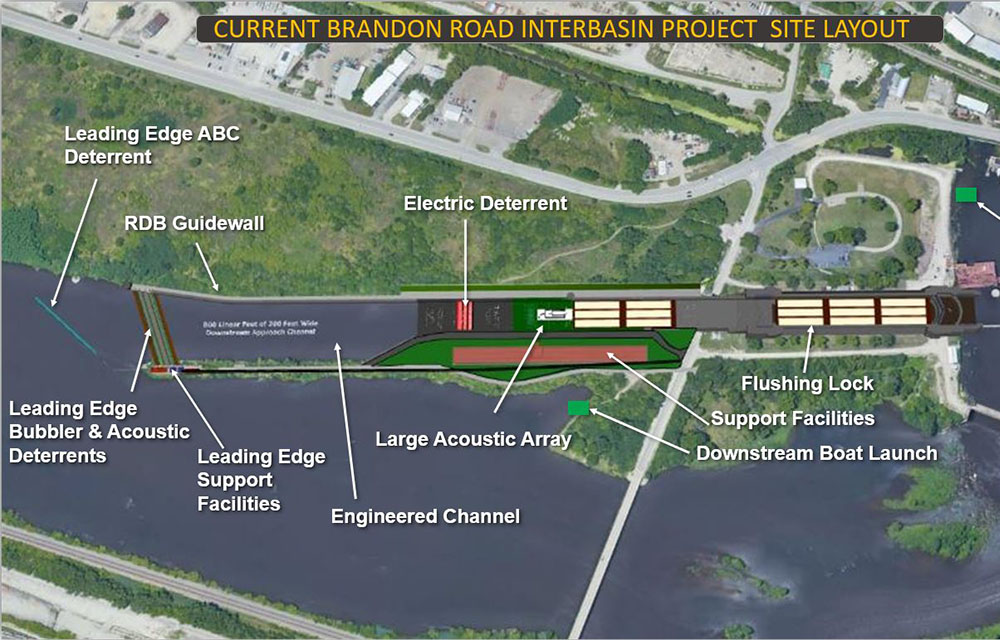
The primary attempt to halt the fish is the Brandon Road Interbasin Project near Joliet, Illinois, U.S.A. The complex project will establish multiple deterrents and barriers at a natural choke point between the carp’s current habitat and the Great Lakes, blocking their forward progress.
“Managed by the U.S. Army Corps of Engineers, Detroit District, this complex ecosystem protection effort acts as a strategic pinch point. By utilizing layered, innovative deterrent technologies, the project will prevent invasive carp and other aquatic nuisance species from moving upstream from the Illinois Waterway into the Great Lakes,” the U.S. Army Corps of Engineers, Detroit District, stated.
Despite a sense of urgency from experts and state officials, work on the project has been stymied by the administration of U.S. President Donald Trump, which has paused, or threatened to pause, federal funding for the project. With the administration pausing federal infrastructure funding in early 2025, the Illinois state government stopped work on the project until it could secure assurances from the federal government that congressionally approved funding would be made available. Ultimately, an April 2025 White House visit from Michigan Governor Gretchen Whitmer secured Trump’s support for the project to commence.
“It’s a very expensive thing – it costs a lot … but we have to save Lake Michigan because these fish, they eat everything in their way, even the other fish. They eat everything. Are people endangered by the fish?” Trump said at the time.
Trump then issued a memo directing the federal government to prioritize stopping Asian carp from spreading. Satisfied, the Illinois state government also moved forward with buying the necessary land for the project.
However, progress was halted again at the beginning of this year, when the federal government issued an administrative pause on the project, much to the chagrin of state officials and representatives.
“Moving this project forward is critical to protecting the Great Lakes from invasive carp,” Michigan’s congressional delegation said in a 15 January joint letter. “It has been thoroughly reviewed by Congress, the Army Corps of Engineers, and local partners, and its funding has been authorized and appropriated by Congress. The current review is unnecessary and could cause delays that put the Great Lakes’ ecosystem and fishing industry at risk.”
Illinois Governor JB Pritzker, who has previously criticized the Trump administration’s approach to the project, accused the president of breaking his promise to support it.
Whitmer once again traveled to the White House in March 2026, winning another statement of support from the president for the project.
“I’m working with Governor Gretchen Whitmer on trying to save The Great Lakes from the rather violent and destructive Asian Carp, which is rapidly taking over Lake Michigan, and all of the beautiful surrounds,” Trump said. “This is on top of everything else I am doing. Only ‘TRUMP’ CAN DO IT!”
Federal funding was finally released, though the Trump administration moved management of the project from the U.S. Army Corps of Engineers’ Rock Island-Illinois District to the Detroit District, accusing the state government of Illinois of being “an unreliable partner.”
“Our partners in the Great Lake States can’t allow one state to have undue influence and use it to play more games,” Assistant Secretary of the Army for Civil Works Adam Telle said in an 9 April social media post.
Pritzker was quick to push back on the administration’s framing, calling their decision to move management to Michigan a “political stunt.”
“Illinois has upheld our commitments. Trump must stop this political stunt and start releasing the funds, get the project moving again, and protect the Great Lakes,” he said. “Illinois owns the land the Brandon Road Project will be built on. Trump cannot just decide to give it away. If he breaks legally binding agreements, Illinois will take action.”
In the weeks since, the federal government has finally released funding for the project.
On 23 April, the Army Corps of Engineers awarded a task order worth up to USD 85 million (EUR 73 million) to Black & Veatch-Stantec BRIP JV of Overland Park, Kansas, U.S.A., “for architect-engineer services to support the project.”
In a 20 May post, the Army Corps of Engineers confirmed that construction had begun.
“Armed with USD 274 million (EUR 235 million) in federal funding and USD 114 million (EUR 98 million) in state funding, crews are setting the groundwork for the first of three major construction increments designed to safeguard our waterways,” the U.S. Army Corps of Engineers, Detroit District, said.
