






A new report from the Environmental Justice Foundation (EJF) has reignited scrutiny of Ghana’s industrial trawl sector, finding that large volumes of illegal bycatch – including juvenile fish critical to artisanal fisheries – continue to enter supply chains.
EJF’s report, “Breaking the Vicious Circle,” states that 53 percent to 60 percent of industrial trawler landings in Ghana consist of bycatch, much of it prohibited under national law.
Sampling of landed fish showed 96 percent of chub mackerel and 97 percent of round sardinella – species that trawlers are not permitted to retain at all and which are deemed the backbone of many African artisanal fisheries and coastal food security – were below minimum legal size.
EJF argues the country’s core problem is not the absence of regulation but the gap between legislation and consistent enforcement.
“The single biggest enforcement gap is the failure to consistently detect, prosecute, and sanction the use of illegal gear and the landing of undersized fish,” EJF Founder and CEO Steve Trent told SeafoodSource. “In short, there is still a gap between the law and its enforcement.”
Trent praised recent reforms under President John Dramani Mahama and Fisheries and Aquaculture Minister Emelia Arthur but warned that illegal practices remain economically viable.
“Offenses that should carry serious penalties are often either not prosecuted or pursued under lesser charges, such as dumping, which attract far lower fines,” he said. “Illegal nets and undersized bycatch are rarely seized. Without systematic at-sea monitoring and meaningful follow-through in the courts, illegal bycatch becomes a cost of doing business rather than a deterrent.”
Still, the report acknowledges tangible progress. For instance, illegal “saiko” transshipments – where industrial trawlers transfer frozen bycatch to canoes at sea – have virtually ceased compared to previous years. EJF has also documented a statistically significant increase in the average size of some small pelagic species following the introduction of new gear directives.
“There are also indications that discarding may have decreased,” Trent said.
Trent also explained the expansion of Ghana’s inshore exclusion zone (IEZ) to 12 nautical miles was a “major, much-needed structural reform” that has been strongly welcomed by artisanal fishers. Recent 12-month license suspensions for repeat offenders also signal a shift away from historically low fines.
Though some progress has been made, many bad actors have simply found a way around roadblocks, Trent said.
“Large volumes of undersized fish are still being landed, overwhelmingly so for species such as round sardinella and chub mackerel,” Trent said. “The trade … has adapted by shifting from sea-based transshipments to land-based distribution. The model has changed, but the incentive remains.”
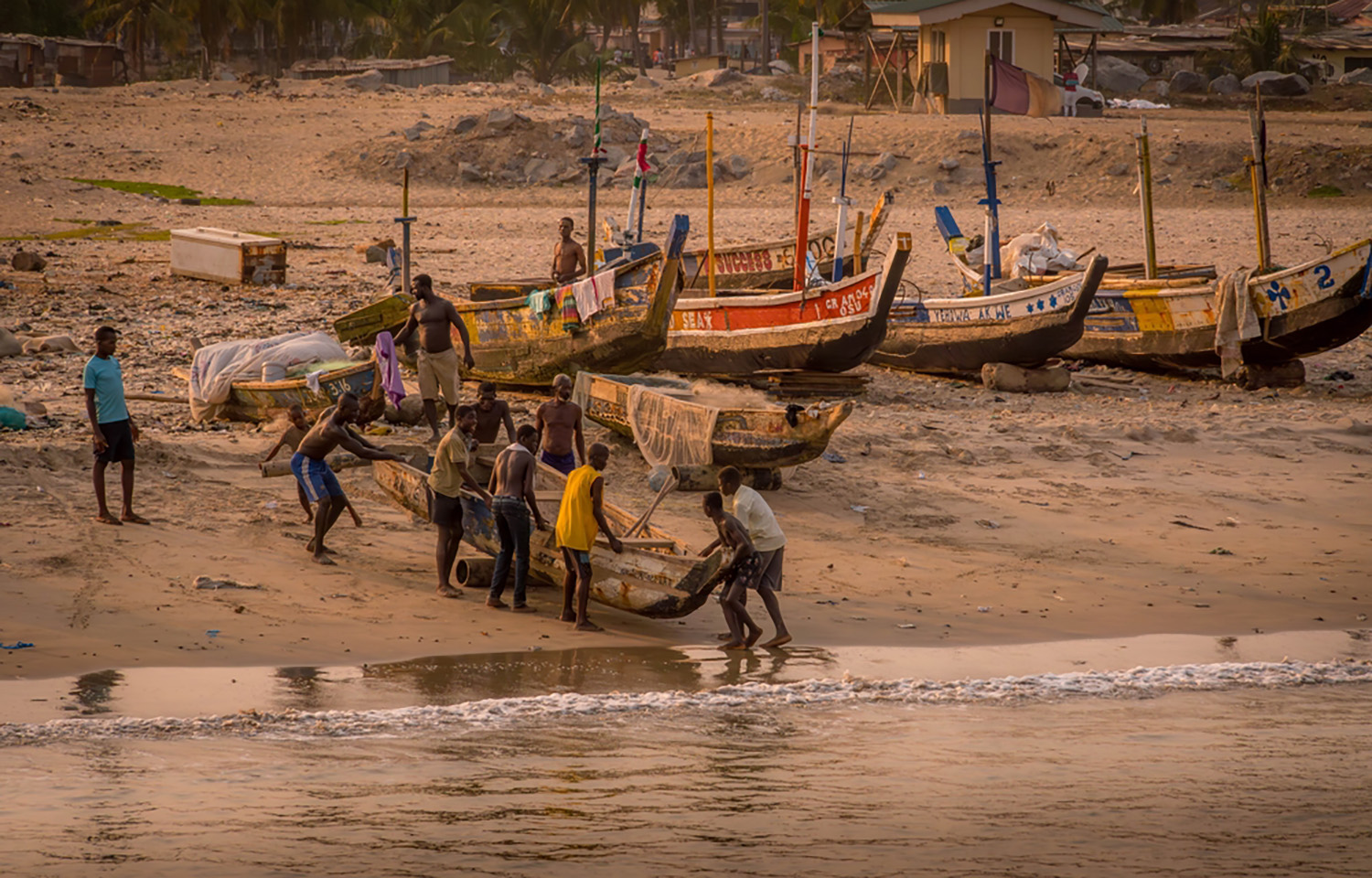
The continued pressure on small pelagic stocks is hitting artisanal fishing communities hardest. EJF surveys show 94 percent of artisanal fishers have reported declining catches, while 87 percent say their incomes have fallen in recent years.
Processors and traders – many of them women – face erratic supply and rising prices, while capital that should sustain coastal livelihoods is captured by industrial operators, many of whom are linked to foreign beneficial ownership that runs counter to Ghanaian restrictions.
The EJF report claims that one of the most effective tools for closing the enforcement gap would be electronic monitoring (EM) across the industrial trawl fleet.
“Technically, electronic monitoring, including onboard CCTV, could be rolled out within one to two years if it is treated as a priority,” Trent said. “The technology is mature and widely used globally. Ghana’s industrial fleet is relatively small, which makes nationwide deployment feasible.”
The main barriers, he said, do not include the technical feasibility of implementing EM but, instead, comprise financial prioritization and resistance from operators benefiting from the current state of opacity.
“If implemented transparently and paired with strong data review and enforcement protocols, electronic monitoring would close one of the most significant enforcement gaps and reduce disputes over what happens at sea,” Trent said.
Ghana’s endorsement of the Global Charter for Fisheries Transparency and commitment to publishing beneficial ownership data are also identified as pivotal steps.
“It is absolutely critical,” Trent said. “Our investigations have documented clear links between Ghanaian-flagged trawlers and foreign beneficial owners, particularly interests based in China. When ownership structures are opaque, accountability weakens, and profits can be externalized while environmental and social costs remain in Ghana.”
Without transparency, EJF warns, most enforcement remains superficial, allowing foreign-linked operators to absorb fines while coastal communities absorb the damage. The NGO said success must be measured in outcomes on the ground rather than policy announcements.
“Within two to three years, we would expect to see stabilization and, ideally, recovery in the size and abundance of small pelagic fish landed by artisanal fishers,” Trent said. “That would mean fewer zero-catch days, more predictable income, and reduced financial precarity.”
He added that processors should regain access to affordable, locally caught fish, while penalties and forfeited proceeds should flow back into the country’s Fisheries Development Fund and alternative livelihood programs.
Meanwhile, EJF’s message to responsible operators is unwavering: They should comply fully with Ghanaian law, Trent said.
“That means refraining from any modification that reduces gear selectivity, stopping the intentional targeting of small pelagic species, ensuring undersized fish are not retained for sale, and supporting full electronic monitoring coverage,” he said. “It also means committing to transparency on beneficial ownership and supply chains and implementing internal compliance systems that hold captains accountable.”
