






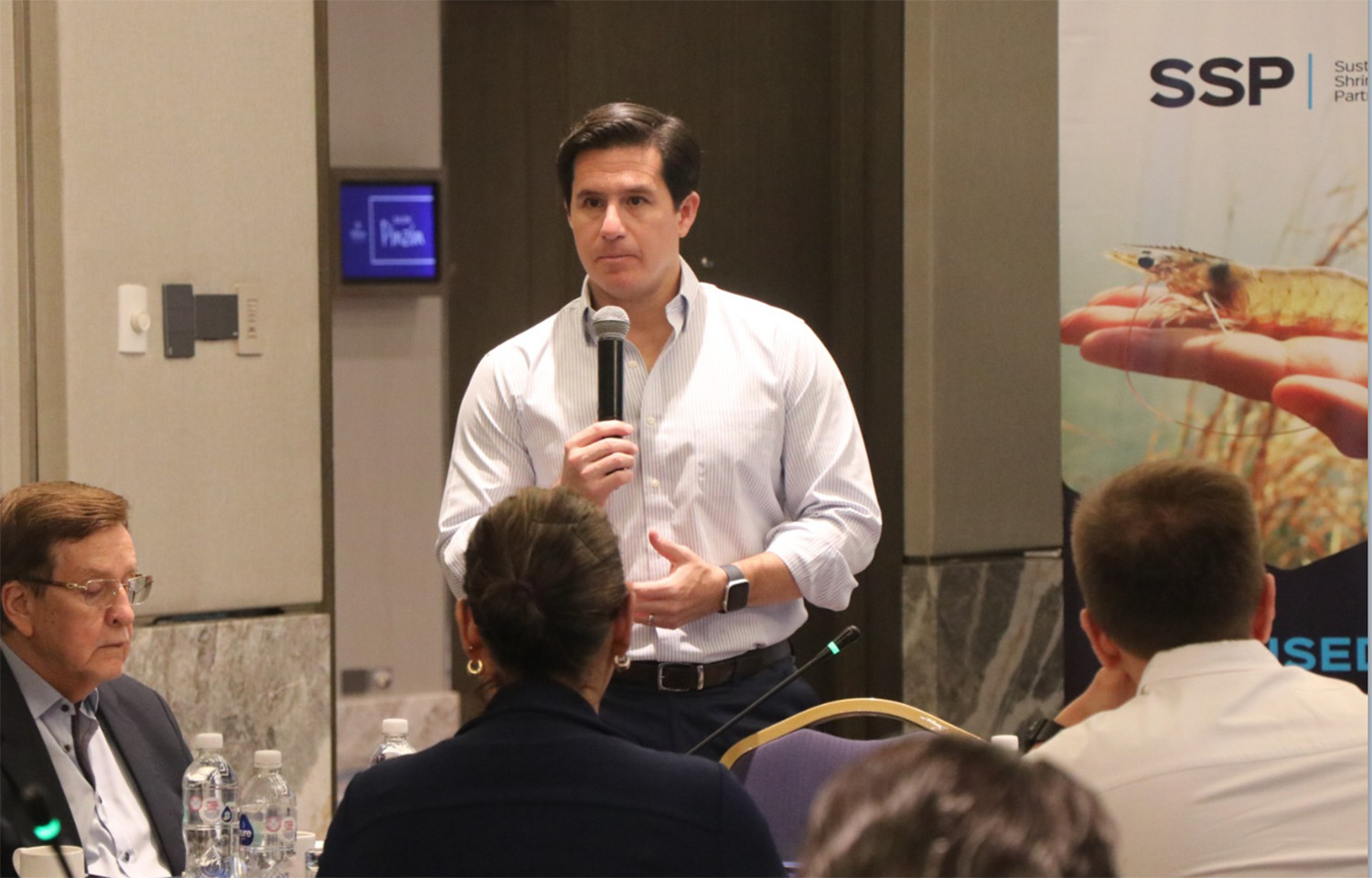
Ecuador’s National Aquaculture Chamber (CNA) and the Sustainable Shrimp Partnership (SSP) have launched a collaborative project that seeks to improve energy security in the nation’s shrimp sector and identify a scalable roadmap for its transition away from diesel energy to cleaner sources.
More than 30 participants will engage in the first phase of the project, dubbed the Energy Working Group, in collaboration with Ecuador’s Corporation for the Promotion of Exports and Investments (CORPEI). The group, which includes producers, processors, and feed companies, will focus on identifying possible bottlenecks that could hinder the transition to cleaner energy in the shrimp sector.
Those findings will then be used as a basis to develop a regulatory and operational framework to bolster energy security.
“The shrimp sector – the country’s main source of foreign exchange and its largest private employer – requires stable and reliable energy to sustain its growth and long-term viability,” CNA Executive President José Antonio Camposano said in a release. “Current demand exceeds the national electricity system’s capacity for generation, transmission, and distribution, and the state alone does not have the resources to meet this need. This is why private investment and close coordination with authorities are essential to advance energy projects.”
Camposano recently said that only about 10 percent of Ecuador’s shrimp farms are connected to the electrical grid, leaving 90 percent of farms using only diesel for their productive activities.
“There is a calculation from a CNA study that estimates between 1,000 and 1,500 MW of energy are required to be able to serve the 230,000 hectares of shrimp farms that exist in the country,” he said. “That represents a whole hydroelectric plant solely for the shrimp sector, so with that demand, we are proactively seeking to identify actors who can help us meet that demand and be able to go to the national government and tell them, ‘Here are several alternatives that take pressure off the national generation system.’ It is not simply a matter of saying that our demand is growing and the public sector must meet my energy demand.”
The Energy Working Group, Camposano said, represents a proactive stance taken by Ecuador's shrimp-farming sector to identify regulatory, procedural, and/or legal bottlenecks while also approaching the private sector for alternative solutions that would help alleviate demand on an already overburdened system that has been underfunded for decades.
“Transitioning to a cleaner energy matrix is no longer just an environmental commitment but also a key strategy to strengthen competitiveness and modernize the shrimp sector,” SSP Director Pamela Nath said, calling for regulatory stability to generate confidence and incentives for investment.
This initiative comes after power outages battered Ecuador for months in 2024, with adverse weather conditions particularly affecting areas where the country’s dams are located. This is especially problematic in Ecuador as hydropower comprises nearly 60 percent of the energy the nation generates. Power cuts were estimated to have cost the shrimp industry millions of dollars, and observers feared extended cuts would cause a mortal blow to the sector.
More recently, Ecuador has experienced national protests that began after President Daniel Noboa ordered the elimination of a USD 1.1 billion (EUR 936 million) state subsidy for diesel on 12 September. The cash-strapped government said the move would free up financing for social credits and programs, but it increased the price of fuel from USD 1.80 (EUR 1.53) to USD 2.80 (EUR 2.38) per gallon, sparking opposition from unions, students, and social and Indigenous organizations.
The government responded by declaring a state of emergency in conflict zones and a curfew in others. Camposano clarified that coastal provinces, where the vast majority of the country’s shrimp production is located, have not had major protest issues to date.
“Obviously, this is a situation that can change from one day to the next, and that is why we are connected with the authorities to be able to report immediately and avoid any potential blockages that can occur on the roads used by the shrimp sector,” he told local press.
Ecuador implemented similar economic measures in 2019 and 2022 which resulted in protests, as well, but Noboa said he “would prefer to die” than repeat those instances.
“We are not going backwards, like what happened in 2019 or 2022. We have to show firmness and heart with the people who really need it,” Noboa said.
The CNA said it would continue to monitor the situation and immediately denounce blockades.
“One thing is legitimate protest; as an association member, even I have expressed protest in situations that I considered unfair in previous administrations,” Camposano said. “But, at no time have you seen me encouraging the closure of roads or the blocking of a legitimate right that a third party has to be able to work. That is something we are going to denounce always. If we find that someone affects our legitimate right to be able to take the shrimp from the farm to a processing area, the food to a farm, or to take the food to our homes, we are going to denounce it, and we are going to ask that the public sector comply with what it has to do.”
Ecuador’s government put an end to diesel subsidies for large shrimp farms at the end of 2022, which the CNA criticized at the time as unfair and inopportune.
