






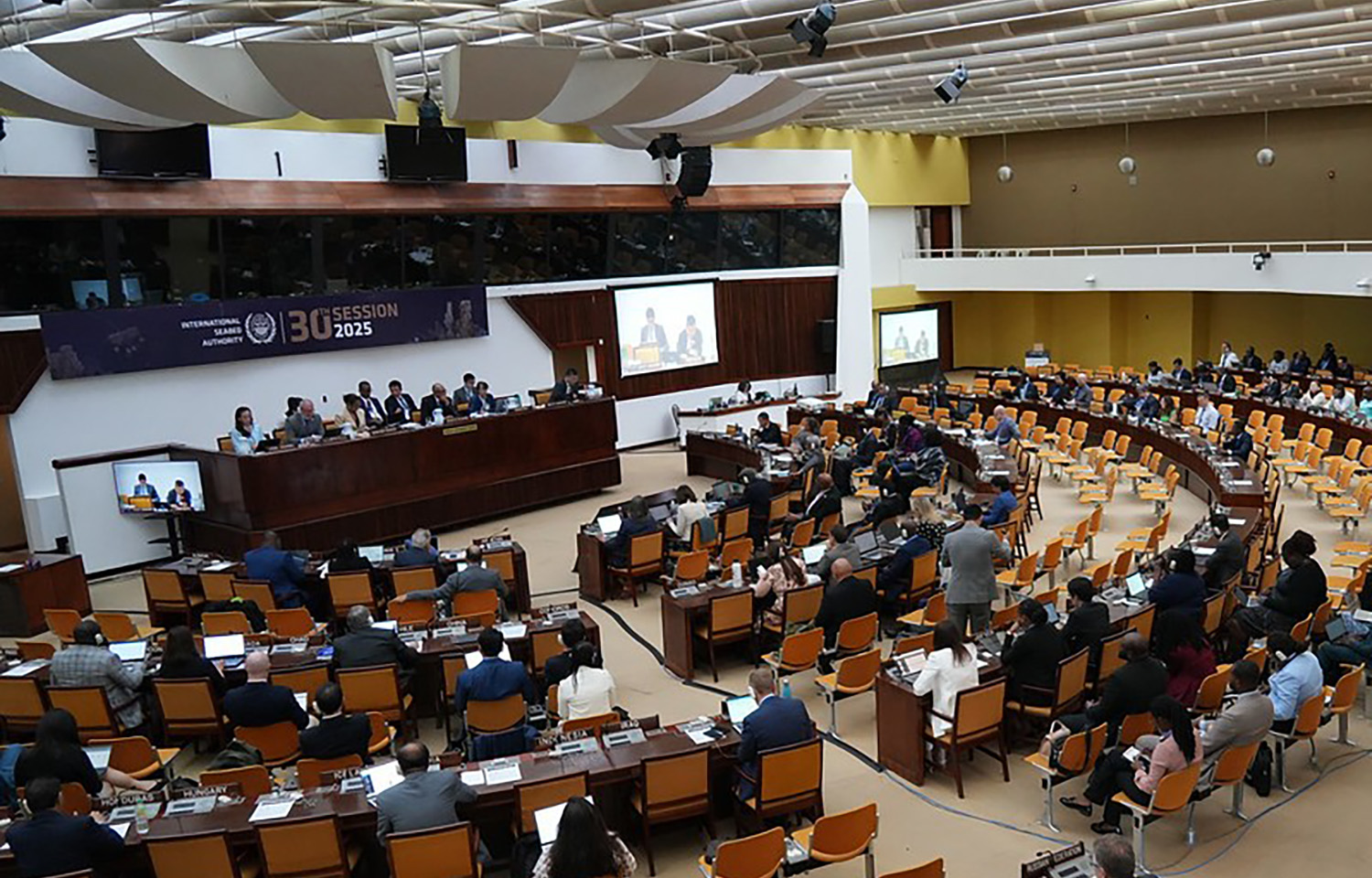
Experts returning from the annual meeting of the International Seabed Authority (ISA) in Kingston, Jamaica, warn increased efforts by The Metals Company (TMC) and the U.S. government to start seabed mining – despite a lack of authority approval – could have wider implications for the health of global fisheries and the rule of law at sea.
The push by TMC to start seabed minign comes as experts continue to assert the scientific knowledge needed to effectively and safely regulate mining of the deep seabed is still incomplete. Despite the continued pressure from regulatory bodies, TMC recently announced plans to commercialize its mining operation in the Clarion-Clipperton Zone (CCZ) – an environmental management area in the Pacific Ocean.
TMC is currently operating via exploratory permits granted by the ISA in 2011 and 2012, but the company is looking to fully commercialize mining operations in the deep sea. U.S. President Donald Trump agreed in March to fast track full permitting through NOAA, in defiance of the ISA and the Law of the Sea.
That push comes as the ISA Legal and Technical Committee works to establish thresholds of environmental harm to which the organization could hold mining operations. Pew Charitable Trusts Project Director Julian Jackson told SeafoodSource the research needed to set these levels was just beginning, and he urged the ISA to adopt a moratorium until it could establish regulations.
According to Jackson one of the most pressing issues are the scientific questions which are still unanswered about the effects of seabed mining on the environment.
“These regulations will take time, necessarily,” he said. “But fundamentally, the science isn’t there.”
One major environmental concern has to do with wastewater discharge, which would disperse toxin-rich and potentially radioactive sediment midway into the water column, potentially endangering ecosystems and fisheries.
Jackson pointed to early research by CSIRO, the national science agency of Australia, which tracked the bioaccumulation of heavy metals in the middle of the water column, where valuable species like tuna can ingest and be harmed by them – potentially passing heavy metals up the food chain to humans.
The authors of the CSIRO study echoed Jackson’s call for more research, saying that despite their ability to model how some heavy metals would disperse throughout the water column, much more knowledge of the varying density of metals in the seafloor was needed. The authors also said that research was needed into “the potential role of midwater species in transferring contaminants between deep and surface ecosystems.”
These and other concerns about the effects of seabed mining have led numerous organizations, including the Global Tuna Alliance (GTA), to sign on to a call for a moratorium on seabed mining. In a letter about its 2023 decision to call for the moratorium, the GTA cited concerns that discharge plumes “could disrupt the feeding and breathing of tuna and their prey, as well as increase fish stress hormone levels” and poison fish flesh with toxins. The GTA also said it was concerned about how noise and boat congestion could affect tuna behavior and migration patterns.
As work continues on what the impacts of sea bed mining could be, TMC said it sought commercialization permits through the Trump administration because it could no longer wait for the ISA to finalize regulatory processes for sea bed mining.
“We believe we have sufficient knowledge to get started and prove we can manage environmental risks,” TMC Chairman and CEO said at the time.
In an executive order announcing the decision, Trump said securing minerals extracted from the sea floor, including nickel, cobalt, copper, manganese, titanium, and rare earth elements, is a “vital” national security priority.
TMC's quest to mine the seabed predates the Trump administration, and Barron has been involved in seabed mining ventures (first at Nautilus, and then at Deep Green Metals, which later became TMC) since 2001.
Multiple experts who spoke to SeafoodSource argued that Barron’s claim that his company has the knowhow to mine the deep sea doesn't align with the regulatory decision making the ISA has been working on.
Jackson said the lengthy process to codify regulations at the ISA is a result of multiple challenges.
“One is the regulations, and two is the science. And then you need to recognize that the two are linked,” Jackson said.
He said that the process of setting up a regulatory framework gets more, not less, complicated as the environmental, social, and political consequences of seabed mining become understood.
“The more we work on it, the more gaps we see are there,” Jackson said. “With dozens of unresolved issues in the International Seabed Authority’s draft deep-sea mining regulations, the ISA still has significant work ahead before any rules can be completed. The threats facing the world’s largest reservoir of biodiversity are too great for haste.”
There are also a number of other concerns outside the environmental impacts. Jackson said there are cultural concerns to be considered, including the religious beliefs of people native to the Pacific – some of whom draw their origin story from the sea floor and see mining as an assault on their heritage.
Added to cultural impacts are economic concerns, particularly for countries where terrestrial mineral mining is a key industry. Multiple African countries – which participated in the ISA meeting – spoke of their concerns that seabed mining of manganese could flood the global market, lowering the value of their terrestrial mining operations, observers told SeafoodSource.
Greenpeace representative Arlo Hemphill, who also attended the ISA meeting, said he thought the challenge which TMC and the Trump administration had offered to the multilaterally-accepted Law of the Sea set a very dangerous precedent.
He said violating the mining provisions in the Law of the Sea – which designate the riches of the sea floor as the common heritage of humankind to be shared by all nations – could lead to a loss of the maritime privileges on which U.S. fishers depend.
Hemphill said The Law of the Sea is what protects U.S. fishers from foreign fleets in exclusive economic zones (EEZs). If the U.S. no longer follows the law, that could mean other nations could unify to challenge the U.S.’s right to the extended continental shelf, as they may not feel the U.S. is entitled to benefit from The Law of the Sea if it won’t comply with it.
If the U.S. is allowed to proceed in mining in international waters, Hemphill said, other countries will also likely begin to violate agreed-upon maritime codes. If the Law of the Sea broke down, freedom of navigation could be challenged, too.
“The Law of the Sea is the bedrock of maritime governance worldwide, and if that starts to become shaken and interpretable in new ways, then that’s less security for the fishing industry,” he said.
