






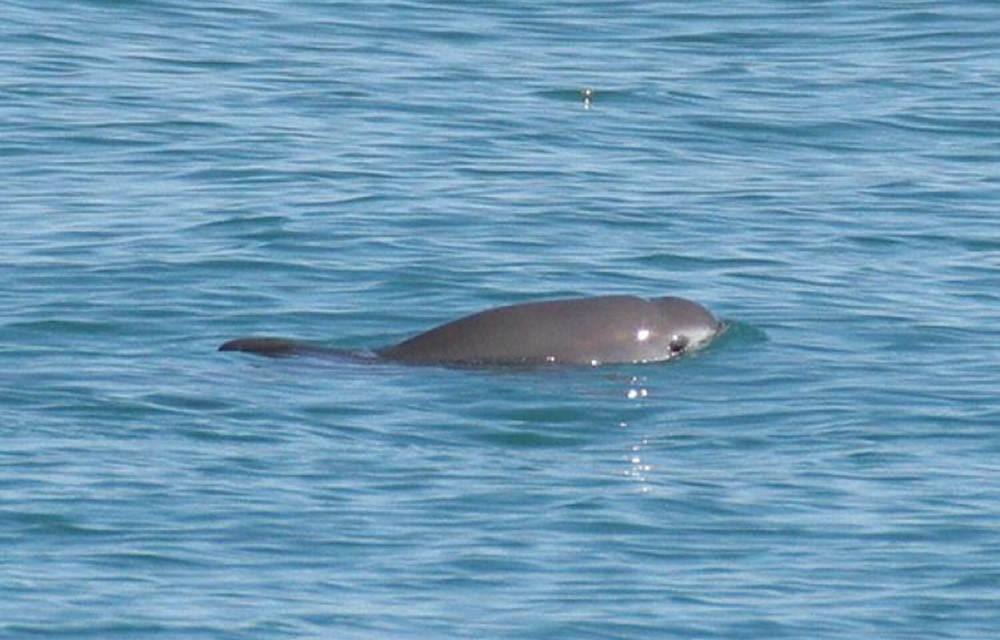
The Mexican government is considering shrinking the area where gillnets are currently prohibited to protect vaquita, an extremely endangered porpoise that exists exclusively in the Northern Gulf of California.
“With just a handful of vaquitas left, I’m stunned and appalled that the Mexican government is proposing to reduce measures to protect them,” Environmental Investigation Agency Senior Ocean Campaigner Sarah Dolman said in a release.
Researchers estimate that there are only seven to 10 individuals left in the wild – down from 567 in 1997 – making vaquita one of the most endangered species on the planet. The most recent survey found some small silver linings for the rare porpoises, including the birth of new calves.
“It also tells us several things: that the vaquita is still there, that it persists, that the downward trend has not continued, that there are even individuals we had not seen for several years – clearly spending time in other areas where we have not been monitoring – and that it continues to reproduce,” Marina Robles García, undersecretary of biodiversity and environmental restoration of Mexico’s Ministry of Environmental and Natural Resources, said last year. “The fact that a species continues to reproduce and appears healthy is the best indicator of its life, of its condition as a species, but also the best invitation to maintain our efforts, our hope, and our joint work.”
Despite that optimism, the Mexican government has continued to face international pressure and criticism over its efforts to protect the remaining vaquita. In 2023, the Secretariat to the Convention on International Trade in Endangered Species of Wild Fauna and Flora (CITES) sanctioned the government for not doing more to combat illegal fishing, one of the major threats to the porpoise. Illegal fishing for lucrative totoaba or shrimp with gillnets can entangle the rare vaquita.
The government claims it has taken action to stop illegal fishing and partnered with the international Sea Shepherd Society on multiple enforcement operations in the Northern Gulf of California to remove illegal gillnets. The government has also begun installing tracking devices on fishing vessels to better detect illegal fishing operations in the area around the vaquitas’ habitat, where gillnet use is prohibited.
Still, an August 2025 report from the Commission for Environmental Cooperation (CEC), a body that investigates the enforcement of environmental law under the United States-Mexico-Canada Agreement, found that Mexican authorities were not enforcing its regulations adequately.
“Although the use of gillnets in the VRA (Vaquita Refuge Area) is banned under the 2020 Gillnets Order, experts and fishermen interviewed by the Secretariat indicate that fishing activities continue at similar levels and with the same modalities as before the restrictions,” the report states.
Now, Mexican regulators are considering shrinking the area where gillnets are prohibited to the relatively small vaquita refuge area. On 5 February, the Intergovernmental Group on Sustainability in the Upper Gulf of California (GIS) proposed the change to support commercial shrimp and clam harvesters.
“Narrowing the scope of protection creates an extinction risk that the vaquita simply cannot afford. This would be a disaster for their chances of recovery,” Dolman said.
“Compared to the 2020 regulations, the Mexican government’s proposal would reduce the area where gillnets are prohibited by more than 85 percent,” Dolman added. “Instead of expanding enforcement, the government is contemplating surrendering the vast majority of the vaquita’s habitat to static fishing nets – the very nets that have been responsible for driving their demise.”
Conservation groups have urged regulators to reject the proposal and instead enforce the 2020 regulations to the fullest extent to give the vaquita a chance at survival.
“The new measures proposed today represent Mexico’s white flag of surrender to the cartels and fishers who have, for decades, overseen or participated in illegal fishing of totoaba and other species, nearly causing the extinction of the vaquita,” Animal Welfare Institute (AWI) Senior Wildlife Biologist DJ Schubert said in a statement. “Mexico’s failure to enforce existing regulations – and now its attempt to roll them back – is sentencing this beloved porpoise to extinction.”
