





Conservation NGO Sea Shepherd Conservation Society conducted multiple operations to remove illegal fishing nets and activity around the habitat of vaquita, a highly endangered porpoise that lives in the Upper Gulf of California.
Though there were more than 500 vaquita in the wild as recently as 1997, illegal fishing has reduced the population to fewer than 10 individuals, making it one of the most endangered species on the planet. Gillnets used to illegally harvest lucrative totoaba or scoop up shrimp can entangle the rare porpoise, further reducing their numbers.
According to Sea Shepherd, illegal fishing pressure intensifies with the onset of totoaba season in the Upper Gulf of California.
“Over the past decade, Sea Shepherd’s role in the Upper Gulf has evolved from emergency net retrieval to active deterrence and rapid response. What began as large-scale cleanup operations has developed into a coordinated, permanent enforcement presence inside the Zero Tolerance Area, working alongside Mexican authorities to detect, document, and remove illegal activity before it can escalate,” Sea Shepherd said in a release. “Last week, that system was tested on consecutive days.”
On 7 February, Sea Shepherd crew were able to use a drone to detect a fishing vessel operating in the Zero Tolerance Area, actively retrieving a deployed net. The team transmitted the information to the Mexico Navy, which responded promptly and escorded the vessel to port for formal proceedings and sanctioning, Sea Shepherd said, adding that the vessel, its engines, and all fishing gear aboard are expected to be seized.
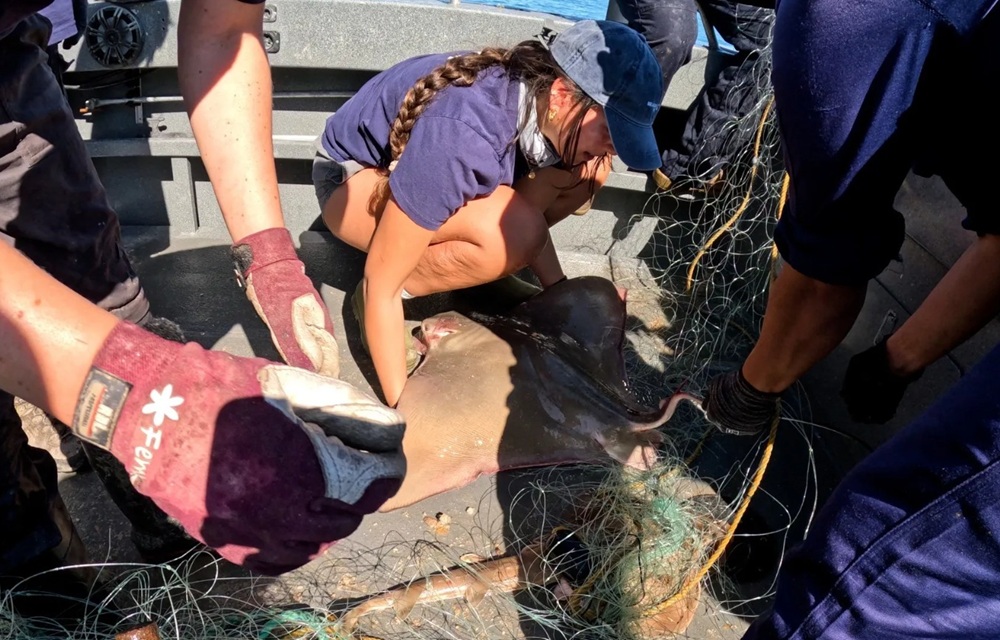
Sea Shepherd also conducted multiple major gillnet removal operations. On 8 February, the crew removed more than 800 meters of shrimp gillnet from the protected zone with 697 animals entangled. While 426 animals were saved and released, 271 were already dead.
On 9 February, the crew removed 1,500 meters of flounder net just outside of the refuge. Sea Shepherd worked with the Mexico Navy to free 146 sharks, rays, and flounders from the net.
“Together, these recoveries are a stark reminder of how massive the impact can be from just one illegal net and how quickly entire sections of the food web can be wiped out,” Sea Shepherd said. “These actions reflect more than a decade of sustained effort in the Upper Gulf of California, where Sea Shepherd crews have removed hundreds of illegal nets from the vaquita refuge, helping lay the groundwork for the continuous federal enforcement presence now operating inside the protected area.”
Though Sea Shepherd has partnered closely with Mexican authorities to improve enforcement around the vaquita protected area, the Mexican government has come under heavy international criticism for not doing more to enforce fishing prohibitions designed to protect the vaquita. In August 2025, the Commission for Environmental Cooperation (CEC), a body that investigates the enforcement of environmental law under the United States-Mexico-Canada Agreement, reported that the Mexican government was not doing enough to enforce its vaquita protection measures.
Despite international concern, the Mexican government claims it has made progress in protecting the porpoise and installing new tracking devices to ensure fishing vessels are entering the protected area.
Most recently, however, Mexican regulators unveiled a proposal to shrink the area where gillnets are prohibited to cover just the vaquita refuge area.
“Compared to the 2020 regulations, the Mexican government’s proposal would reduce the area where gillnets are prohibited by more than 85 percent,” Environmental Investigation Agency Senior Ocean Campaigner Sarah Dolman said. “Instead of expanding enforcement, the government is contemplating surrendering the vast majority of the vaquita’s habitat to static fishing nets – the very nets that have been responsible for driving their demise.”
