






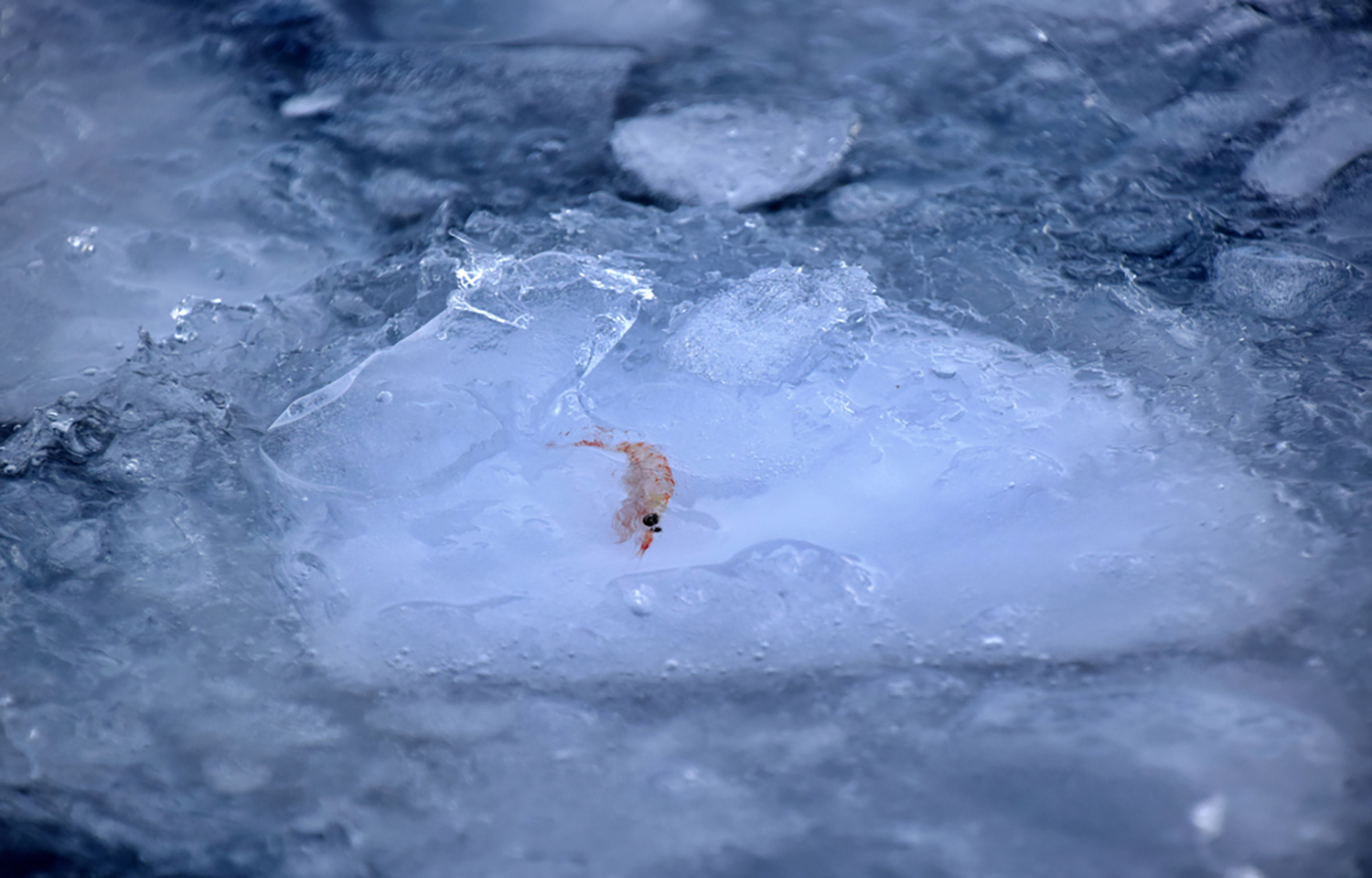
New research has incidentally discovered that microplastics may cause Antarctic krill to eject food more often than normal, causing the small crustacean to possibly miss feeding opportunities and, therefore, fail to sustain healthy energy levels.
The study, titled “The production of ‘food boluses’ by Antarctic krill and implications for organic matter transport” and published in Biology Letters, originally set out to examine the concentration of phytoplankton needed to increase the rate at which Antarctic krill form and eject “food boluses,” which are compacted pellets of partially digested food that help move organic matter from the surface to deeper waters – comprising a key part of the Southern Ocean carbon cycle.
Conducted by the University of Tasmania in Australia, the study unexpectedly discovered contamination in its findings, in which some of the expelled boluses had a reddish tinge.
Anita Butterley, the study’s lead author, investigated and realized the coloration came from tiny wool fibers shed from clothing.
“Later, during the actual experiments, I examined boluses under the microscope and consistently found tiny blue fragments. The buckets appeared clean, but eventually, I traced the source to a plastic cleaning sponge. Seeing those fibers, despite taking care, was a real eye-opener. It highlighted how easily microplastic contamination can occur and how pervasive plastics are in laboratory and real-world environments. It wasn’t the focus of the study but turned out to be a very interesting aspect,” Butterley said.
Krill are small marine animals that form a crucial part of the oceanic food web, serving as a primary food source for a number of animals, such as seals, whales, penguins, seabirds, and fish. Krill feed on even smaller organisms called phytoplankton by filtering seawater and gathering the cells into a compact mass, or “bolus.” Using their mandibles and appendages, they rotate the bolus and strip off strands of phytoplankton to eat. When the bolus becomes too large to manipulate, the krill will then eject it.
“Krill are huge contributors to carbon export in the Southern Ocean as they swarm in massive numbers, and their sinking fecal pellets help transport carbon to the deep sea. Boluses appear to be another pathway as they are compact packets that sink rapidly and could play a role in carbon transport,” Butterley said. “Rejecting boluses may help krill avoid poor-quality or harmful material, but doing so too often could mean missed feeding opportunities and reduced energy intake. Understanding how often boluses form under what conditions and whether this occurs in the wild, not just the laboratory, is important for determining their true role in both krill-feeding ecology and carbon cycling.”
High rates of bolus rejection are sometimes normal for krill, such as when a phytoplankton bloom occurs. When krill encounter extremely high concentrations of phytoplankton, they begin ejecting boluses more frequently simply because they cannot digest the material fast enough. This higher ejection rate is usually no cause for concern considering the krill have an unlimited supply of phytoplankton on which they can feed.
The concern arises, though, according to Butterley, when microplastics are the cause of bolus ejection, especially when food is limited.
“Phytoplankton naturally aggregate as many species form sticky colonies or clumps. If microplastics are present, they can easily become incorporated into these aggregates simply due to physical mixing and surface properties. The exact likelihood depends on particle size, density, and shape, but it's certainly possible for phytoplankton and plastics to be trapped together in the same material that krill ingest,” Butterley said.
Therefore, if krill prematurely reject boluses at a high rate, without excess phytoplankton available to make up the loss, they may be discarding valuable food and risk not meeting their energy needs.
“Krill continued feeding even when microplastics were present. However, we observed more bolus rejections, suggesting that plastics may disrupt normal feeding and force krill to eject more material they’ve already processed. While they still ingest food, increased rejection likely means they’re expending energy without gaining full nutritional benefit, which could have implications if microplastics become more prevalent in their environment,” Butterley said.
The study was released soon after the most recent krill-fishing season in the Antarctic closed early for the first time ever when its catch limit of 620,000 metric tons (MT) was reached in just seven months.
During that season, Chinese fishing firm Liaoyu Group set nationwide krill catch records, with its totals for the most recent season eclipsing 70,000 MT and its daily high exceeding 1,019 MT, both of which are records for the Chinese distant-water fleet, which has grown to nearly twice the size of Norway’s and is seeking even greater expansion.
Additionally, other nations, such as India, are preparing to enter the fishery.
This increased fishing pressure, along with climate change, microplastics, and other environmental pressures, have resulted in some stakeholders to urge caution in the fragile Antarctic ecosystem.
“While current total catches may seem modest relative to biomass estimates, risks are significant,” Dimitri Sclabos, the CEO of krill consultancy firm Tharos, said in August. “Climate change has come to stay, amplifying vulnerability. Market and industry drivers will raise pressure. High-value markets and improved oil extraction technologies increase economic incentives to raise the fishing effort.”
