


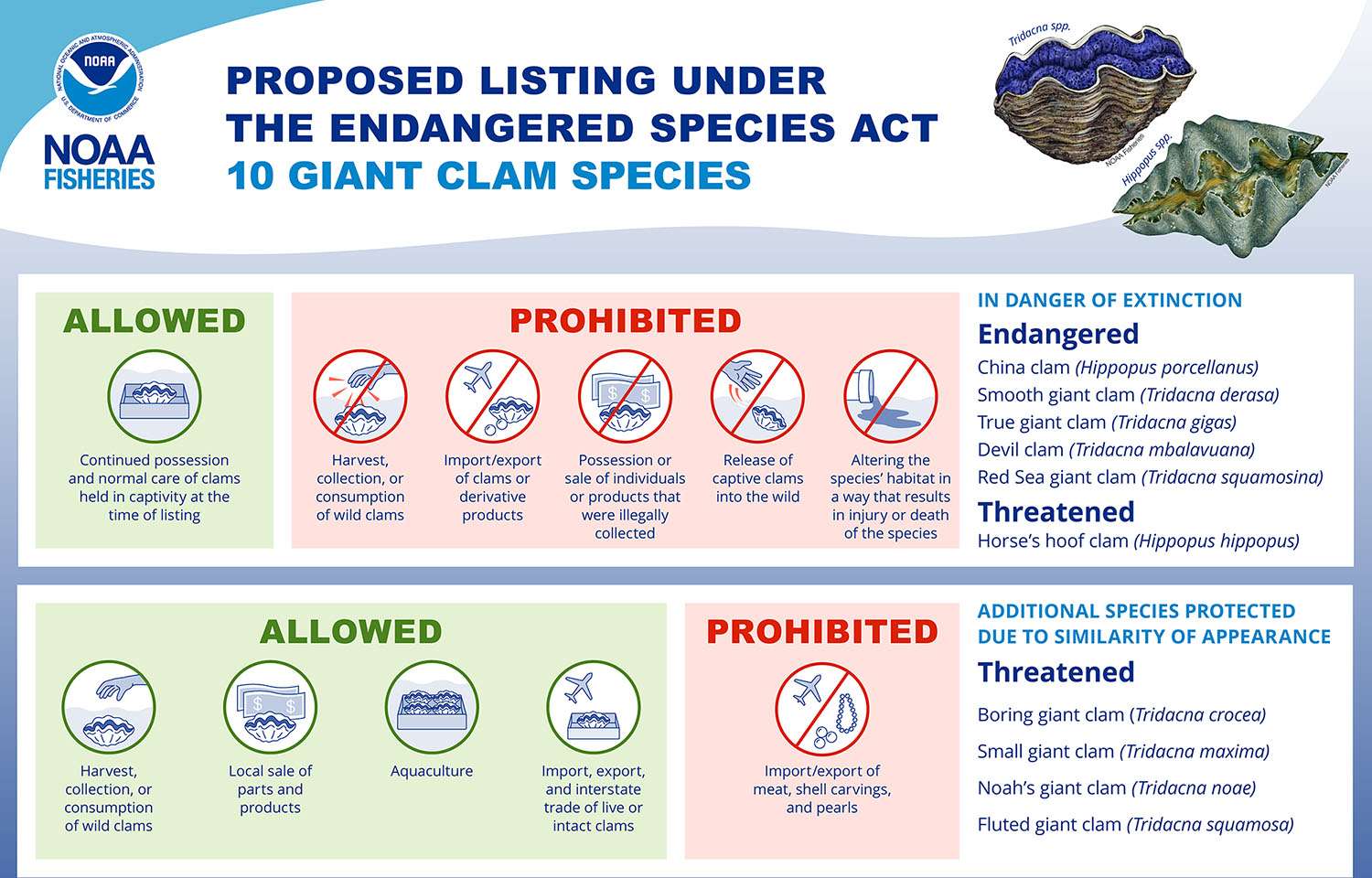
The Western Pacific Regional Fishery Management Council (WPRFMC), which has authority over the stewardship of fisheries in the state and territorial waters of Hawaii and the U.S. Pacific Islands, is pushing back against a proposal to list giant clams in the U.S. Endangered Species Act (ESA).
In July, NOAA Fisheries released proposed rules for species of giant clams under the ESA, which would list the species H. porcellanus, T. mbalavuana, T. squamosina, T. derasa, and T. gigas as endangered species and H. hippopus as a threatened species. Under the ESA, harvest or collection of the clams would become illegal – as would any behavior that could alter the species’ habitat in a way that makes its survival more difficult.
The WPRFMC has objected to the listing, with council members questioning the process that led to the proposal – including where the surveys were conducted.
“I feel NMFS is just ramming this through the system,” WPRFMC Council Member Sylvian Igisomar, who is also the chair of the Northern Mariana Islands Department of Lands and Natural Resources.
Igisomar said he questioned whether NOAA Fisheries’ surveys considered unpopulated as well as populated areas when gathering information on the giant clams.
“Some of these species shouldn’t have been [proposed]; just because you can’t access an area doesn’t mean the clams are not there,” Igisomar said.
According to a release from the WPRFMC, the council is pushing for NOAA Fisheries to engage with local agencies and communities earlier in the process and work proactively before considering a full ESA listing for a species.
Council Member Chelsa Muña said that historically, naming a species to the ESA list is something that has been hard to undo – and could prove impossible to change if the core reasons for the clams’ decline is climate change.
“If climate change is included as one of the threats, there is nothing we can really do to change that impact,” Muña said.
Muña said the species hasn’t been present in certain areas of the WPRFMC's jurisdiction for many years, and the listing could complicate efforts to reintroduce them.
“We are working with Palau to reintroduce the species. It’s disconcerting to see the ones that don’t occur in the Marianas on the list since they’re not part of the natural habitat. You will be restricting our ability to repopulate the area,” she said.
American Samoa Council Member Archie Soliai added that giant clams are important to the island’s culture, and listing the species under the ESA would also inhibit the food security of those living on the island.
“For the whole session we heard on ESA and Marine Mammal Protection Act issues, what sticks out the most is ‘restrict, control, and prohibit,’” Soliai said.
The WPRFMC has pushed back against federal regulations in the past. The council widely opposed proposals for new marine sanctuaries in the region, which they said made it difficult for U.S.-based fishing boats to compete with foreign ones.
