





Ecuador’s shrimp production has seen double-digit percentage growth for over a decade, making it the top shrimp producer in the world by volume.
Experts at this year's Global Shrimp Forum predict it the sector is still far from its peak capacity.
Statistics shared throughout the forum highlighted the dominance of Ecuador’s shrimp exports, the strength of major shrimp companies in the country, and how Ecuador’s National Aquaculture Chamber is working to advocate for the industry. Alongside that, experts at the forum also predicted the industry had plenty of room to grow its production capacity based on its current trajectory and the innovations the country is capitalizing on.
Thai Union Feedmill Ecuador CEO Eduardo Arosemena said the trajectory of the country’s shrimp industry can be separated into three stages: the recovery and capability building stage, the technification and export expansion stage, and the current stage he called the “efficiency, resilience, and value” stage.
Arosemena said the industry’s current production capacity is rooted in the first of those three stages, which came as Ecuador was forced to solve some of the environmental problems inherent in its geographic makeup.
“It makes us have to adapt. This has made our production model very sustainable but also very adaptable,” Arosemena said.
On top of the geography of Ecuador, disease challenges were also a big issue in that first stage. Like many other major shrimp-producing countries, in the 2000s, Ecuador had to grapple with diseases like white spot syndrome virus, which severely hampered production.
Arosemena said the country’s method of overcoming those diseases is a big part of its current success. Instead of solving those problems with drugs or vaccines, it solved them with farming methods and genetics.
“Our genetics program was developed exclusively around Ecuadorian conditions,” he said.
Arosemena said the country started using selective genetics over a decade ago and, since that time, has generated up to 80 different genetic families that are specific to conditions in a given location in Ecuador.
Selective breeding has helped the country create a much more disease tolerant and in some cases resistant animal, Camaronera Escalante CEO Luis Burgos added.
Arosemena said those early efforts helped jumpstart Ecuador’s volume production and resulted in the industry churning out a high volume of shrimp at a time when prices were favorable.
“If you crossed volume with price, you would see that at some point in time, there was large profitability right in the middle between recovery and scaling,” he said. “The market took a very long vision and said, ‘Instead of using this money somewhere else, we’re going to reinvest it in shrimp to make us more efficient and more technified.’ The industry is seeing the capitalization of that vision.”
The realities on the ground now point to the industry's ability to continue that trajectory, with Arosemena explaining there are currently 240,000 hectares of productive shrimp farms but 80 percent of the country’s volume comes out of just 80,000 of those hectares – meaning the other 160,000 hectares have room to grow.
Burgos said the reason for that expected continued increase in production again comes down to genetics, which has created families of shrimp that grow much faster without sacrificing health or feed conversion ratios. He predicted Ecuador can double its production capacity in the next several years without increasing its density, all from the same hectares it is already using.
He said advances in breeding allow the country to have faster-growing, disease-tolerant shrimp that have twice the weight gain of current genetic strains.
“We have already seen it in a few individuals inside families,” Burgos said.
He said another advancement the genetics industry is working on is transitioning from disease-tolerant shrimp to 100 percent resistant shrimp for certain conditions like white spot.
“We are working on a program to have 100 percent resistance, not just tolerance, so you could get to the point where you inject the virus and it doesn’t replicate on the shrimp’s DNA,” Burgos said.
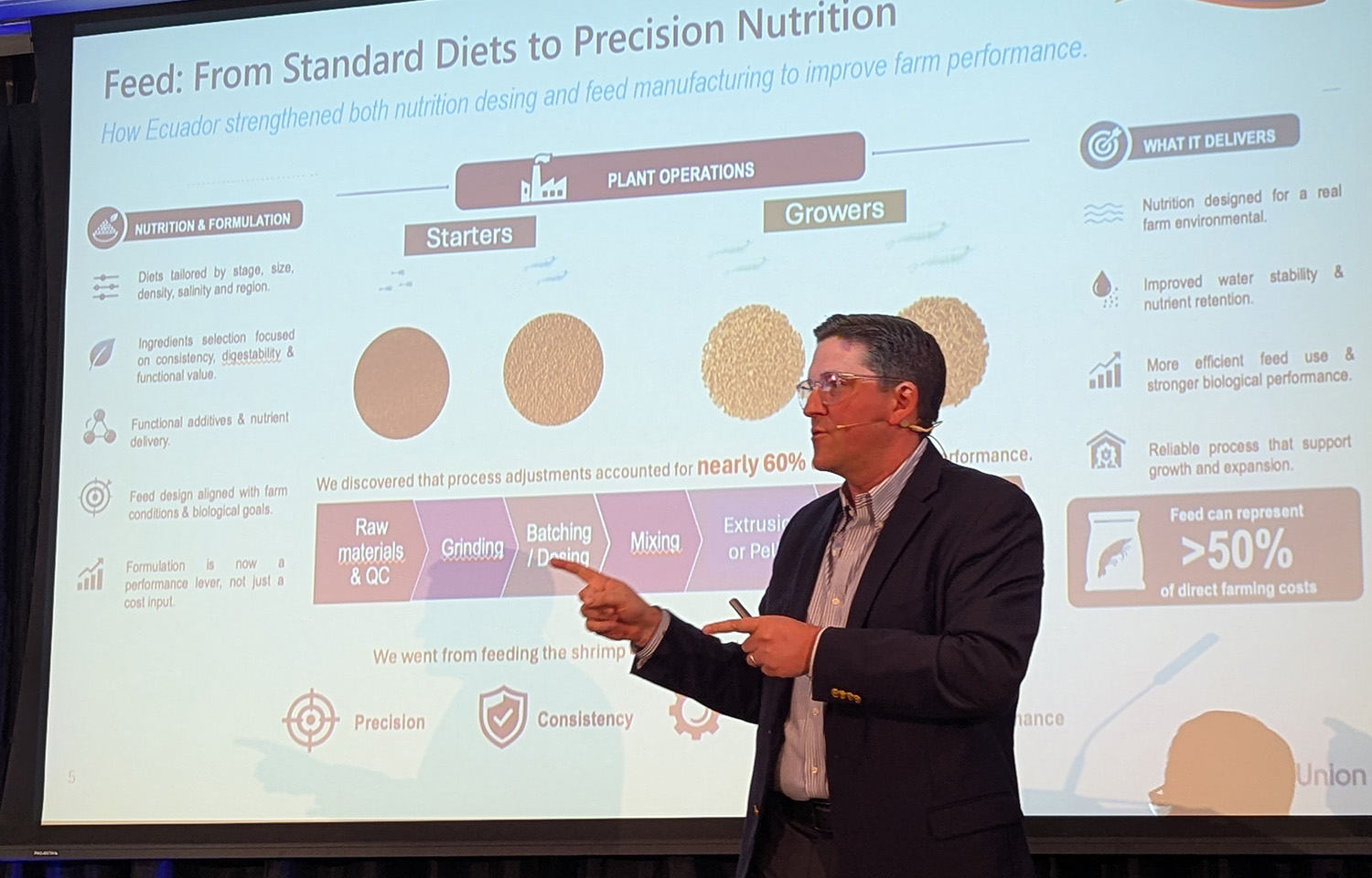
Arosemena said advances in feed have also made shrimp farming much more productive. He said he’s been in the aquaculture feed industry for 25 years and has seen it evolve from a generic product to one made specifically for the species.
“When I first joined, I said, ‘This is a really nice chicken feed,’” he said. “Now, the feed is actually shrimp feed, and we know so much more that we didn’t know 10 years ago. The game has completely changed.”
Physical composition has also changed to ensure shrimp are eating the feed, rather than birds.
“Right now, you either have fat shrimp or fat birds,” Arosemena said. “If that feed does not sink within three seconds, you will have fat birds.”
Additionally, feed timing has evolved to match shrimp behavior, he said. In the past, shrimp were often fed four times a day; now, in certain cases, they’ll be fed 15 to 20 times per hour.
“We not only learned that they could eat a lot and grow a lot faster. We learned they like to eat at specific times of the day,” he said.
There are still some obstacles remaining for growth, he said, including access to reliable electricity, which is holding some shrimp aquaculture operations back. However, solar power is rapidly becoming cheaper and filling that gap.
“We have enough sunlight on the coast. We have some players working with that,” Burgos said. “Solar and batteries today are very efficient compared to diesel, as long as you can depreciate the investment over 20 to 25 years.”
